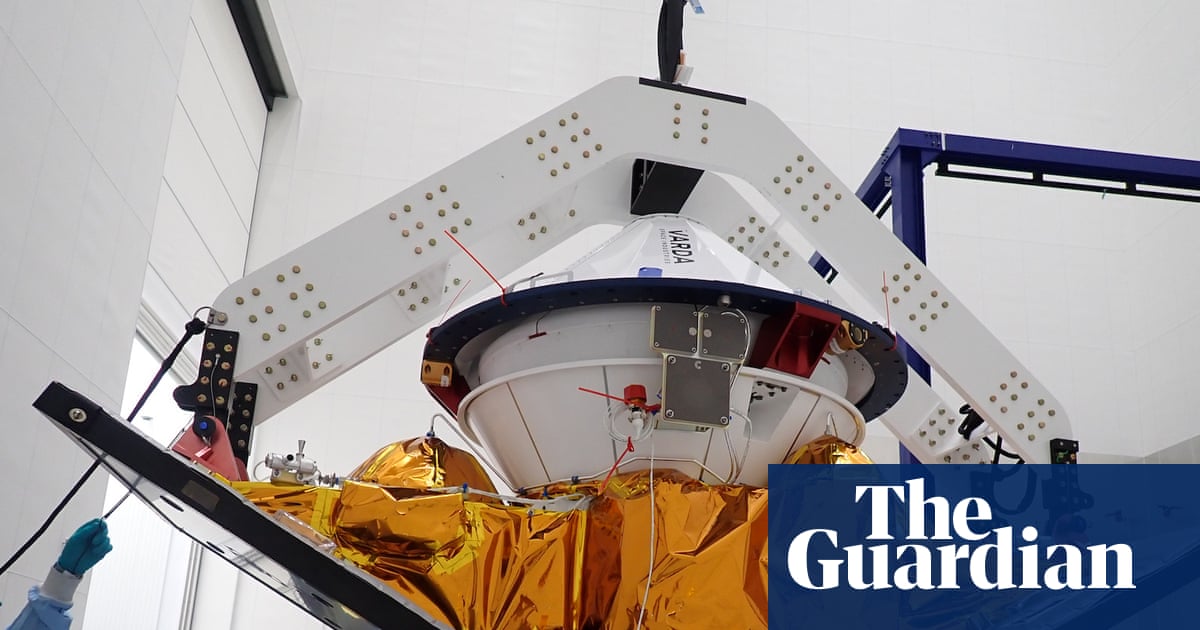

R oughly 300 miles above our heads, three washing machine-sized capsules are orbiting the Earth. Inside one of them, tiny crystals of a potential cancer drug are being grown in the weightlessness of space. The others are testing heat protection materials and navigation systems for when the capsules plunge back through Earth’s atmosphere at hypersonic speeds. Together, they represent a small but significant step towards what some hope will become a lucrative new industry: manufacturing drugs and other materials in space.
The spacecraft belong to California-based Varda Space Industries. On 1 October, it launched two onboard the same rocket, followed by the third on 20 October. With a record three spacecraft now simultaneously in orbit for the first time, the company is edging closer to its ambition of operating a fleet of orbiting pharmaceutical factories.
“We’re the first company in human history to launch multiple commercial re-entry vehicles simultaneously, and as the frequency of launches increases, the once ‘crazy future’ of manufacturing products in space is becoming more and more certain,” said Will Bruey, Varda’s chief executive.
There are several reasons for wanting to manufacture certain materials in space, one of the most important being microgravity. On Earth, gravity causes particles suspended in liquids to settle, while differences in density create currents. Both can interfere with the growth of crystals. “If you are able to remove those effects, you can make crystals grow in a much more ordered sort of way,” said Dr Meganne Christian, mission manager for in-space manufacturing at the UK-based Satellite Applications Catapult.
For pharmaceutical companies, this could open up new ways of formulating medicines, as the size, shape and arrangement of drug crystals can affect how easily drugs dissolve, how stable they are and how they can be administered. In some cases, this could enable drugs that currently require intravenous infusions to be reformulated into more convenient injections.
Other materials, such as the semiconductors used in everything from smartphones to electric vehicles, could also benefit from being manufactured in space, where microgravity and the absence of air could help produce purer crystals with fewer defects.
“Personally, I would really love to try and make graphene in microgravity,” said Christian. “Theoretically, it is this incredible material, but in practice you get a whole lot of defects in the crystals. It’s a similar story for semiconductors. If you can reduce the number of defects, you can get a much higher-performing material.”
Scientists have been experimenting with manufacturing in microgravity for decades, particularly aboard the International Space Station (ISS). But the ISS has predominantly served as a “test kitchen” for scientific ideas and is scheduled to be retired around 2030. “It wasn’t necessarily designed with manufacturing in mind,” said Dr Ryan Reeves, deputy chief scientist for the ISS National Laboratory.
Several companies are developing commercial space stations to replace the ISS, while others are designing specialist laboratories and equipment for conducting experiments aboard them. Among them is the UK-based BioOrbit, which recently sent a microwave-sized laboratory to the ISS as a step towards the production of self-injected cancer drugs.
However, for large-scale manufacturing and certain industrial processes, “you need to get humans out of the picture, because we’re dirty, we cause vibrations, and we require a whole higher level of safety,” said Christian.
This is where Varda’s autonomous factories come in. Known as free-flyers, they hitch a ride into orbit aboard SpaceX rockets, carrying miniature laboratories in which materials can be processed without astronauts. Once the experiments are complete, a capsule separates from the spacecraft, plunges through the atmosphere and parachutes safely back to an uninhabited region of Earth.
Varda is among the furthest advanced in demonstrating this approach, having already returned several capsules from orbit. It plans to launch another seven missions in 2027, and a further 10 in 2028.
The ability to conduct experiments frequently is particularly important for drug development. “If scientists have to wait 10 years between experiments or even a year, that really doesn’t fit into the speed of modern drug development,” said Michael Reilly, Varda’s chief strategy officer.
While Varda’s manufacturing ambitions are focused on pharmaceuticals, other companies are developing similar systems to produce different materials. For example, Cardiff-based Space Forge is exploring a hybrid approach, in which semiconductor crystals grown aboard spacecraft could be returned to Earth and used as templates for growing larger quantities, much like a sourdough starter.
Its first spacecraft, ForgeStar-1, recently demonstrated some of the processes needed to manufacture these semiconductor “seed wafers”, although it has yet to produce a finished material and return it to Earth. Andrew Bacon, the company’s co-founder and chief technology officer, said they hope to demonstrate the entire manufacturing and return process before 2030.
For Bacon, recent developments, including Varda’s launches, suggest that space manufacturing is approaching a turning point. “Since we started in 2018, nobody was talking about it. Now a lot of companies [are] talking about it,” he said. “People are starting to take this market very seriously. It does feel like we’re at the start of a new Industrial Revolution.”
Falling launch costs and increasingly frequent commercial rocket flights have helped to fuel this optimism. But significant challenges remain, including demonstrating that the benefits of manufacturing in orbit justify the expense. “It’s not going to be commercially viable for every application,” said Christian. “We have to identify those high-value use cases where it makes sense to do the work in microgravity.”
Regulators will also need to adapt to accommodate space-manufactured products. Later this year, the UK’s Medicines and Healthcare products Regulatory Agency (MHRA) is expected to publish a plan clarifying how existing medicines regulations will apply to drugs manufactured in orbit.
But for now, one of the biggest challenges is demonstrating that space manufacturing can deliver consistently reliable results. “To get something to a commercially viable point, it needs to be done again and again and again,” said Christian. “That’s what these capsules need to do. They need to demonstrate this repeat performance.”