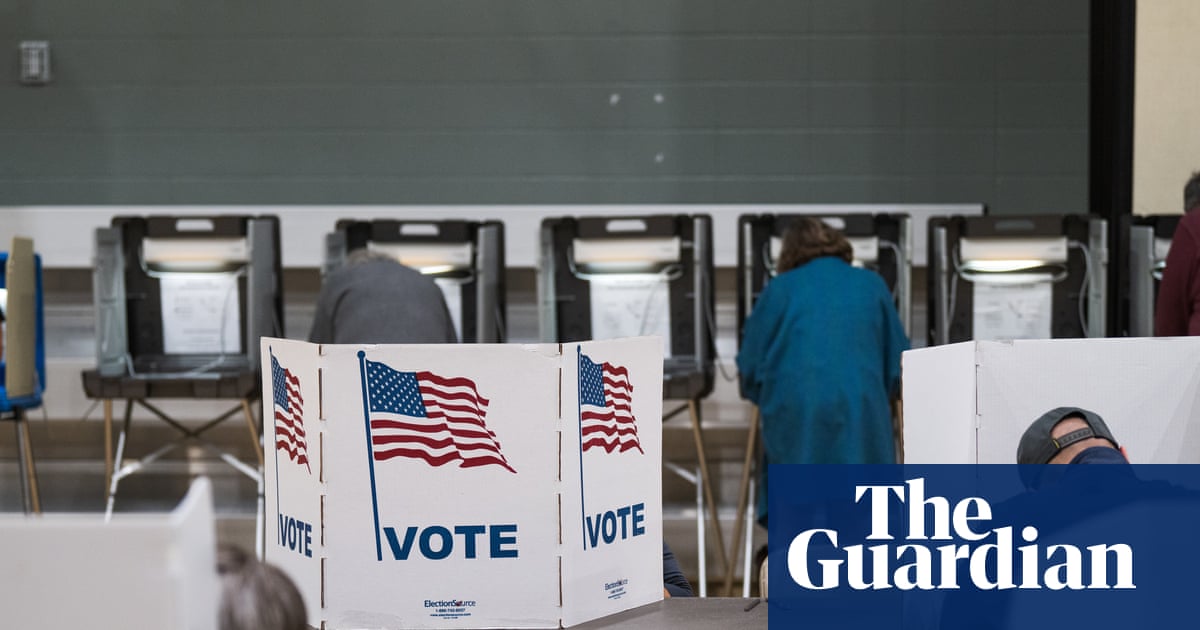
The US midterm elections could have an outsized impact on the future of the United States – that’s why over the last month, we’ve been hosting a series of reader conversations on big-ticket issues Americans will see on their ballots.
Democratic and Republican voters have picked their nominees for key races across the US, and our reporting team has been closely following the races, which will determine the balance of power in Congress.
US election day is 3 November 2026. From immigration to the economy and the money behind political campaigns, here are the reader conversations to look back on.
One of the key questions is, with the Democrats poised to take the House and perhaps even the Senate, what does the rise of the party’s progressive left mean for the broader Democratic coalition? How will candidates such as Michigan’s Abdul El-Sayed co-exist with the party’s more established centrists – and will the growing influence of democratic socialists push the party in a new direction?
Here’s one of the questions our reporters answered; read the full Q&A here :
Citizen_Squared writes : After the disaster of the Trump years, the Democrats still do not have a clear message/vision/plan for ending the destruction Maga has done. Talking endlessly about affordability is not a governing vision. The polls may have the Democrats ahead for the House and Senate but thanks to extreme gerrymandering, voter restrictions and a big assist from the corrupt Supreme Court in striking out the Voting Rights Act, don’t be surprised if the gains by the Democrats are limited on election day. If that happens, the party will collapse into civil war.
David Smith: Yes, if Democrats underperform, there are sure to be recriminations and huge pressure on Senate leader Chuck Schumer and House leader Hakeem Jeffries (it’s been notable how many candidates are unwilling to endorse Schumer). But the day after the midterms will also fire the starting gun for the 2028 presidential primary, which will probably be galvanising and energising. Candidates will come forward with their visions and that will take up a lot of oxygen.
In conversation with the Guardian’s readers:
Joseph Gedeon , political breaking news correspondent
Rachel Leingang , midwest political correspondent
Shrai Popat , US politics live blogger
David Smith , Washington bureau chief
Over the last few months, our team has covered in depth:
How major companies that urged Congress to strengthen the Voting Rights Act continue to contribute to state political groups that are actively working to undermine the legislation .
The vast extent of spending by crypto money and big tech to shape this year’s races.
Aipac and its linked Super Pacs’ role in funding Democratic candidates facing opponents from the progressive left.
Who is funding political campaigns for the midterms and where is it going?
Here’s one of the questions our reporters answered; read the full Q&A here :
WillDean asks : One of the biggest stories in British politics in 2026 has been a couple of large donations to Reform from two crypto billionaires that are large enough to have a dramatic impact on the entire political landscape. How much of a role is crypto money playing in the midterms – and does it make less of an impact there because there is so much money being spent everywhere already?
Chris Stein: Super Pacs tied to cryptocurrency spent millions in the primaries, though they didn’t always achieve the desired result. One of the major players is called Fairshake, which has made more than $13.3m in independent expenditures this year in Illinois, including nearly $2.5m against state lawmaker La Shawn Ford, who nonetheless won the Democratic primary for a US House district, and nearly $9.9m against lieutenant governor Juliana Stratton, who won the Democratic Senate nomination anyway. They also spent about $800,000 against state senator Robert Peters, who lost the primary for another US House district. That’s not the last we’ll hear of Fairshake this cycle – they are reportedly planning to spend $30m against Sherrod Brown , a Democrat and cryptocurrency foe who is running to return to the Senate in Ohio.
In conversation with the Guardian’s readers:
Joseph Gedeon , political breaking news correspondent
Chris Stein , senior politics reporter
The war with Iran has had major implications for Americans’ wallets , government spending and US foreign policy. It has also been an important factor in reshaping the political landscape as the war enters its ninth month, with the 2026 US midterms quickly approaching.
Our team of reporters has helped readers understand the costs of the war and political consequences for Trump and candidates running in November. So, how could the war affect US voters at the polls?
Here’s one of the questions our reporters answered; read the full Q&A here :
Elizabeth Knudson, a student journalist at American University, asks: Mike Rogers [Republican candidate for US Senate in Michigan] and Ashley Hinson [Republican Iowa congresswoman] have been rather vocal about their dissent toward Trump due to the war. Why them specifically? Are their states’ constituencies most impacted by the war? Are there any other Senate candidates who may also feel hostility toward Trump for the war, due to the war impacting their state worse than others?
Lauren Gambino: Both are in incredibly tight races. The war is unpopular and they don’t want to be seen as cheerleaders for a war that the voters they hope to represent are opposed to. Particularly in Iowa, where Hinson is running for Senate, the war is driving up the costs of essential operating inputs like diesel and fertilizer. This comes atop Trump’s trade war, which had already squeezed US farmers.
In both states, the Democratic candidates are pounding them on affordability and cost of living and being publicly supportive of the war can dilute the Republicans’ ability to respond.
In conversation with the Guardian’s readers:
Lauren Gambino , senior political correspondent
Joseph Gedeon , political breaking news correspondent
Andrew Roth , global affairs correspondent
Robert Tait , political correspondent
The US economy is a hot topic for voters. Food and gas prices remain high, the job market is unstable, consumers are angrier than ever , and a new Fed chair, Kevin Warsh , took over this year.
A team of business, labor and consumer rights reporters are here to answer your questions about the economy and how it could shape the midterm results. They’ve covered inflation , cost-of-living increases , tariffs , labor , policy proposals and more.
Here’s one of the questions our reporters answered; read the full Q&A here :
From an Instagram user: What utility has seen the biggest surge in pricing since 2nd Trump administration?
Gaya Gupta: We can answer this by looking at data from the Bureau of Labor Statistics. Utility gas services increased at an annual rate of 5% this month, slightly more than the 4.4% increase in electricity. Last year, in Trump’s first September in office, gas services had increased by 11.7% compared to the year before, while electricity increased by 5.1%.
Looking more broadly at energy commodities – which don’t necessarily show up as a monthly bill, but can still affect overall household expenses – we can see that fuel oil, which is used to heat homes and offices, increased by 74.2% compared to the year before. (In comparison, fuel oil had increased by just 4.1% in the September 2025 report).
In conversation with the Guardian’s readers:
Heather Timmons , consumer and corporate rights reporter
Since Donald Trump began his second term , ICE arrests have reached record levels , operations have become deadly , and immigration raids have hit politicians’ homes . Our reporting has documented the experiences of those directly affected by the harsh conditions in detention centers and resistance to ICE agents on the ground.
Here’s one of the questions our reporters answered; read the full Q&A here :
Bruce, Maryland asks in a callout question: What is the Democrats’ policy on immigration? Why is the party (not individual candidates) so afraid of publicizing its position on major issues (DEI, immigration, climate change, etc.)?
Sam Levin: On the campaign trail, immigration has not been a major talking point of many Democratic candidates, and I think it remains to be seen what their specific policy priorities would be if they regain control of Congress. I’m chatting with a politics colleague about it now, and she pointed out that many Democrats have largely avoided the subject other than condemning Trump’s crackdown and agreeing there must be controls at the border. Democrats have not been aligned and put forward a clear, proactive vision on what they would do differently.
In conversation with the Guardian’s readers:
Maanvi Singh , immigration reporter
José Olivares , immigration reporter
Sam Levin , Los Angeles correspondent
Our final midterms reader conversation will be on Friday, 6 November, at 12pm ET. Check back here soon for more on how to submit your question.
Bookmark the US midterms 2026 page for live coverage and results through election week.