Those born overseas trust the government more and are more satisfied with its services, but a survey suggests more Australians are losing faith in politicians and parties.
Geography, age, gender and education increasingly affect people's attitudes towards democracy and politics, and could shape how they vote in upcoming elections, according to the McKinnon Index.
The 2026 survey of 4,000 Australians indicates trust in federal politicians has fallen from 35.9 per cent to 30.5 per cent in a year, while trust in state and territory politicians has dropped six percentage points to 32.7 per cent.
Falls in faith come amid a divisive time in Australian politics , where debates over freedom of speech, immigration and antisemitism have coincided with rising distrust.
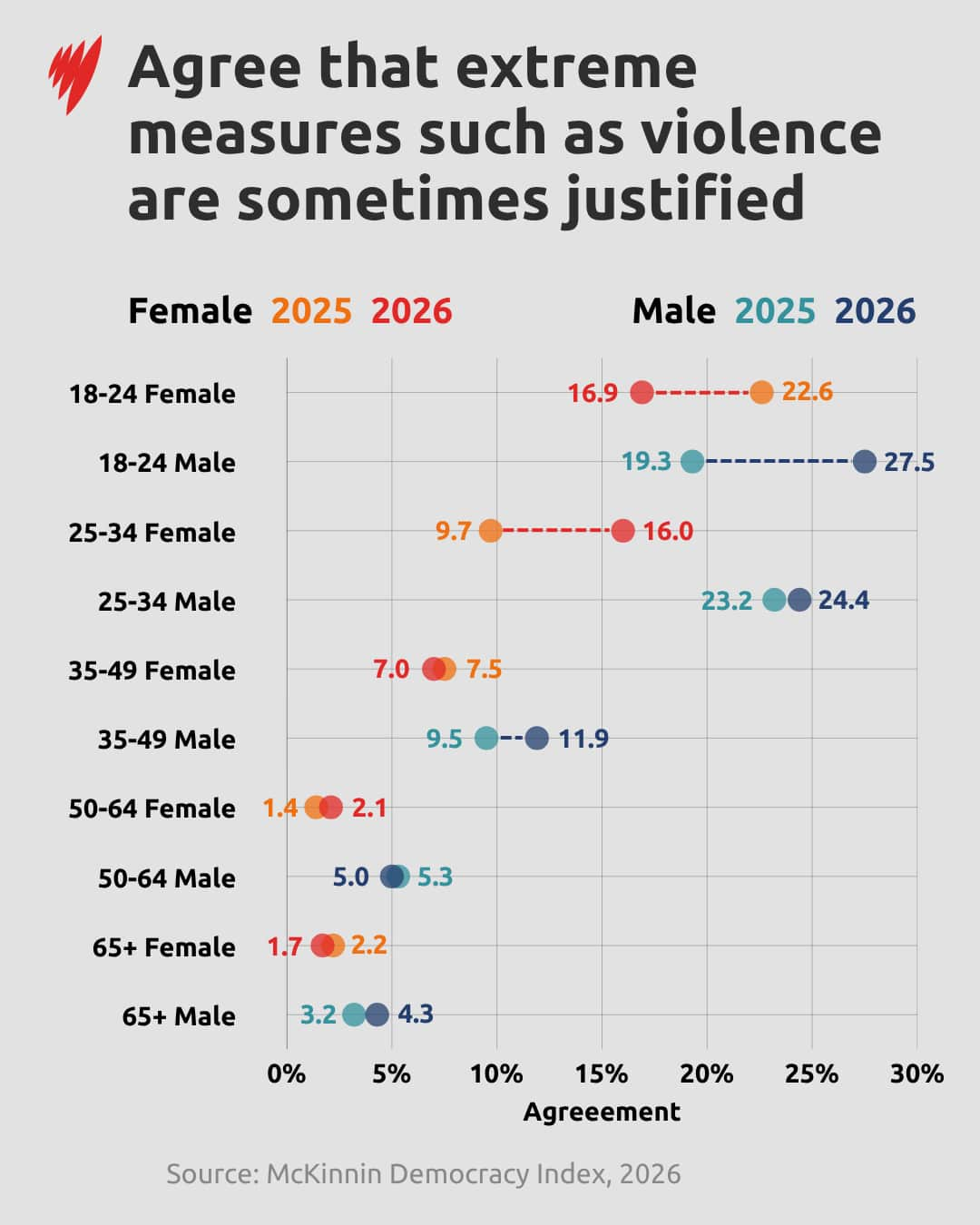
At the same time, young people's attitudes towards violence is shifting, with more men believing violence can sometimes be justified to advance a cause they care about.
Your trusted source for staying up-to-date with the world around you. Get free daily news updates and analysis, straight to your inbox.
Associate professor Josh Roose from the Alfred Deakin Institute for Citizenship and Globalisation at Deakin University told SBS News that the survey data should be considered "tentatively", but does line up with broader social patterns.
The key trends in this year's index could affect politics and policy. So how have people's attitudes shifted in the last 12 months?
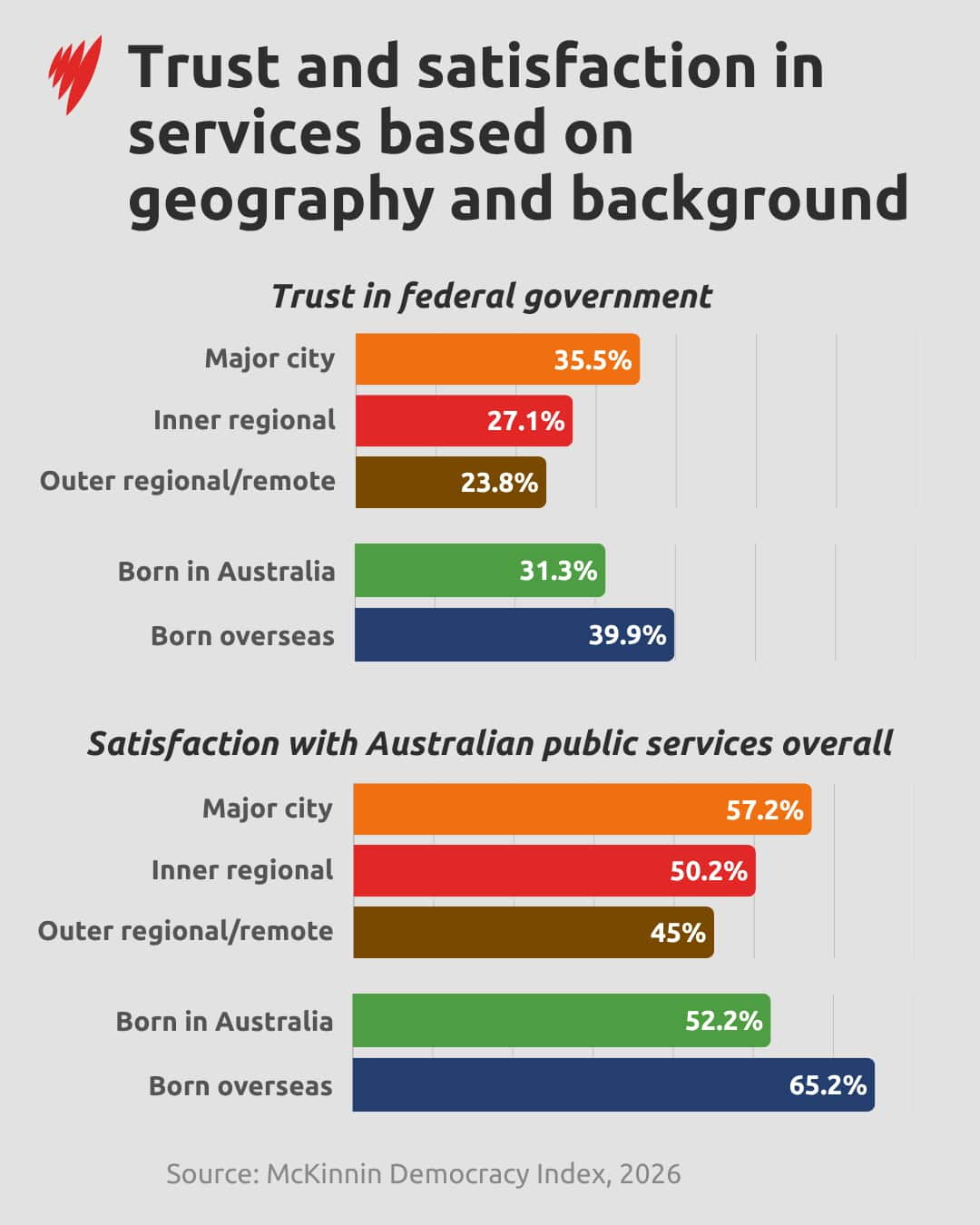
People living outside major cities remain less satisfied with democracy, less trusting of government and less content with public services.
Just 40.3 per cent of those in outer regional and remote areas are satisfied with democracy, compared with 52.9 per cent of major-city residents.
Support for democracy is also weaker outside metropolitan areas. Only 68.5 per cent of people in outer regional areas believe democracy is preferable to other forms of government, compared with 77.1 per cent in both inner regional areas and major cities.
Roose said that Australians are more likely to trust and be satisfied with the government if they have benefited from funding and programs, which could explain why urban areas scored higher.
"There's been a stripping of public services and infrastructure from regional Australia for decades where political parties tend to prioritise areas of high growth, in particular in urban Australia," he said.
The gap is also evident in perceptions of political influence. Just 38.6 per cent of people in outer regional and remote areas feel they have a say in politics, compared with 50.6 per cent in major cities.
By contrast, people born overseas report greater trust in government and higher satisfaction with public services.
Roose said that people born in Australia would be more aware of declining services or access over time compared with newer arrivals who may see Australia's support systems as superior to their home countries.
"There's a different understanding. People have different starting points for when they're engaging with that system and what they're likely to view it as," he said.
Young Australians remain much less supportive of democracy than older generations, and this year young men widened the gap further.
Support for democracy among men aged 18 to 24 fell 10.3 percentage points to 56.1 per cent points in 2026.
Among young men, belief that people can freely express political opinions fell 22.8 percentage points to 49.8 per cent.
Social media and time spent online play an "enormous role", Roose said.
"There's also been a concerted effort online by not only platform providers, but also potentially other states to undermine confidence in democracy, particularly amongst younger users," he added.
Attitudes towards violence have also taken a turn, with men of all age groups believing violence for a cause can be justified, at a higher rate than women.
The biggest jump was an 8.2 per cent increase in men aged 18-24, with 27.5 per cent saying extreme measures such as violence can sometimes be justified to advance a cause.
However, women in this age group are more satisfied with democracy than they were last year, and less accepting of violence.
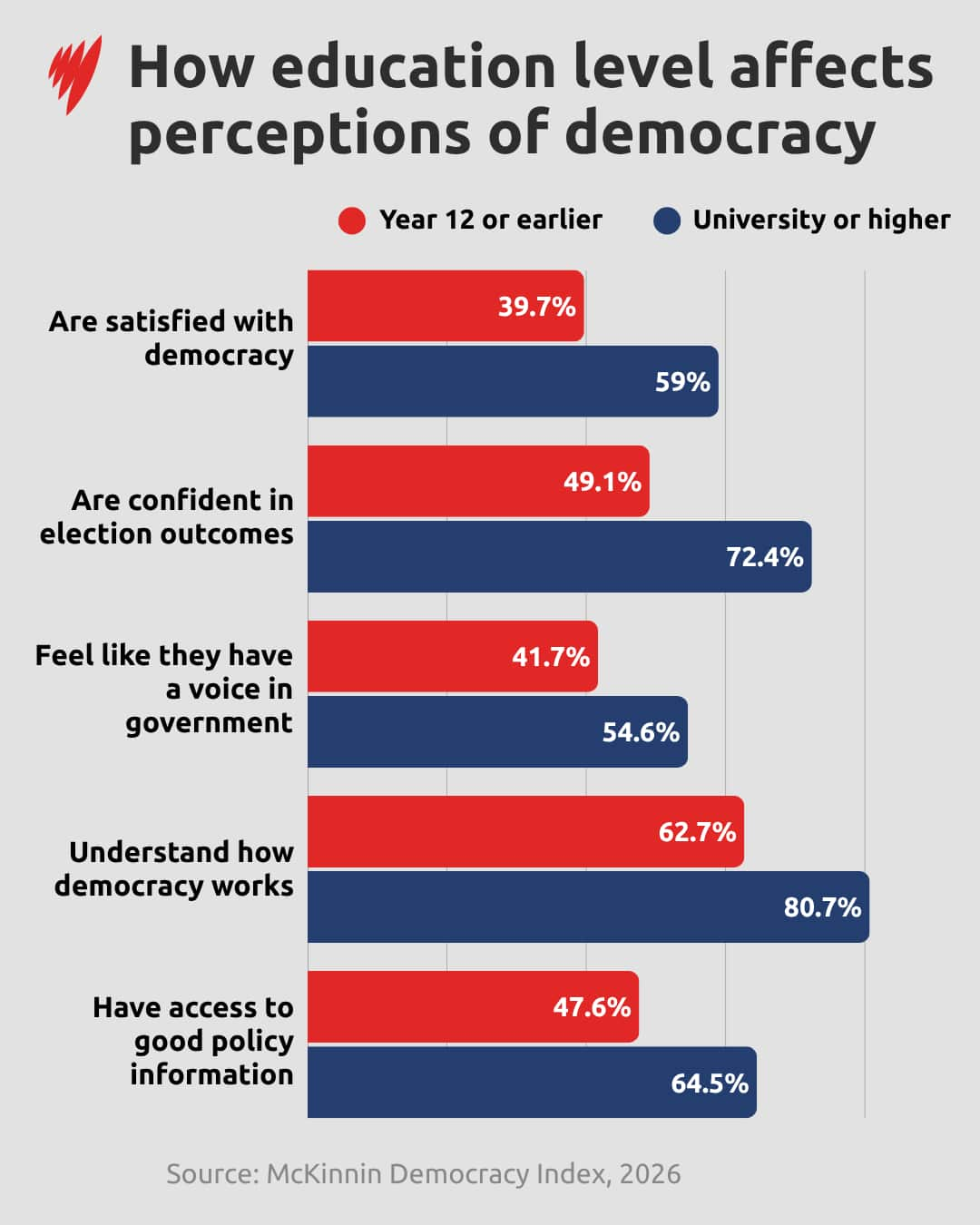
Educational attainment appears to be a more significant fault line than income for democratic confidence and political participation, raising questions about whether Australia's democratic institutions serve all sections of the community equally.
Just 39.7 per cent of Australians whose education ended at high school are satisfied with democracy, compared with 59 per cent of university graduates.
"There's been a professionalisation of the political class over a period of time where there are very few people with real-world experience entering politics," Roose said.
"There's a quite binary view of the professional politician as someone who's not like them, someone who doesn't represent their interests, someone who doesn't really care about them."
The divide is even more pronounced when it comes to confidence in elections.
Almost three-quarters of university graduates express confidence in election outcomes, compared with fewer than half of those with a high school education or less.