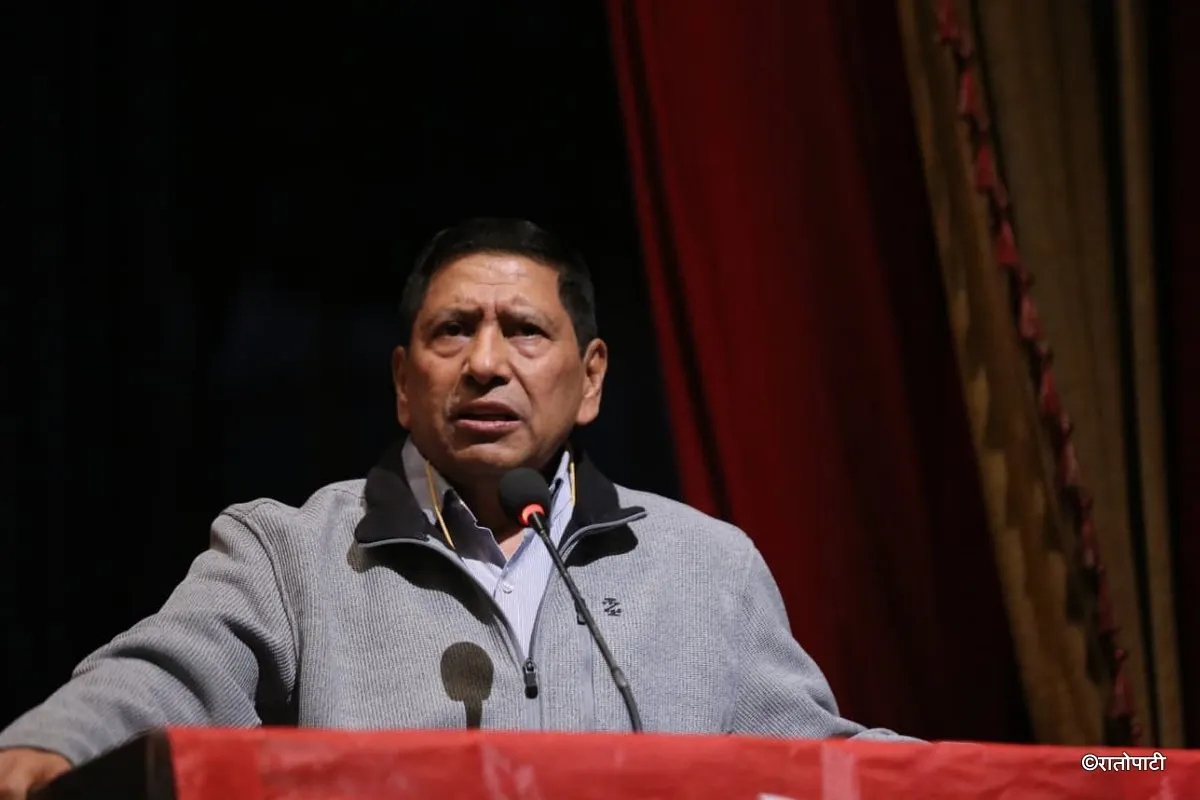
Kathmandu. Nepali Communist Party leader and former Deputy Prime Minister Narayankaji Shrestha has said that the Inam Sapkota case is not just a normal incident but a symbolic tendency reflecting the character of Nepal's state and society. He commented that although Nepal's historical political change was a qualitative leap in terms of democratization, all state mechanisms have not been able to transform democratically accordingly. He mentioned that although feudalism has ended, comprador capitalism has dominated the process of Nepali capitalization instead of national capital. He stated that this is true for all countries or societies that have moved forward in the process of capitalization by ending feudalism in today's world where globalized financial capitalism is the main trend. Furthermore, he stated that the main organs of the state, the army, judiciary, and bureaucracy, have not been concretely transformed during the completion of the democratic revolution in Nepal, and the main organs of the state retain their traditional status quo character. He clarified that it is necessary for the political parties that fought for change and their governments, based on the political change and the constitution that institutionalized it, to lead the development of national capital and the overall democratization process of the state. He said that the established political forces and their governments that led the revolutionary and democratic struggle have not been able to fulfill this main task, have not been able to keep it at the center, and have become polluted by it themselves. In this background, the situation where that tendency remains dominant in the state and society has arisen, and based on that, the current political situation, including the government of right-wing populist forces, has emerged as part of a geopolitical strategic game, he analyzed. Overall, he emphasized that comprador capitalism cannot end and national capital cannot develop unless society moves in a socialist-oriented direction as directed by the constitution. He mentioned that recent events have clarified how compradorized the state organs are. He clarified that his support and backing will remain as long as the government takes steps against this middleman and comprador tendency. However, he warned that it would be unfortunate and fatal if it were used or limited for political calculations and revenge.
Read full story at source ( english.ratopati.com )