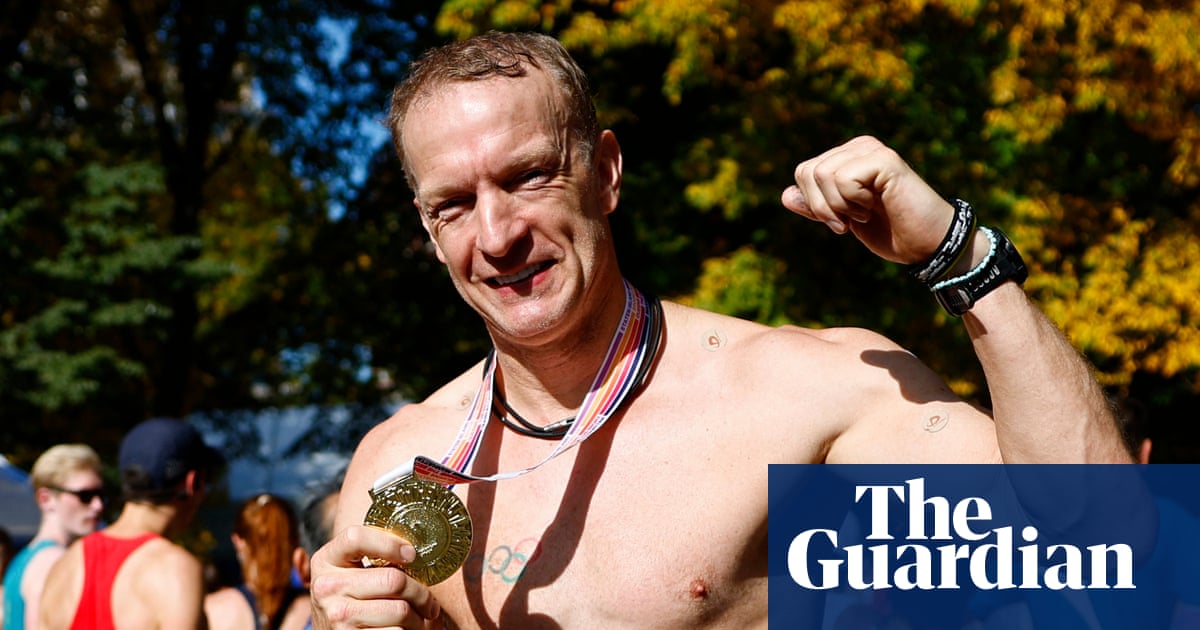
Mathew Kent (left) and guide Brad Manczak cross the finishing line at the Ironman 70.3 Geelong earlier this year. ( Supplied )
When Mathew Kent is competing in the first leg of a triathlon or half ironman event, things can feel a little dicey.
"I get very paranoid when I feel a splash around me swimming," says the 37-year-old visually impaired athlete.
"I hope it's a person, not a shark."
Kent has retinitis pigmentosa, a genetic eye disorder that causes vision loss including night blindness and tunnel vision, with his vision currently limited to 0-5 degrees.
"It's almost like putting a hole through a piece of paper and you look through that hole … you just see what's in front of you," he says.
During the swim leg of a triathlon, Kent is connected to a guide via a tether around both of their waists.
The pair stay out wide of the pack to avoid thrashing arms and potential collisions.
The pair share a laugh while competing in the Barwon Heads Triathlon. ( Supplied: Beckworth Racing )
"Because [the guide] is on my left, I breathe a lot to my left. So I try and find him while I'm swimming," Kent says.
"If the tether gets really tight, I know I'm going the wrong way — then I try and push back into him.
"Every now and then I swim over the top of him," he laughs.
Kent, who lives in Albury, is training for the Ironman 70.3 Melbourne on November 8, which he will tackle with guide Brad Manczak.
The 70.3 represents the number of miles covered, which equates to 113 kilometres, accounting for the 1.8-kilometre swim, 90-kilometre ride and 21.1-kilometre run.
The pair has already competed in other events together including the half marathon in the recent Geelong Running Festival, along with the Ironman 70.3 Geelong in March and the Barwon Heads Triathlon.
Kent (left) and Manczak compete in the half marathon at the Geelong Running Festival in September. ( Supplied )
Kent was fully sighted until he was 15, after which he gradually began losing his vision.
He could still get his car licence, as long as he didn't drive at night.
However, by age 20, Kent says he had lost most of his sight — and as a result, that car licence and much of his freedom.
"You have to sort of change everything you do," he says.
Having been a sporty teen who loved water polo, Kent found himself limited in the sporting activities he could do.
That was until his brother Jeremy "dragged" him into triathlon about three years ago, becoming his first guide.
Mathew Kent's brother Jeremy (right) encouraged him to give triathlons a go. ( Supplied )
Last year, the brothers attempted a full ironman in Busselton, Western Australia.
They had completed the 3.8-kilometre swim, and were about 20 kilometres off finishing the 180-kilometre bike leg when they had to pull out due to illness.
Kent now mostly trains with the help of a local support worker, and then teams up with Manczak, who lives in Jan Juc, for race days.
Manczak, an experienced triathlete and ironman, says being a guide is a very different experience to racing solo.
"You've got to try to navigate a tandem bike," he says.
"But also just that communication and being aware of everything around you really."
Four legs are better than two — until it comes to going uphill. ( Supplied: Beckworth Racing )
From his perspective, the swim leg is the easiest part of a triathlon because there is not much to do in terms of communicating with Kent.
"He'll just keep a feel of where I am, and I'll just make sure he's OK," Manczak says.
From there, they will reach a specially allocated section of the transition area and switch to Kent's custom-made tandem bike — imported from the Czech Republic.
And while the pair does not always stand out in the swim and run legs, Kent's extra-long bike is a show stopper.
"They do notice a tandem bike," Manczak says, noting that four legs rather than two can equate to a fair bit of speed.
While Kent says it is great fun smashing the field on the downhill sections, with the pair reaching up to 70 kilometres an hour, inclines are another story.
"We're like a truck going up a hill because we're double the weight on the bike."
By the time they reach the run leg of a triathlon, the field has thankfully usually spread out.
Kent and Manczak use the same tether they did in the swim, again fixed around their waists.
If it is a consistently flat section, Manczak says his offsider will just jog normally.
However, Kent may sometimes rest his hand on his arm for some extra support.
"Where the guide comes into most importance is during the run because any change in gradient or surface or anything around, you kind of have to talk Matt through it," Manczak says.
Competing in a triathlon or half ironman together is one way to forge a fast bond. ( Supplied )
Manczak says triathlon can be a selfish sport, especially over longer distances.
"Unless you're training with a group, it's a lot of time on your own and it can be quite isolating," he says.
"So to help Matty out has been rewarding for myself. But it's great to see him achieve and be happy with the races as well."
As the November Melbourne half ironman nears, Kent says he does not have an exact time in mind but wouldn't mind finishing in about six hours.
It is a long time to be exercising intensely for.
"Oh it is, but we're done by lunchtime, and we can have a beer at 1 o'clock," Kent says.
And while he enjoys the challenge of such events, it's not really about winning, even if he and Manczak are likely to do very well in their category due to a dearth of other visually impaired competitors.
"You can't take life too seriously, with what I've been through," says Kent.
"Now I'm just having a bit of fun and just enjoying the moment."