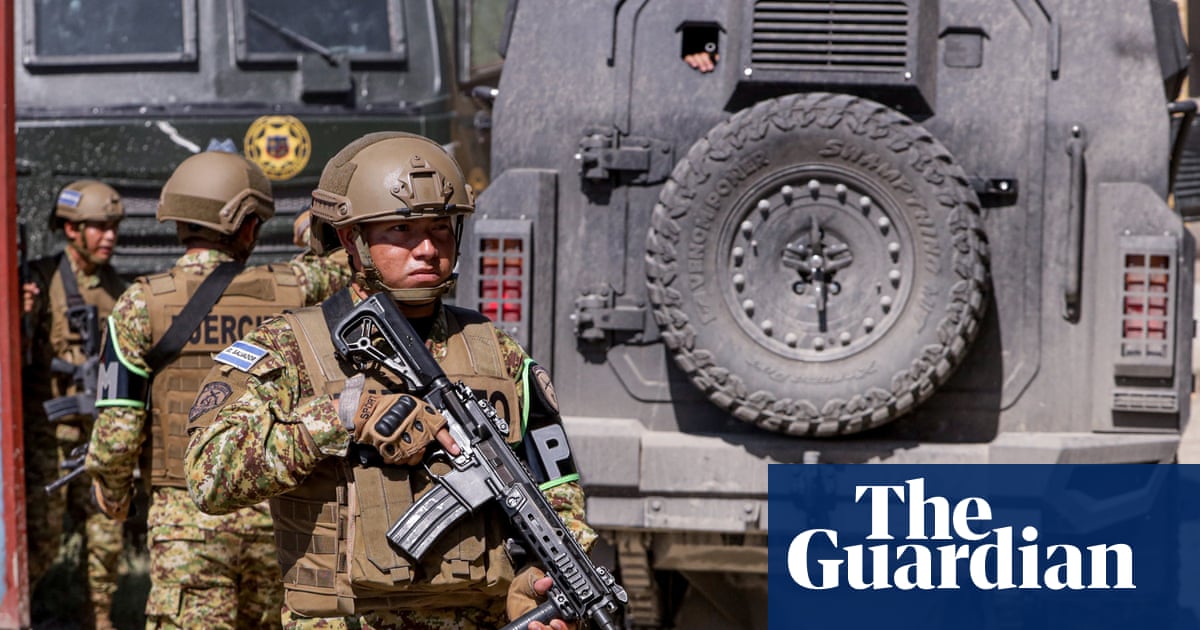
What could go wrong? For over a week, El Salvador has been quietly sending troops to Haiti, a project whose scale was only revealed publicly last night: More than 2,000 Salvadoran soldiers will be sent to the Caribbean nation, but their mission and mandate remain opaque.
The deployment is a wildcard in Port-au-Prince, a city of densely-inhabited hills where battle lines constantly shift between dozens of gangs and anti-gang groups, including foreign forces, neighborhood vigilantes, and mercenaries.
Two thousand soldiers is a significant arrival here. That’s more than Haiti’s entire army, and about a quarter of the urban footprint of the Haitian National Police. It’s about equal to the current staffing of the multinational UN-backed Gang Suppression Force (GSF) and far outnumbers the private military contractors on the Haitian government’s secretive “task force.”
But how do they fit into Haiti’s fractured security landscape? Who is paying for it all? And what exactly is their mission? For now, the Salvadoran forces’ command structure has not been established, according to a source close to the matter.
Exclusive: Inside Erik Prince’s secretive operation taking on Haiti’s gangs
Little light was shed by parallel communiqués released Wednesday evening by El Salvador and Haiti, which described a call between President Nayib Bukele and interim Haitian leader Alix Didier Fils-Aimé about the overall security situation and status of four missing Salvadorans air technicians.
The air technicians, catalyst for this deployment, disappeared earlier this month after an apparent gang ambush. They had been working with the GSF in a noncombat role, according to Salvadoran officials. In the immediate aftermath, 100 Salvadoran special forces were sent to Haiti to assist in search and rescue operations — a precursor to the now expanded force.
Ten days later, local sources say it is unlikely that the missing four can be recovered. If Salvadoran forces cannot achieve that, they’ll likely seek other wins, perhaps joining one of several existing security forces for an extended push against the gangs in retaliation.
A clue to their plans may eventually lie with their physical location; at time of reporting, the Salvadorans were not staying at the main GSF base.
El Salvador sends troops to Haiti to rescue four service members
Bukele has argued that he has unique bona fides to address Haiti’s crisis. His government’s own hardline crackdown on gangs back home did restore peace to what was once the most violent country in the Western Hemisphere — though critics highlight his use of mass incarceration and accusations of widespread abuses.
In a message posted to X last week, he addressed the gangs in Haitian Creole: “There is still time to avoid this,” Bukele said. “Return our four countrymen to us alive and unharmed and everything will return to the way it was before the kidnapping.”
Most residents of Port-au-Prince would rather see dramatic change, after years of brutal gang violence that have driven over a million people from their homes. Just two hours from Florida’s coast, the city is terrorized by frequent gang kidnappings, rape and arson, all broadcast on social media.
On Thursday, Haitians nationwide were reminded again of just how much insecurity has put civil life on pause, with the news that long-deferred presidential elections are postponed yet again until next year.
But experts warn about the dangers of additional players on a crowded urban battlefield. “The situation is volatile and could become more violent with innocent people being harmed,” Bill O’Neill, the UN’s human rights expert for Haiti, said.
Romain LeCoeur, Haiti expert at the Global Initiative against Transnational Organized Crime, echoed the concern. “Haiti’s security response no longer rests on a single strategy, but on a juxtaposition of multilateral, national and private actors, each operating under its own rules,” he said.
“As long as no one can say who decides and who is accountable, every operation risks adding to the confusion rather than to security.”
Reporting contributed by CNN’s Merlin Delcid in El Salvador.