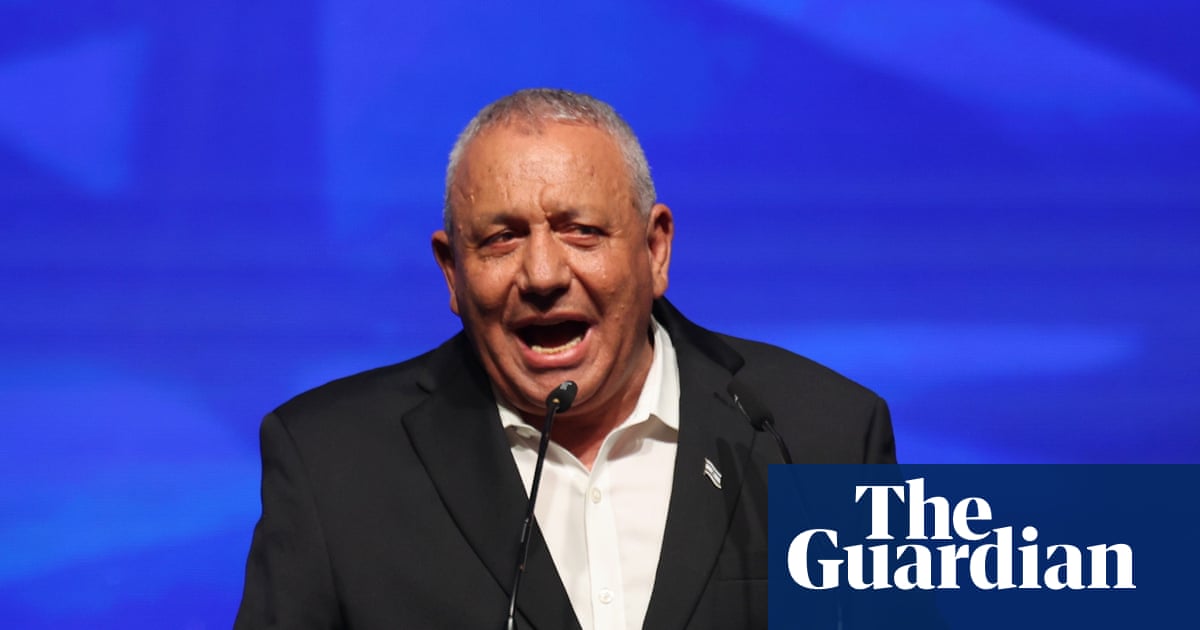
Gadi Eisenkot and Benjamin Netanyahu will negotiate how to form a coalition. ( ABC News: Michelle McNamara )
As the dust continues to settle after Tuesday's Israeli election, it is becoming clearer by the hour that the route forward has a mix of political hurdles and landmines.
The inconclusive result , showing neither the pro-Netanyahu parties nor the so-called 'change' bloc gaining enough support to form a majority coalition government, means weeks of messy and complicated negotiations.
For a country that has already gone through immense upheaval in recent years, this could put even further strain on the community, particularly given how deep-rooted ideological differences will play into the process.
However, politics is about power and influence, and how to wield them. So pragmatism (if you want to call it that) could shine through and lead to an outcome.
Here are four ways the situation could play out.
Neither of the blocs so far have enough seats in the Israeli Knesset to form a majority coalition, which would be 61 seats out of the 120 up for grabs.
As it stands the pro-Netanyahu camp, which is essentially his current coalition, is on track to secure 53 seats.
They include the prime minister's own Likud party, the ultra-Orthodox Jewish parties of United Torah Judaism and Shas, and the far-right nationalist parties of Otzma Yehudit and Religious Zionism, led by Itamar Ben-Gvir and Bezalel Smotrich.
A drop in support for those two men has been part of the problem for Likud, chipping away at the foundations that have been propping up Netanyahu during the last coalition.
The world where this grouping somehow forms a minority government seems to exist in an alternate reality, as all the other parties in the Knesset have campaigned on being 'anti-Bibi' and would rail against it.
There could — and the word could is doing a lot of heavy lifting — be a situation where the 'change' camp forms a minority government.
Gadi Eisenkot's Yashar party, Naftali Bennett and Yair Lapid's Together list (B'Yachad), Yair Golan's Democrats, and Avigdor Liberman's Yisrael Beiteinu could cobble together some government that operates in the Knesset.
Former prime ministers Naftali Bennett and Yair Lapid are against Benjamin Netanyahu. ( Reuters: Itai Ron )
But to do so, they would need guarantees from the Arab-Israeli parties that they would not block their agenda, even if those parties are not part of the new coalition government.
Given the surge in support for the Joint List and the United Arab List from Arab-Israeli voters, it is hard to see a scenario where they would be willing to trade influence inside a new government to sit outside it and play nice when they have record representation.
That's why there is a lot of talk about a majority government formed with the support of the Arab-Israeli parties, bringing Eisenkot and his fellow 'change' challengers into office.
The problem with that is the rhetoric from within the anti-Netanyahu camp towards the Arab-Israeli parties.
Eisenkot had said before the election he would not work with them, while Liberman announced he was totally opposed to it.
But Golan insisted less than 24 hours after the vote that putting aside differences with the Joint List and the United Arab List was the path forward, if it meant the end of the third Netanyahu-era.
That bad blood could be difficult to scrub out of any coalition fabric, and the right wing parties — particularly Netanyahu's Likud — have already ratcheted up the anti-Arab rhetoric, accusing the parties of stealing the election as they cast doubt on how they possibly secured so much support.
Israeli-Palestinian candidate Yousef Jabareen is the leader of the Joint List party. ( Reuters: Ammar Awad )
There is a reason why Netanyahu is Israel's longest serving prime minister — he is a canny operator and negotiator.
While being faced with a sense of his political mortality, Netanyahu could look to convince some of his most ardent opponents to join forces with him.
This could take the shape of Bennet defecting to his camp or Liberman choosing to work with him over the Arab parties.
Loyalty to parties is not guaranteed as well. There could be defections within the parties with people breaking away from one side and joining another, even if the party as a whole does not move.
It is also not totally outside the realm of possibility that he would make an approach to someone like Eisenkot to try to resolve the deadlock, pitching a government where the pair and their parties worked together in a broad coalition.
Gadi Eisenkot, leader of the Yashar party, has been Benjamin Netanyahu's main opponent in the election. ( Reuters: Shir Torem )
This is not without precedent. Netanyahu entered into a coalition with Benny Gantz and his Blue and White party in 2020, and had agreed to alternate the prime ministership.
But that partnership crumbled before Gantz got his shot at the top job.
The issue is that Eisenkot and Yashar have made being 'anti-Bibi' their entire brand during this campaign, describing the prime minister as basically everything from corrupt to morally bankrupt.
But if that hatchet can be buried, something like this could happen.
Netanyahu and Eisenkot have to convince Israeli President Issac Herzog they are best suited to form government in one of the above ways.
Herzog has seven days from when the official results are finalised on November 4 to decide who gets the mandate.
It is worth remembering that when the final results of the election are known, the Knesset is set in position and members are sworn in, even if the government remains in caretaker mode with Netanyahu still as the prime minister.
Israeli media has speculated that in that event, the anti-Netanyahu forces may try to use their numbers to push legislative changes even if there is no new government.
Among the measures that could be pursued could be laws banning someone from serving as prime minister if they were indicted for crimes. Netanyahu is still battling corruption charges.
If negotiations on forming a coalition do not yield a result within 28 days and a possible 14-day extension, the president can choose another leader to try with the same allotted time.
Failing that, Knesset members vote on a third candidate for a final attempt. If they fail after 21 days, the Knesset is automatically dissolved and new elections have to be called within 90 days.
This process to break the deadlock will take months, and it is an outcome Herzog wants to avoid.
But again, it is not without precedent. Between 2019 and 2022, Israel held five different elections.
It may be great for political nerds, but not necessarily for political stability in a country dealing with immense social upheaval and major conflicts on multiple fronts.