You have reached your maximum number of saved items.
Remove items from your saved list to add more.
You've used all of your gift articles. 3 more will become available on the 1st of every month.
Australian steel giant BlueScope raised its earnings forecast significantly this week, driven largely by a near 75 per cent increase in earnings from its North American mini-mill.
Its directors should send a thank-you card to Donald Trump. It’s his tariffs that are primarily responsible for US steel prices reaching their highest level in four years.
That was a foreseeable outcome, and one that was clearly foreseen by the BlueScope board when it repeatedly rejected takeover offers from the Stokes family’s business conglomerate SGH and North America’s Steel Dynamics earlier this year.
Given that BlueScope’s shares are now trading nearly 40 per cent above the price offered in the initial approach in December last year, and have exceeded the final, sweetened price in the $14.2 billion bid, it’s obvious that the company’s directors and their opportunistic suitors had a better understanding of what was happening in the US than BlueScope’s shareholders.
BlueScope’s experience is a good illustration of how tariffs affect an economy, and how destructive they can be for all but their direct beneficiaries, in this case the US domestic steel producers.
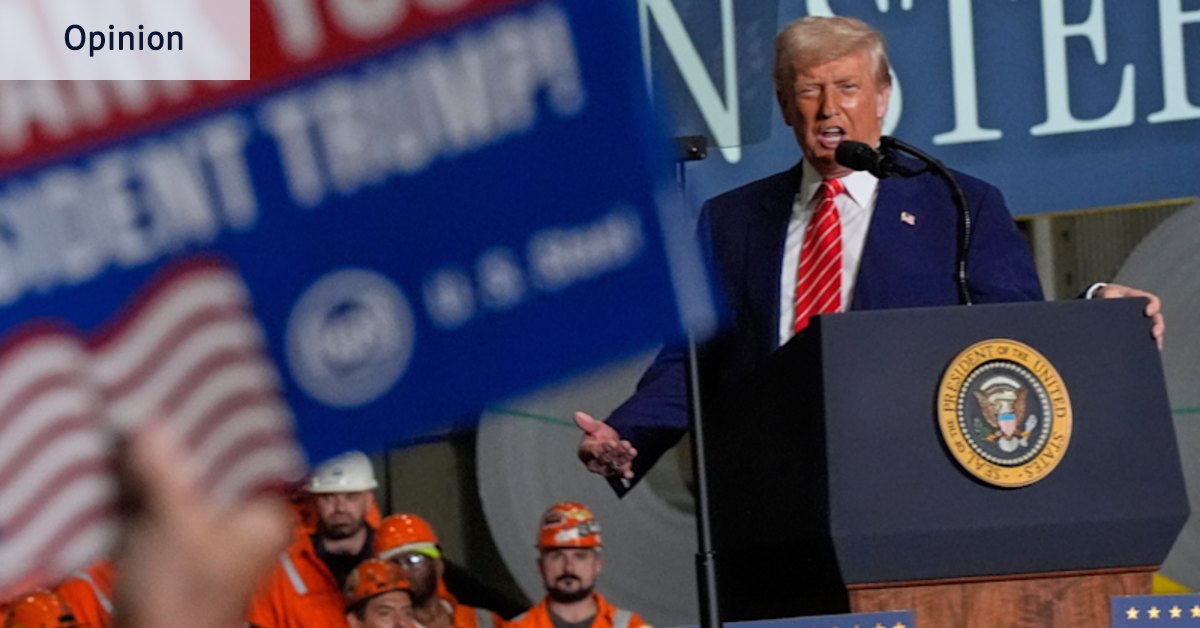
One of the first things Trump did after his inauguration last year was to slap 25 per cent tariffs on steel and aluminium imports, citing national security grounds.
In June last year, after a lower court ruled Trump’s broader “Liberation Day” tariffs illegal (a decision later reaffirmed by the US Supreme Court), Trump doubled the rate on steel and aluminium imports to 50 per cent.
At the same time, he approved a takeover of US Steel by Japan’s Nippon Steel , a deal he had vehemently opposed (as did Joe Biden) during the election campaign, where both presidential candidates were chasing the votes of the steelworkers and their union in the crucial swing state of Pennsylvania.
The approval was sensible. Nippon Steel had promised to invest $US14 billion (close to $20 billion) in US Steel’s capital-starved struggling and shrinking operations.
It was also fortuitous for Nippon Steel, with the doubling of the steel tariff (and its extension to downstream products largely containing steel) providing protection from imports and almost guaranteeing higher prices for its US output.
And so it has transpired. Last month was the 12th consecutive monthly increase in US steel prices . They are up by more than a third since Trump regained the presidency.
Hot-rolled coil prices are up by more than 50 per cent. (US aluminium prices, where the tariffs also doubled, are nearly 60 per cent higher over the same period). US steel spreads are more than $US500 a tonne wider than they were at the start of last year.
That’s provided windfalls for the US producers. The largest, Nucor, had net income of $US2 billion last year. In only the first nine months of this year it has generated $US3.2 billion. Its share price is almost 120 per cent higher than it was on Inauguration Day last year.
It is worth noting that the US experience is almost unique. While prices in the European Union have been rising this year, most markets have experienced price declines, and export prices from China - the world’s largest steel producer - were lower last year and have remained soft. US hot-rolled coil prices are more than 50 per cent higher than those in the EU.
So, Trump’s tariffs have produced a bonanza for US steel producers.
They’ve also helped boost US steel production by about 7.5 per cent since he regained the White House and lifted steel industry employment by about 0.7 per cent although, given that there are only about 85,000 people employed in the upstream steel and iron ore industries, that’s an inconsequential number.
The tariffs have also, as was intended, reduced the market share of steel imports, which are down from about 19 per cent to 16 per cent of the US market this year or, in tonnages, about 14 per cent below last year’s.
US production volumes have risen, but the capacity utilisation rate in the sector has only edged up from just under 74 per cent to just over 75 per cent.
What isn’t apparent from the data is the impact of the tariffs on the industry’s customers, the downstream steel-using companies that use steel (and/or aluminium) to make their products.
What we can see is that Trump’s tariffs generally may have produced a boom in steel industry profits, but they haven’t produced a manufacturing sector boom. Employment in manufacturing, while picking up this year, is still more than 20,000 jobs below the level when Biden left office.
During Trump’s first term as president, when he first imposed a 25 per cent tariff on steel imports, the Peterson Institute for International Economics produced a study that concluded that the tariffs cost American downstream steel-using companies about $US5.6 billion, or about $US650,000 for each job added in the steel sector.
US Federal Reserve Board researchers found that those tariffs cost about 75,000 jobs in the downstream companies, or more than eight times the number of jobs added by steelmakers.
It would be reasonable to conclude that, with the doubling of the tariff rate, the impact on steel-consuming companies and downstream jobs and investment would be greater.
While the Trump tariffs have produced windfall profits for BlueScope and other North American steel companies and their shareholders, they haven’t radically revitalised the US steel industry. And the cost to companies downstream would be massively greater than any increase in steel industry investment, production and jobs.
Trump’s steel and aluminium tariffs haven’t been challenged in the courts, in contrast to his continuing efforts to create a baseline global tariff regime. They do seem to stand on firmer legal ground.
It’s also unlikely, given that the Democrats are as keen to win the support of steel industry workers and their powerful union as the Republicans, that a shift in the control of Congress or a change in the occupancy of the White House will lead to a material change in the tariffs.
Despite the evidence of their destructiveness – studies and data showing that the benefits to steel producers are far outweighed by the damage to their customers and, ultimately, US consumers via higher prices and higher inflation – it would seem likely that the tariffs -- and the fat spreads and profits for the steelmakers, including BlueScope -- are to remain in place indefinitely.
The Market Recap newsletter is a wrap of the day’s trading. Get it each weekday afternoon .
You have reached your maximum number of saved items.
Remove items from your saved list to add more.
You've used all of your gift articles. 3 more will become available on the 1st of every month.