Melissa Arnot Reid first came to Nepal in 2008 as an assistant guide on an Everest expedition. She was 23 and had been guiding for only three years. She had arrived, by her own account, with “an incredible level of naivety.” Summitting Everest, she thought then, was “the master’s degree for a guide”, a way to be taken seriously. She made it to the top on her very first try.
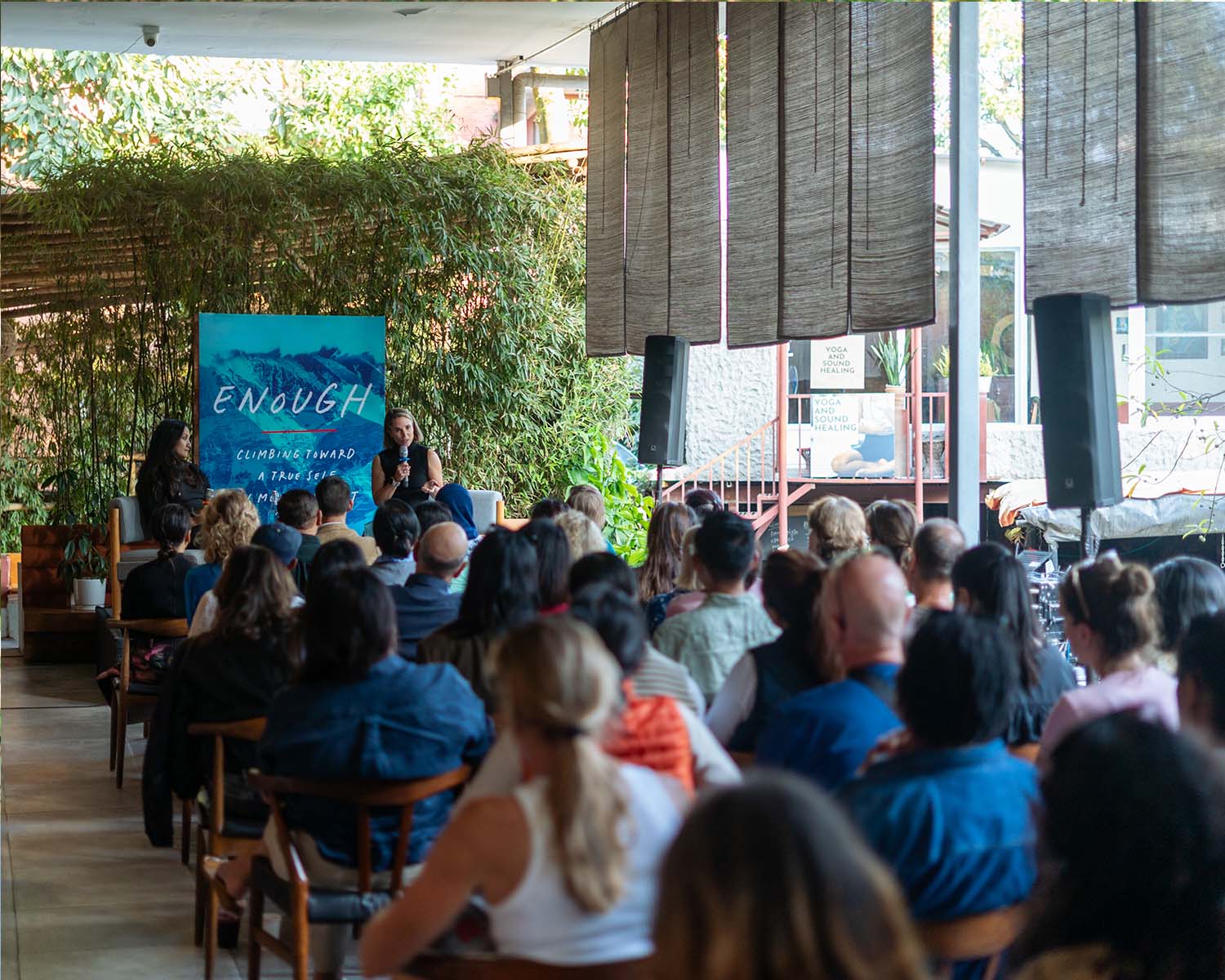
Reid returned to Nepal every year for the subsequent 18 springs. And on Monday, she held the Nepal launch of her memoir—‘Enough: Climbing Toward a True Self on Mount Everest’—at Le Sherpa Restaurant in Maharajgunj, Kathmandu. The Pasang Lhamu Foundation, named after the first Nepali woman to climb Everest, who died on the descent in 1993, hosted the event.
Raised in Montana and Colorado, Reid began guiding at 19 and learned her trade on Washington’s Mount Rainier. She has stood on top of Everest six times. In May 2016, she became the first American woman to summit Everest and descend without supplemental oxygen—and only the seventh woman ever to do so. In 2014, she made the first ascent of Mustang Himal in Nepal. Four years earlier, she co-founded the Juniper Fund, which supports the families of mountain workers killed on the job.
For Reid, Nepal is not simply the setting of her climbing record. She returned to the country every spring for nine consecutive years, first as a young guide seeking legitimacy and later as co-founder of the Juniper Fund. Her memoir turns that long relationship with Nepal and with Everest into an achievement that cannot substitute for self-acceptance, and that people who make Himalayan expeditions possible deserve more than symbolic recognition.
The record, however, she told the audience, was never the real story. “Anyone expecting an adventure book will probably be disappointed,” she said of her memoir. “It is a book about the journey of being deeply human, which means being deeply flawed.”
The book opens on Mount Everest’s South Col, with Reid fighting for breath inside a fragile yellow nylon tent perched on exposed rock about five miles above sea level. From there, the memoir reaches back to her childhood in southern Colorado and the volatile home life that shaped her. She said she long presented a public story of success and resilience while keeping its painful origins hidden.
She wrote her first draft believing it would remain in a locked drawer, and changing the password every week. Writing honestly, she said, allowed her to step outside her shame and eventually develop compassion for the younger version of herself.
Now, when readers call her past behaviour terrible, she agrees: “I hated her too.”
Her drive, she said, came from a need to belong. If she did the hardest thing alone, she believed, no one could say she had not earned her place. Climbing taught her the opposite: “Nothing big, nothing worth doing is ever done alone.”
When asked whether life has changed for women in the mountains, Reid said that change has been slow, but a woman climbing alone is no longer an unusual sight. “If you call out for girls in the mountains, you might now have to ask which one,” she said, pointing to the growing number of women on expeditions. Still, women are expected to work more and expect less, she said. They are judged too young or too old to be taken seriously, and mocked if they climb while raising children.
Reid was careful to place her own achievement within a longer history. In her book, she named Francys Distefano-Arsentiev, the American who reached the summit without supplemental oxygen in 1998 but died during the descent. “It is not me who was first,” Reid said. A summit, she added, is “just one moment,” while the longer expedition and the life one returns to is where its meaning is truly found.
In the book, Reid also talks about Chhewang Nima Sherpa, whom she met in 2008 when he already had 19 Everest summits. In autumn 2010, an avalanche swept him away on the Baruntse mountain in Khumbu region. His sons were 11 and 13. The next day, sitting with his widow in their village, Reid said she understood that this was “the worst day” for the family, not for her. His wife did not need money, she said. She needed the choices she had lost.
That conversation became the Juniper Fund from which now she supports 88 families, about 300 people. “The most important thing that I have done in my life is not climbing Everest,” she said. “But climbing Everest allowed me to have a voice.”
During Monday’s event, Lakhpa Futi Sherpa, team leader on Pasang Lhamu’s 1993 expedition and her cousin, said a summit is like a goal in football—one person may score, but the success belongs to everyone who played.
Reid called Everest “a fancy billboard” that she uses to point attention to fund the families. When asked what a more accountable and equitable high-altitude mountaineering culture would look like, she said, “I’m a foreigner,” and argued that the industry should be managed by Nepalis. Any meaningful change, she said, must begin with listening to the people who own and work within the industry.
Her one suggestion was a short briefing for every climber on fixed lines, waste management at Camp II, expectations during an incident, and how rescue works for both climbers and local workers.
She closed on her title. “Enough,” she said, means three things: I’ve done enough, I’ve had enough, and I am enough. “I can never do anything to become enough,” she added, “because I already am.”
Enough: Climbing Toward a True Self on Mount Everest
Aarya Chand is a reporter at The Kathmandu Post covering social issues. Before moving to the social beat, Chand was an intern covering culture and lifestyle for the Post.