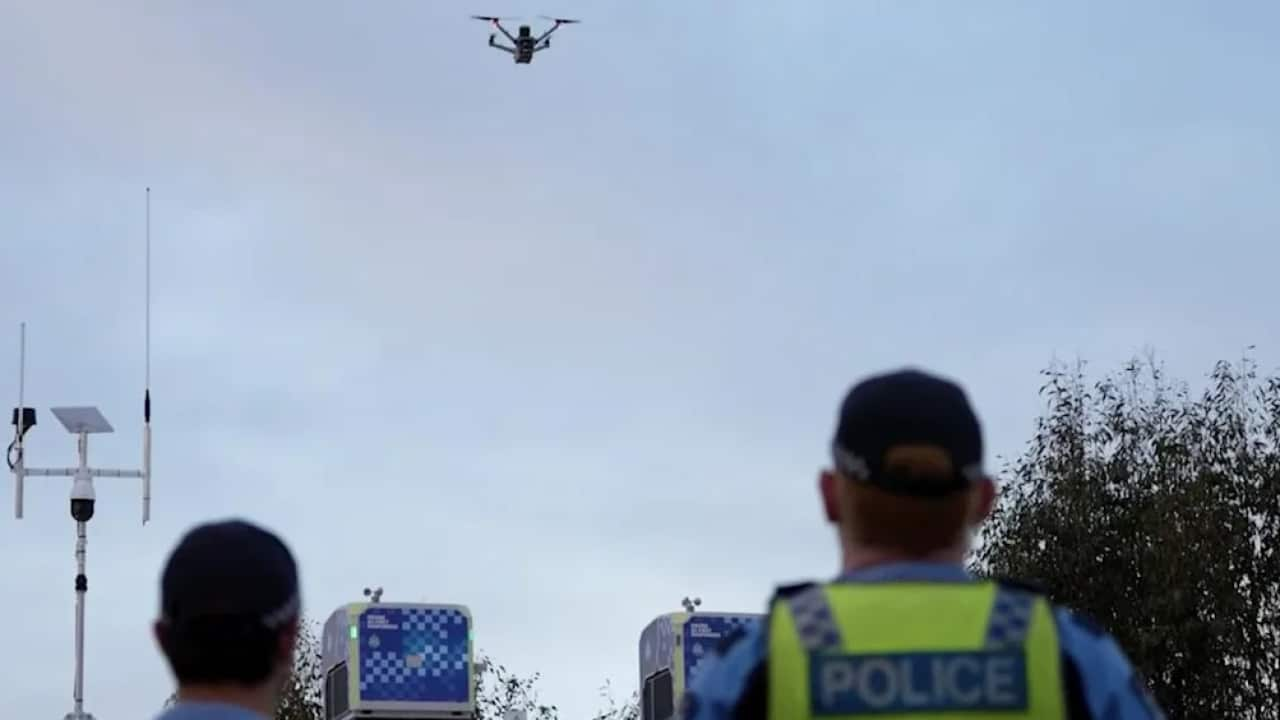
WA Police is expanding Australia's first automated Drone as First Responder (DFR) fleet, aiming to fill the sky with remote aircraft dispatched from Perth's CBD to emergency scenes within seconds.
While the police promote the rapid-response technology as a vital tool to catch criminals and protect officers, civil liberties advocates warn the rapid rollout risks allowing Australian aerial policing to outpace laws meant to protect individual privacy.
WA Police is also trialling artificial intelligence-assisted facial recognition cameras, and while its drone program is the most advanced in the country, similar programs are being used across Australia.
It's "pretty scary, dystopian stuff", Tom Sulston, head of policy at the digital human rights charity Digital Rights Watch, told SBS News about the direction policing technology is moving in Australia.
In announcing an extension of the drone program, WA Police commissioner Col Blanch said unmanned aircraft will not be patrolling or hovering passively.
Your trusted source for staying up-to-date with the world around you. Get free daily news updates and analysis, straight to your inbox.
"We don't do patrol, we simply do response," he told ABC News. "You ring 000, we come to help."
However, the commissioner also said that he hopes the program will expand: "The aim is to have as many as possible out there so we cover maximum distance throughout the state," he said.
WA Police Minister Reece Whitby went further, saying criminals "won't see us coming ... won't hear us coming, but we'll be there in the air watching your every move".
The DFR X program, which will initially operate across the southern Perth suburbs of Baldivis, Kwinana, and Rockingham, is the latest move by Australian police who are increasingly experimenting with drones.
Sulston said it is "inevitable" their use will increase among police forces and it's therefore essential Australia has the frameworks to ensure they are used responsibly.
"If you don't have good transparency legislation over the police to know what they're doing, then how are we holding them accountable?"
Many police forces across Australia have been using drones for years for operations from search and rescue to monitoring unfolding incidents. Their small size, rapid response, and low cost make them particularly convenient.
Unlike traditional approaches, where drones are launched manually by officers at the scene, WA's DFR X system houses drones in docking stations atop police stations, ready to launch remotely from a central command centre in Perth.
Flying "beyond visual line of sight", the drones are designed to arrive on the scene of a Triple Zero call in less than a minute, feeding high-quality video back to headquarters before officers can arrive.
In north-west NSW, the state's police force has been conducting its own controversial and high-profile automated drone trial in the regional centre of Moree.
Officers stationed more than 600km away in Sydney have been piloting the aircraft to respond to property crime, break-ins, and vehicle theft.
In August, the Minns government moved to expand the trial, saying police surveys reported strong community support. However, the operation has drawn criticism from national human rights organisations and legal advocates.
Australian Human Rights Commissioner Lorraine Finlay warned NSW should halt any wider rollout until the civil liberties impacts of automated aerial policing can be properly addressed.
"While existing surveillance laws regulate some aspects of these activities, they leave important questions about permissible uses, data handling, transparency and independent oversight unresolved," she said.
"Effective policing and human rights should never be treated as competing priorities. We should expect both."
Deploying automated drones over regional towns, particularly ones with a significant First Nations population like Moree, risks establishing a regime of persistent overhead surveillance of already over-policed demographics, civil rights groups say.
The shift from police helicopters to manually operated drones and automated suburban fleets raises legal questions, as it's unclear what happens when drones film private property while travelling to a callout.
Under Australian common law, property owners have limited rights to the airspace above their land.
"Aeroplanes can fly overhead, helicopters can fly overhead, but they are constrained by no damage or nuisance being caused," Sulston said.
"If a police drone flies over your house and you want to go out and sunbathe in the garden, and it's videoing you doing that, that could count as a nuisance."
Modern aerial imaging makes distinctions about private space unclear, as Sulston said most people will be completely unaware they have been filmed from above.
"If you're in private from street level, but you're publicly viewable from 200m up, is that a private or a public place?" he said. "Those are largely legally untested questions.
"We have to have pre-existing transparency and reporting regimes so that we collectively can see what the police have been looking at and make a call on whether this is a reasonable thing for them to be doing."
The operation of drones beyond line of sight is regulated by the Civil Aviation Safety Authority (CASA), which told SBS News it has "approved emergency service operators" for such use.
"CASA has worked closely with police and emergency service operators over many years to support the safe use of drones," a spokesperson said.
However, CASA does not regulate how drones are used or what footage they can collect, only their aviation safety.
Privacy protections are left to state and federal legislation, which often predates the use of autonomous robotics.
State police forces are largely exempt from the federal Privacy Act 1988 when carrying out law enforcement roles.
In WA, there is no comprehensive public-sector privacy regime and surveillance device laws are designed for much more primitive technology.
When asked about the retention of footage, WA Police told SBS News that video captured during drone flights is "retained in accordance with agency retention policy".
Asked what protections are in place to prevent private residences being recorded, SBS News was told that "all DFR X flights are in accordance with CASA Regulations and endorsed Operations Manual".
"This requires a pilot to navigate remotely whilst transiting to an incident, using the aircraft camera to scan to the horizon for aircraft and hazards.
"Only once a DFR X aircraft has arrived at the incident will the pilot use the camera to record information relating to the incident."