Land transactions are declining in Nepal’s hill districts as migration to the Tarai and urban areas gathers pace, leaving an increasing amount of farmland abandoned. Land that was once bought by villagers when families moved to the plains is now becoming difficult to sell, even when it is productive.
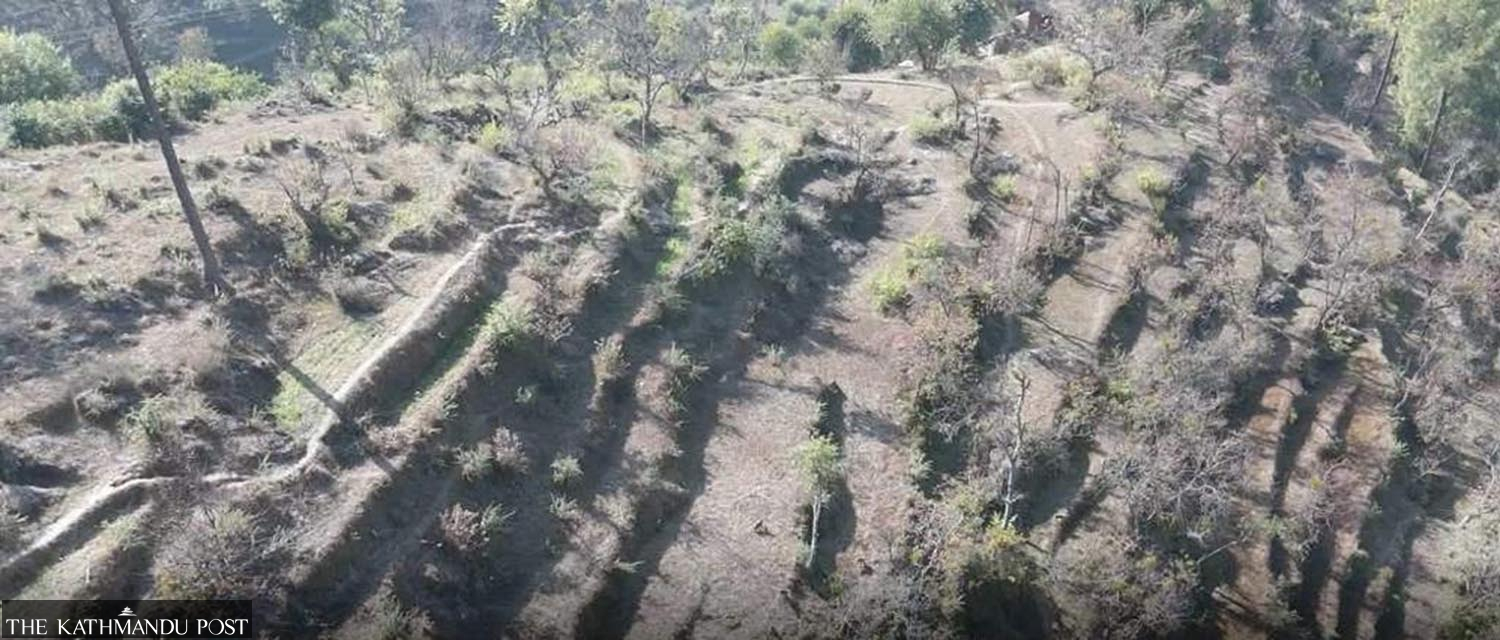
Many families moving to the Tarai or cities are leaving their land uncultivated after failing to find buyers. Four years after moving from Pancheshwar Rural Municipality in Baitadi to Kanchanpur, Bharat Chand has seen his 11 ropani of farmland (one ropani equals 0.050874 hectares) become overgrown with scrub and grass.
“I initially tried to sell the land, but nobody was willing to buy it. Now I would even let someone farm it for free, but nobody is interested,” Chand said. “Only the elderly remain in the villages to look after the land. The younger men have moved elsewhere in Nepal or abroad, while their wives have relocated to towns with their children so they can attend school.”
The situation is widespread across Baitadi, where even fertile farmland is becoming increasingly difficult to sell, locals say.
The National Sample Census of Agriculture 2021/22 recorded 19,925 hectares of land operated by farmers in Baitadi. Of this, 1,067.2 hectares were left fallow. The district also had 11,911.8 hectares under temporary crops and 685.1 hectares used as temporary pasture and grassland.
Bina Bhatta, vice-chair of Pancheshwar Rural Municipality, said the declining demand for farmland was largely driven by migration to the Tarai and a shortage of people willing to work in agriculture in the villages.
“People from the hills have increasingly made it a priority to buy even a small plot in the Tarai to build a house, often stretching their finances to do so. As a result, nobody wants to buy farmland in the hills,” Bhatta said. “Since farming alone cannot sustain a family, more people are moving to market centres, even if they have to live in rented accommodation, and taking up whatever small jobs they can find.”
The rural municipality has introduced agricultural subsidies and skills training programmes to discourage migration, keep farmland in use and help residents become self-reliant. But local people have shown little interest in these initiatives, Bhatta said.
Padam Rokaya, a local civil society leader and land-services agent, said crop losses caused by wild animals and poor returns relative to the labour involved had further discouraged farming and reduced demand for agricultural land.
He said local, provincial and federal governments needed to develop concrete plans to create income-generating opportunities in villages and expand subsidy programmes.
The Land Revenue Office, Baitadi, has systematically maintained land transaction records only for the past two fiscal years. Earlier data are unavailable because records were not properly maintained, the office said. The available figures, however, show a decline in transactions.
The office registered transactions involving 537 land parcels across the district in the fiscal year 2024-25. The number fell to 451 in 2025-26.
Nabin Prasad Ojha, information officer at the office, said most people coming to register land transactions were buying plots for residential purposes rather than agricultural use. Their preferred locations were areas along roads, local government centres and market hubs.
Revenue from land registrations also declined, falling from Rs4.69 million in 2024-25 to Rs4.45 million in 2025-26, Ojha said.
Only 44 land transactions were registered in the first quarter of the current fiscal year, according to office records. If the trend continues, the annual total is likely to fall further from last year’s figure.
Registered land transactions include sales, gifts, property partitions, donations and exchanges.