

A s Albert Rakotoarisoa emerges from the forest into a clearing in Mangabe reserve in the east of Madagascar , he sees dozens of holes dug in the marshy ground, a sign that people have been here to search for gold.
“I came a couple of weeks ago, and these weren’t here,” he says as he surveys the damage, counting 40 holes. “I’m really disappointed.”
Rakotoarisoa, 52, patrols the area regularly on behalf of a local group of volunteers and Madagasikara Voakajy, an organisation that protects the island’s endemic species and their habitats. He has noticed an increase in illegal artisanal gold mining over the last year, as the price of the precious metal has hit record highs.
Standing on a felled tree branch amid the holes, most of which have filled with water, he remembers this as a former haven for golden mantella frogs, an endangered species that exists only in two or possibly three sites in a small area of Madagascar.
“I haven’t seen any here since 2024,” says Rakotoarisoa. “The golden mantella is a source of pride for me, because I remember my father telling me as a child that it is only found in these parts.”
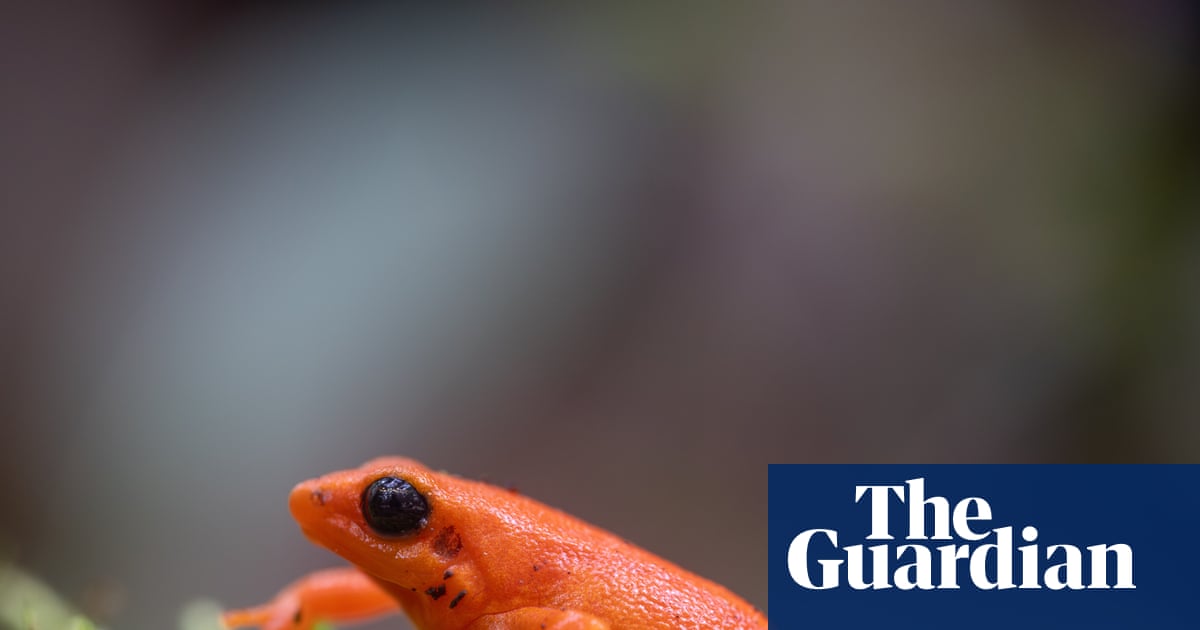
The size of a fingernail, and coloured a bright red-orange with black eyes, the frog is classed as endangered on the International Union for Conservation of Nature’s red list . There is a Malagasy saying: “ Rehefa misy sahona menc dia misy volamena ”(“Where there is a red frog [the golden mantella], there is gold”).
Its scientific name, Mantella aurantiaca , contains the letters Au, which is also the chemical symbol for gold. Now, the species has become a warning sign of the wider threat that goldmining poses to Madagascar as it destroys the frog’s habitats and populations shrink.
Madagascar, located off the east African coast, is a biodiversity hotspot : approximately 95% of Madagascar’s reptiles, 89% of its plant life and 92% of its mammals exist nowhere else on Earth . The rate of deforestation in the country is alarming. According to Global Nature Watch, from 2001 to 2025, Madagascar lost 5.4m hectares (ha) – 14.5m acres – of tree cover, which is 32% of the tree cover that existed in 2000.
To try to safeguard some of Madagascar’s wildlife and forest cover, the government had created 122 protected areas by 2015. Mangabe, which is also home to 10 species of endangered lemur, stretches over 27,188ha. It is one of five protected areas that have lost half of their forest cover and is classified as critically endangered.
Any goldmining within protected areas is illegal, explains Valéry Ramaherison, extractives project officer at Transparency International Madagascar. Despite this, it is on the rise.
“Madagascar is a poor country and the situation is not improving,” he says. “Local communities, and some authorities, are switching to small-scale mining for quick money.”
About 80% of Madagascar’s population live on less than $2.15 (£1.60) a day. The country is also among the most vulnerable in the world to the climate crisis, with regular droughts, floods and cyclones causing death, displacement, and damage to crops and infrastructure.
Alakambaty, a village within Mangabe, is home to about 600 people, mostly subsistence farmers. It lies two to three hours – by off-road motorbike along a bumpy dirt track – from the nearest town. Hanta Soamalala, the village mayor, sits on a bench outside the primary school, which overlooks houses, rice paddies, forest and surrounding hills.
“The lack of agricultural production is the major challenge here,” she says. “The main reason is the climate. People grow crops but they don’t get the yield they expect. Before, we could predict when the rain would come, we knew when to plant. Since the weather has changed, and we get drought, cyclones and flooding, we are lost.
“We don’t have a solution other than to just accept the situation and wait for the next season to arrive.”
Soamalala, 50, admits this has pushed people to turn to goldmining. “It is both good and bad,” she says. “The mining destroys the habitats of wildlife, but at least it can help people survive.”
Miners told the Guardian that if they found a site where there is gold, it could take a week to gather about a gram of the metal, which is then sold in Moramanga, the nearest town, for up to 480,000 ariary (£83.40).
Most of the gold collected in Madagascar ends up in the United Arab Emirates, says Ramaherison, and there are substantial discrepancies between officially reported gold production and the scale of artisanal mining. In 2023, the UN Comtrade database reported that 1,162kg of gold was exported from the country , while the national gold agency in Madagascar registered nothing.
In January, Carl Andriamparany, Madagascar’s minister of mines, told a press conference that the government had “acknowledged our current inability to effectively regulate the sector and establish a rigorous monitoring system”.
Back in Alakambaty, Soamala heads down to lead a community meeting with villagers and representatives from Madagasikara Voakajy. The rules governing protected areas are read out and people are encouraged to sign up to the local organisation of volunteers who patrol the area for infractions.
Voahirana Randriamamonjy, who oversees the Mangabe protected area for Madagasikara Voakajy, says it is difficult to get people interested in protecting the forest. The work is hard and largely unpaid.
She also thinks there is a lack of education and awareness about environmental issues. “Most people don’t have pride in the biodiversity of Madagascar and this is linked to them not really taking care of the environment,” she says.
“People don’t care; people are poor and goldmining is seen as a way of getting money quickly, while deforestation is to plant rice for subsistence.”
Despite this apathy, the local organisation has 120 volunteers. They are one of a number of groups that work with Madagasikara Voakajy to raise awareness among communities of the forest’s importance. Together, they conduct patrols, create firebreaks, and restore woodland and the marsh ponds where golden mantella frogs live.
Members are also trying to implement sustainable farming techniques and have started making compost and growing plants and trees native to the area in a dedicated nursery.
About six miles (10km) away from Alakambaty, the Guardian spots six golden mantella frogs within a 20-metre copse of trees. A short walk away, just outside the protected area, the landscape is littered with piles of orange earth and tidy, circular holes that descend up to 40 metres into the ground. Each one has steps cut into the side for people to climb down.
As the Guardian approaches, a small group of people run away. A man and a woman in their 20s come back to explain that they do this because their crops fail so often and they need the money. They say they have no hope of finding large nuggets of gold, but perhaps enough specks to supplement their dwindling income from farming.
These scenes are replicated throughout the country. Earlier this month, Transparency International’s Ramaherison was sent drone footage of mining destruction, similar to that in Mangabe, from one of the country’s largest rainforests in the east. The footage was sent by Alliance Voahary Gasy, a coalition of environmental organisations.
“Once someone finds a small amount of gold in a place, the information will spread very quickly and there will be a gold rush,” he says.
“Meanwhile, we have local authorities who don’t have the resources to do surveillance or carry out arrests. In some cases, the local authorities are also part of the illegal activity.”
In Alakambaty, Randriamamonjy accepts there is no simple solution to preventing illegal goldmining and deforestation. She would like to see more stable, long-term funding for conservation organisations, economic opportunities for communities, and action taken against the individuals who finance illegal operations, buy gold and move it through illegal supply chains.
“If communities see tangible and lasting benefits from protecting a forest – income, stronger organisations, secure resource-management rights and a meaningful voice in decisions – while illegal mining becomes harder to finance, sell and operate, then the incentives begin to change,” she says.
Find more age of extinction coverage here , and follow the biodiversity reporters Rebecca Ratcliffe , Phoebe Weston and Patrick Greenfield in the Guardian app for more nature coverage.