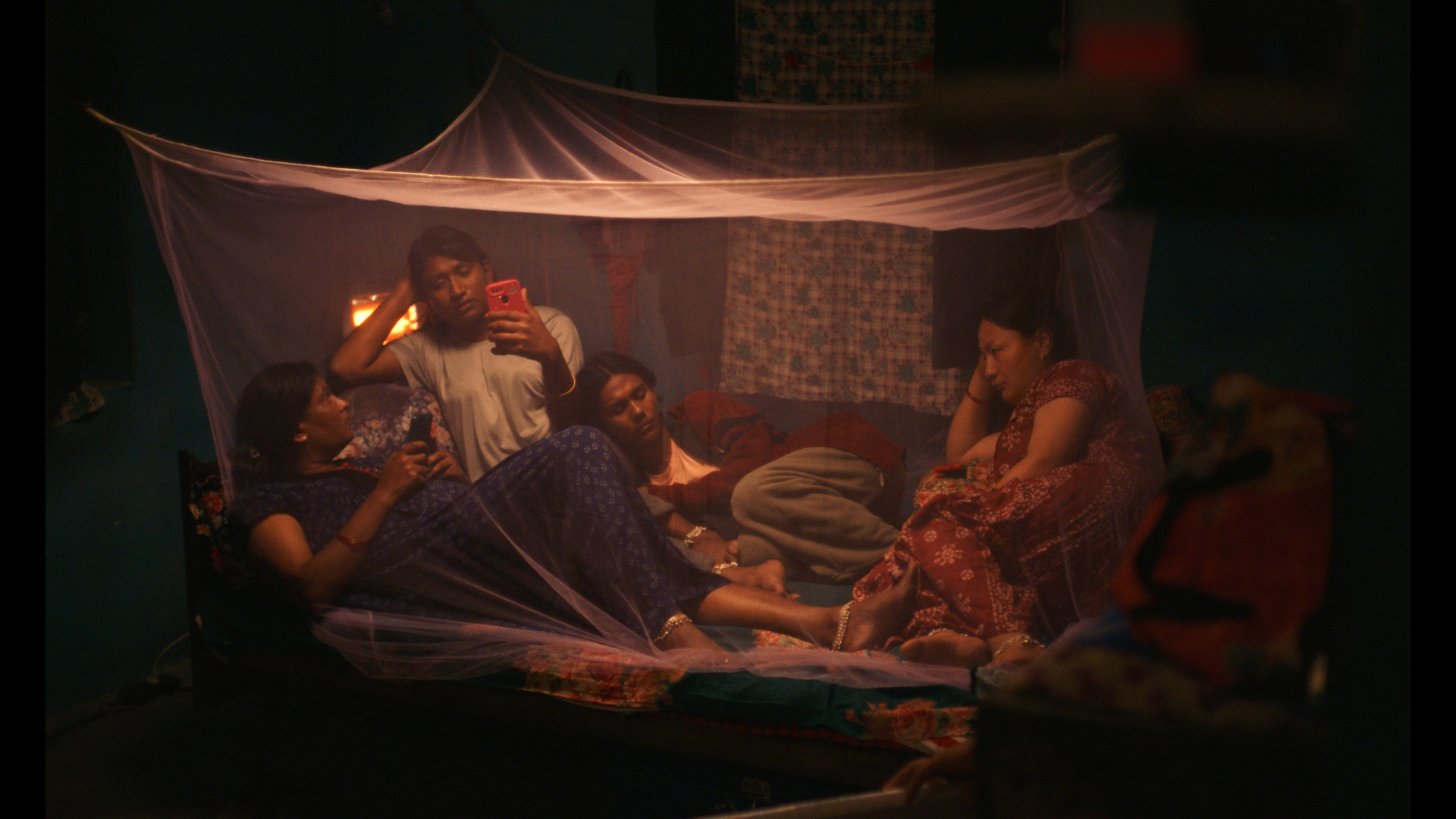
In the history of visual art, few subjects have been returned to as faithfully and universally as the bond between mother and child. From gilded Renaissance canvases of the Madonna tenderly cradling Christ to South Asian temple carvings of a playful Yashoda and Krishna, motherhood has long been enshrined in a halo of warmth and security. In Nepal’s 2026 Cannes hit, ‘Elephants in the Fog’ (‘Tiniharu’), director Abinash Bikram Shah brings fresh complexity to the traditional ideal of motherhood by centring his film on the women of the Kinnar community perched at the edge of gender and society in a deeply human portrait of chosen family in modern Nepal.
Set in the Terai village of Thori, the film unfolds behind the uneasy hum of an electric fence stretched along the forest edge to protect the villagers' harvest from wild elephants. In the haze, the electric fence looks less like a defence than a nervous thread struggling to contain the threatening weight of the jungle. Throughout the film, Shah invites us to consider the invisible fences built around womanhood in Nepal: borders between society and the self, between the roles women are expected to perform and the unspoken desires stirring within them. These borders are reinforced by the surveillance of laj and izzat —the pervasive dread of social shame and lost honour, of what the neighbours might whisper about us behind shuttered windows. Within this tense landscape, the film follows a community of Kinnar women led by their matriarch Pirati (brought to life with the extraordinary grace of Pushpa Thing Lama) and her adopted daughters. For years, Pirati’s small gharana , or chosen family, has existed in a selfless covenant with the village. By day, dressed in vibrant saris and clinking glass bangles, they enter households to sing and bestow ashirwad (ritual blessings) upon weddings and newborns. By night, they fearlessly patrol the fields, banging tin drums and shining torches to ward off wild elephants.
Rather than offering an airbrushed portrait of womanhood or romanticising Pirati’s maternal sacrifice, Shah exposes the quiet wounds left by suppressing personal needs and desires in the name of duty; wounds that settle deeply in the unspoken spaces between mothers and daughters. From an early age, we learn the gendered choreography of domestic harmony: how a daughter should soften her voice, how a son should carry burdens without complaint, how a mother should show endless service, and how a father should guard the household’s reputation. Pirati is a chosen matriarch who has been given the role of a mother, wrapping herself in its attached duties, demands, and self-denial. In wearing this gendered role daily, she has discovered a devotion so fierce that it threatens to tear her being in two. Watching her wrestle between her obligation to her daughters and her secret longing to elope with the local Drum Master, the audience returns to a central question: are the roles given to women by society disguising who they truly are, or do years of rehearsing this role eventually become their identity? And, if so, at what cost?
Shah captures this conflict between outward duty and inward truth through a distinctly Nepali lens of motherhood, embodied in Pirati’s unsentimental ‘tough love’. When Pirati’s youngest adopted daughter, Apsara, senses Pirati’s restlessness and pleads with her not to leave their household, she is voicing a child’s raw need for comfort and reassurance. However, her daughter’s vulnerability unsettles and enrages Pirati. It threatens the performance of maternal strength that Pirati has spent years perfecting and awakens the longing she has worked so hard to bury: the simple, forbidden wish to belong to herself. Unable to express tenderness in that moment, Pirati responds to Apsara’s pain with biting words, sarcasm, and anger. She uses aggressiveness as a shield against her inner helplessness, even though a protective love burns beneath her hardened exterior. Both women are divided by an invisible veil of fog, unable to speak their full hearts to each other because of their unmet needs hidden under the roles of mother and daughter.
For much of the film, the elephants remain unseen—half-real, half-imagined shapes moving like ghosts through the white haze, and provoking an irrational hysteria in the villagers. We come to realise that for the villagers of Thori, the fiercest elephants are the ones roaming inside their own minds: the fear of scandal, difference, and losing social standing, echoing Seneca’s observation that “we suffer more often in imagination than in reality.” The moment Apsara vanishes into the trees during a night patrol, those inner anxieties quickly overpower reason, and the village’s pious gratitude to the Kinnar women evaporates overnight. Beneath their neighbours’ outward respect lies a vicious prejudice that hardens instantly into blind loyalty to family bloodlines and suspicion of anyone on the margins of society. Only a single empathetic police officer steps through the fog of ignorance to help them, while the rest of the village bands together to scapegoat and persecute the women, driven by misinformation and fear of disgrace.
Moving with the rhythm of a midnight thriller, we follow Pirati as she searches frantically for her daughter, only to discover that Apsara has returned to her biological family who had once bitterly rejected and disowned her. Behind Apsara’s return to her former family lies a primal fear of social exile, an instinct familiar to anyone who has lived under the weight of expectation. When belonging is tightly bound to bloodline and mainstream conformity, the hunger for validation, even from those who mistreat you, runs deep. Therefore, Apsara chooses to abandon the warmth of her chosen family for the conditional acceptance of mainstream society.
In a haunting shot in the film, Apsara, dressed once more in male clothes, stands gazing from a window as her mother forcefully pushes Pirati away from the threshold to protect the family’s izzat . In that single frame, Shah captures a stark confrontation between two forms of motherhood: Apsara’s natural mother, whose affection is tied to social respectability and protecting patriarchal norms, and Pirati, the mother whose unconditional love embraces her daughter wholly, without shame, condition, or blood tie. Even so, Apsara does not run to defend Pirati, the only parent who ever accepted her as she truly is. Framed behind the glass like a prisoner in her own home, she watches in frozen silence as Pirati is turned back into the fog.
As the fallout from Apsara’s departure shatters the household and culminates in the villagers setting fire to the women’s home in the ultimate act of betrayal, the fog no longer feels like winter weather; it hangs over the community with the suffocating weight of grief. When trust is broken beyond repair, the Kinnar women’s long-contained rage erupts into a destructive elephant stampede from the forest—the storm outside mirroring the fury within. We spend our lives building fences in the hope that they will keep us safe, to create palatable versions of ourselves for society, but Shah’s film warns us that when we put people in boxes, eventually the wild force we tried to control will sweep us away like a tidal wave.
If our fences are destined to break, how can we live meaningfully in the fog? At the close of the film, I was drawn back to its very first image, where Pirati is quietly gathering blue flowers in the forest. She drops the small flowers into a jar of water, telling Apsara that a flower needs warmth to spread its colour. When the water is warm, the petals bleed their vibrant blue effortlessly—just like the homely warmth that Pirati and her daughters create when they braid each other’s hair. Later, when the ritual is repeated in cold water, there is no colour. Without trust and affection, both the flower and the human spirit stay locked within themselves. Shah’s moving portrait of a chosen family in modern Nepal leaves us with this enduring truth: the fault does not lie with the flower, but with the water surrounding it. Often, we mistake obedience for love and social respectability for safety, forgetting that these can keep the water cold. Blood may begin a family, but only warmth and tenderness sustain it. In a world full of fog, fences, and judgement, Pirati’s maternal voice reminds us that we should not try to change the flower, but warm the water around it.
Rai is a freelance Nepali writer. Her writing explores how the arts capture lived cultural experience and shifting social realities. She is a graduate in Literature & Arts from University of Oxford.
Rai is a freelance Nepali writer. Her writing explores how the arts capture lived cultural experience and shifting social realities. She is a graduate in Literature & Arts from University of Oxford.