Currently under construction, Brisbane’s new train line aims to relieve congestion and increase capacity through the CBD to accommodate South-East Queensland’s growing population, while helping the city prepare for the 2032 Olympic Games.
The project includes four new underground stations and eight rebuilt or upgraded surface stations across the city.
Cross River Rail is a new heavy rail line through the heart of Brisbane’s CBD, consisting of 10.2 kilometres of new tracks, 5.9 kilometres of it in an underground tunnel.
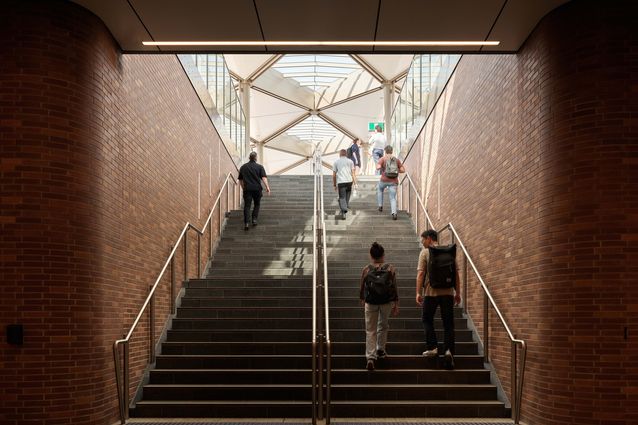
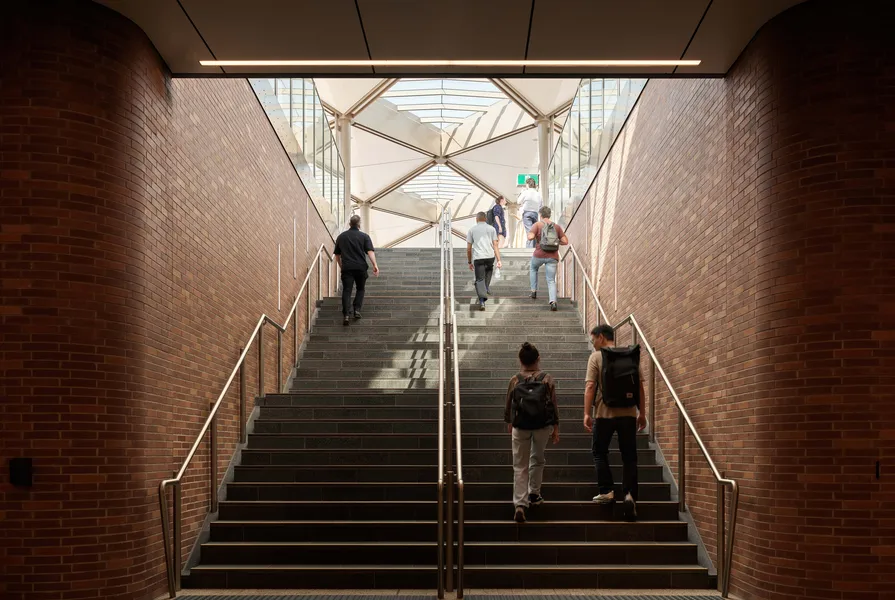
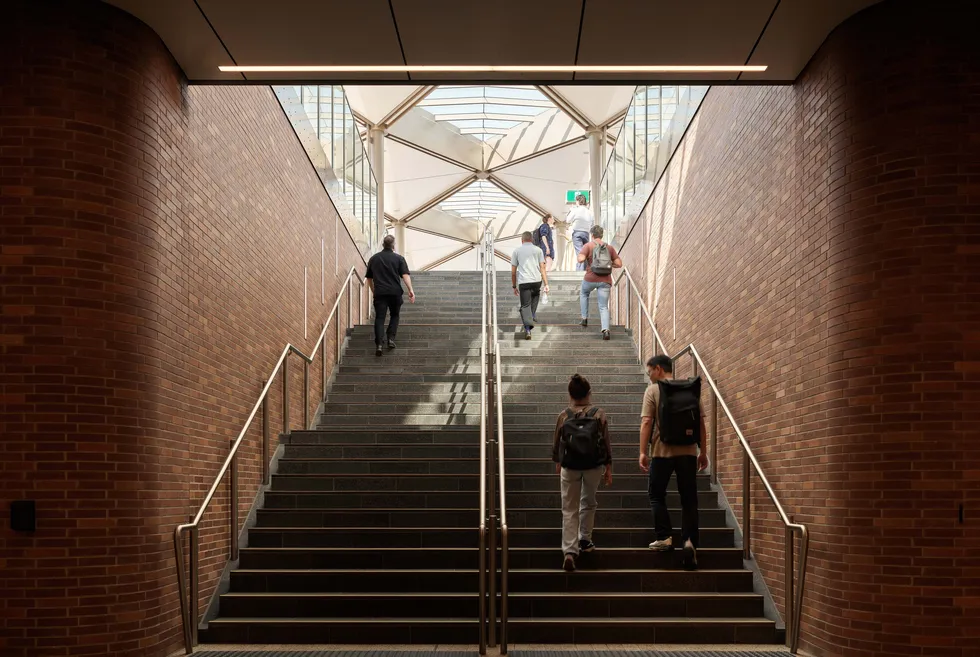
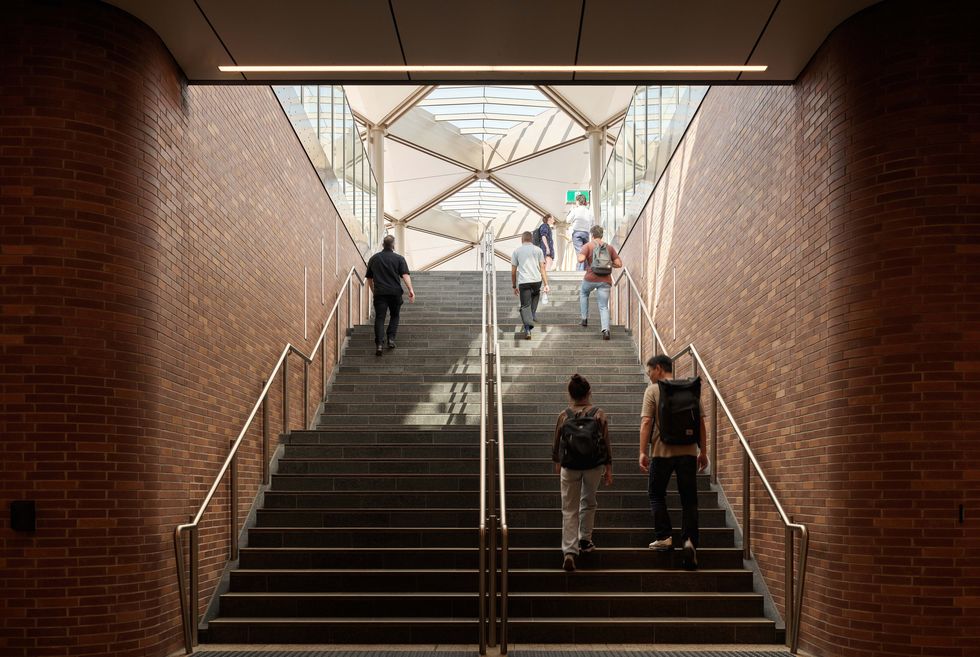
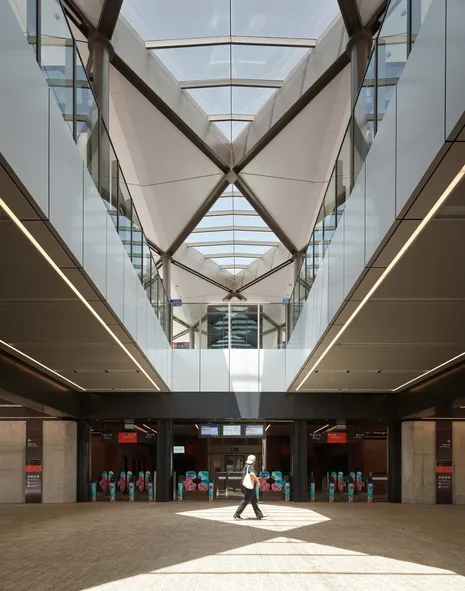
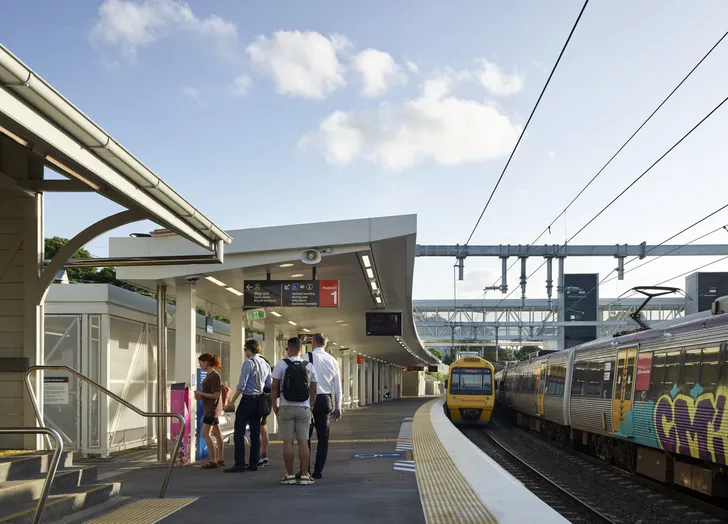
Exhibition Station’s redesign evokes the form of the John MacDonald Stand at the adjacent Brisbane Showground.
The project aims to relieve congestion and increase capacity for transport through the Brisbane CBD to accommodate South-East Queensland’s growing population as it swells from 3.5 million to 5 million by 2036, as well as assist Brisbane in preparing for the 2032 Olympic Games. It also reduces reliance on motor vehicle transport, making mobility more sustainable for the future.
The new line connects to existing tracks in the north and south, unlocking the bottleneck caused by Brisbane’s single river crossing at Merivale Bridge. There will be four new underground city stations in Brisbane, as well as associated works to upgrade or rebuild eight of the city’s existing stations. Three new stations on the Gold Coast will also be added. The project is coordinated with land use planning, creating five new precincts at Boggo Road, Woolloongabba, Albert Street, Roma Street, and Exhibition for urban regeneration as transport-oriented developments.
The project aims to relieve congestion and increase capacity for Brisbane’s rapidly growing population.
Station architect Hassell’s approach is to create individual designs for each station united by a fittingly Queensland motif: sitting in the shade of a giant fig tree. This concept is interpreted at each station as a distinctive canopy that filters light, providing a dappled space. The designs also look to improve the street canopy of trees beyond the station, leaving a legacy of shade and amenity for a subtropical city. Station designs take bold directions, such as the centrepiece at Roma Street, which will feature a floating canopy and plaza with a Grand Central-like multi-modal connector between suburban and interstate services, while restoring views to the historic Roma Street Station.
This is a visionary infrastructure for Brisbane that leaves a legacy for future generations.
This case study is part of a spotlight on rail infrastructure by Philip Vivian. Read the other case studies on the Metronet Morley–Ellenbrook Line Project by Woods Bagot with TRCB Architects, TCL and UDLA, and the Sydney Metro City Stations .
Australia’s capital cities are undergoing a transformative rail boom, and architects are playing a central role. It’s an opportunity to reshape not only how we …
Connecting Perth CBD to the city’s previously underserved north-east corridor, the Ellenbrook Line includes five new above-ground stations, each tailored to its specific context but …