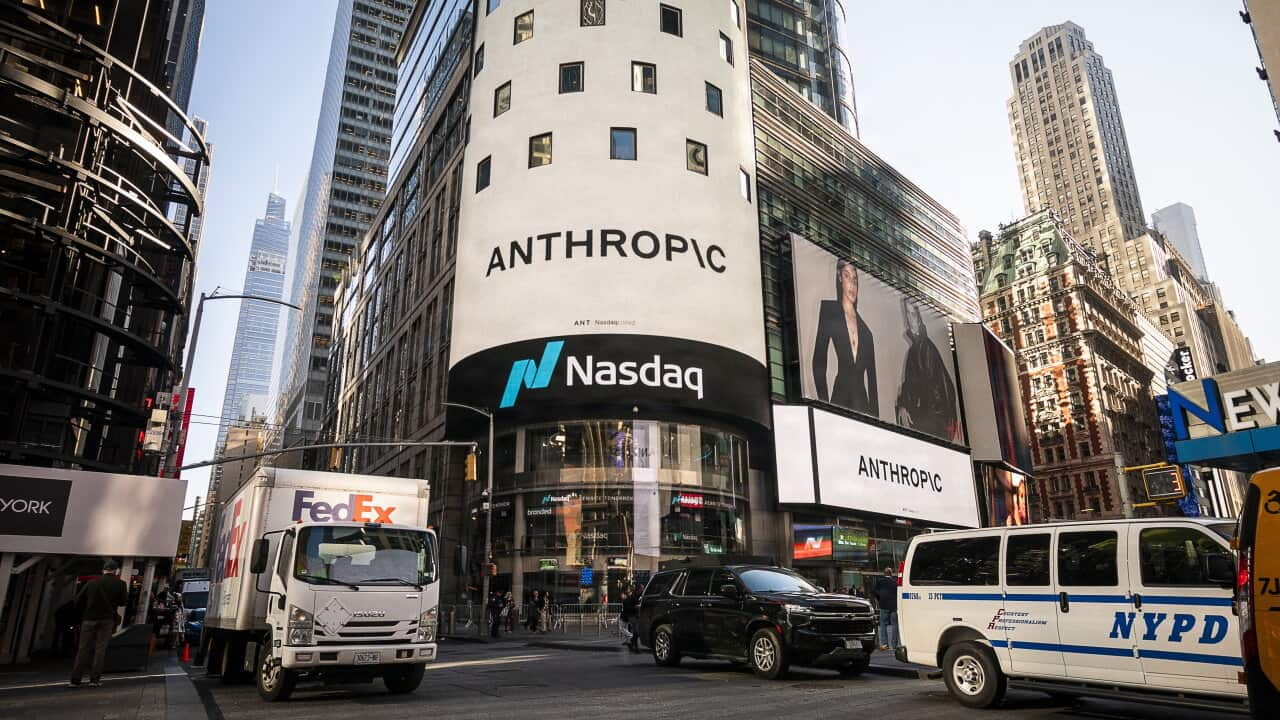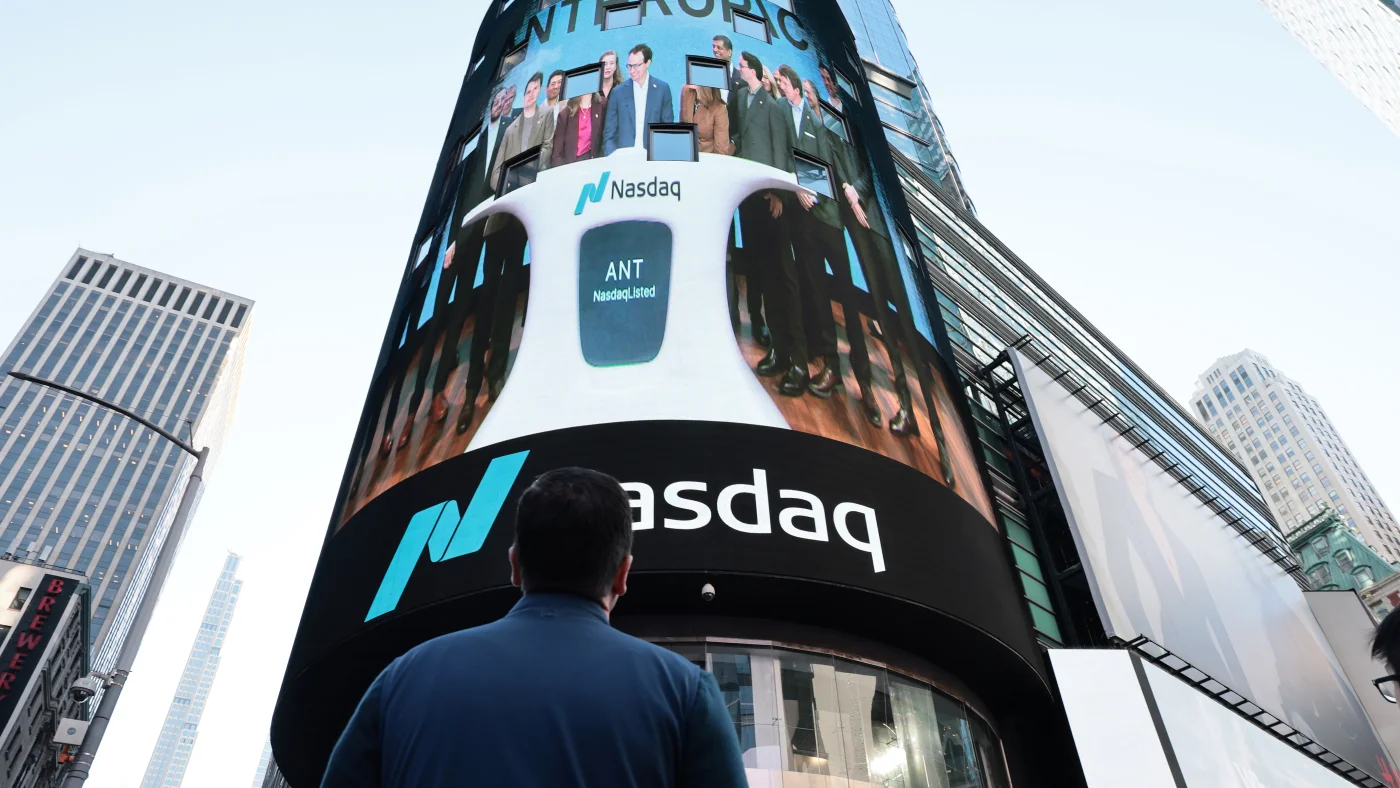
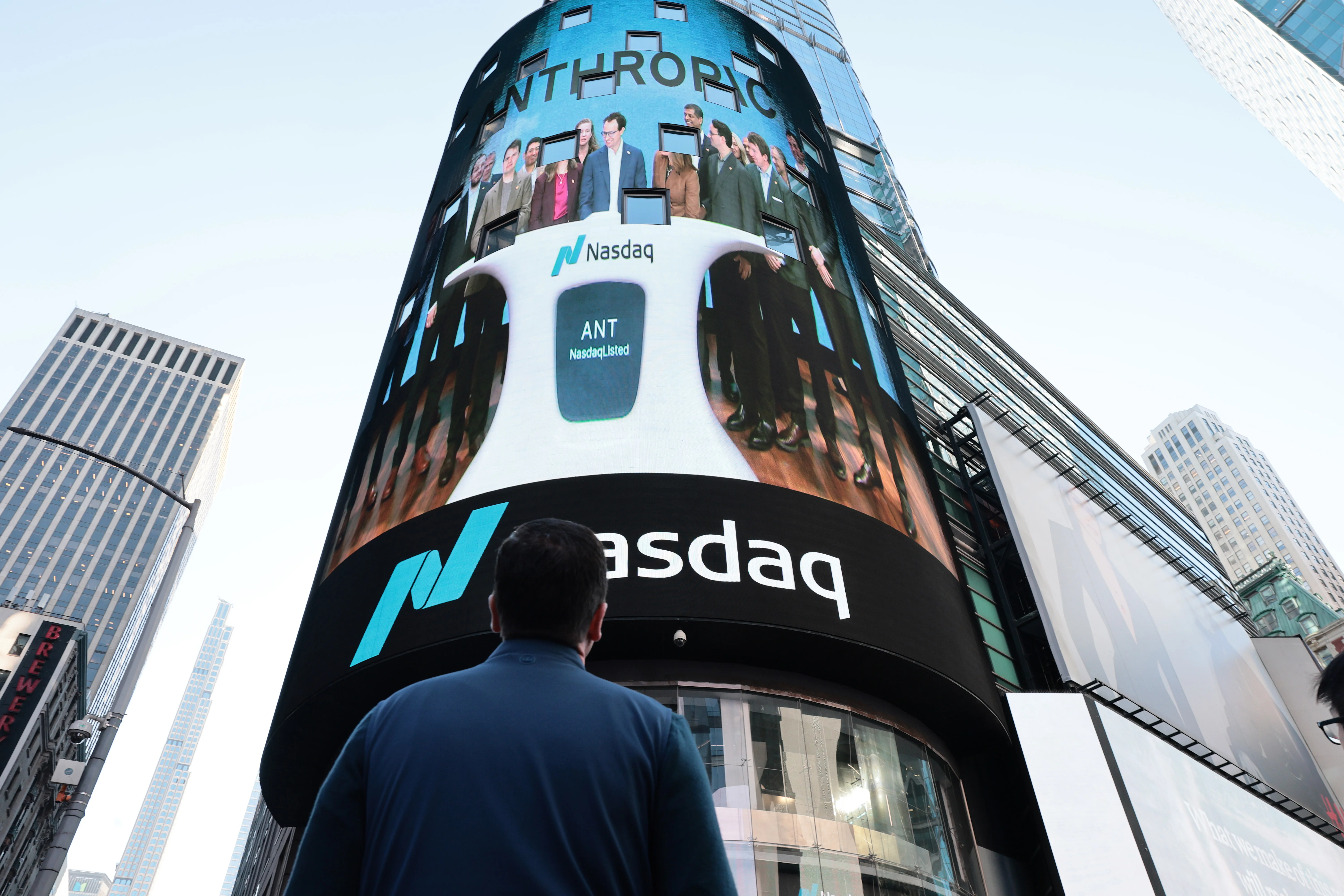

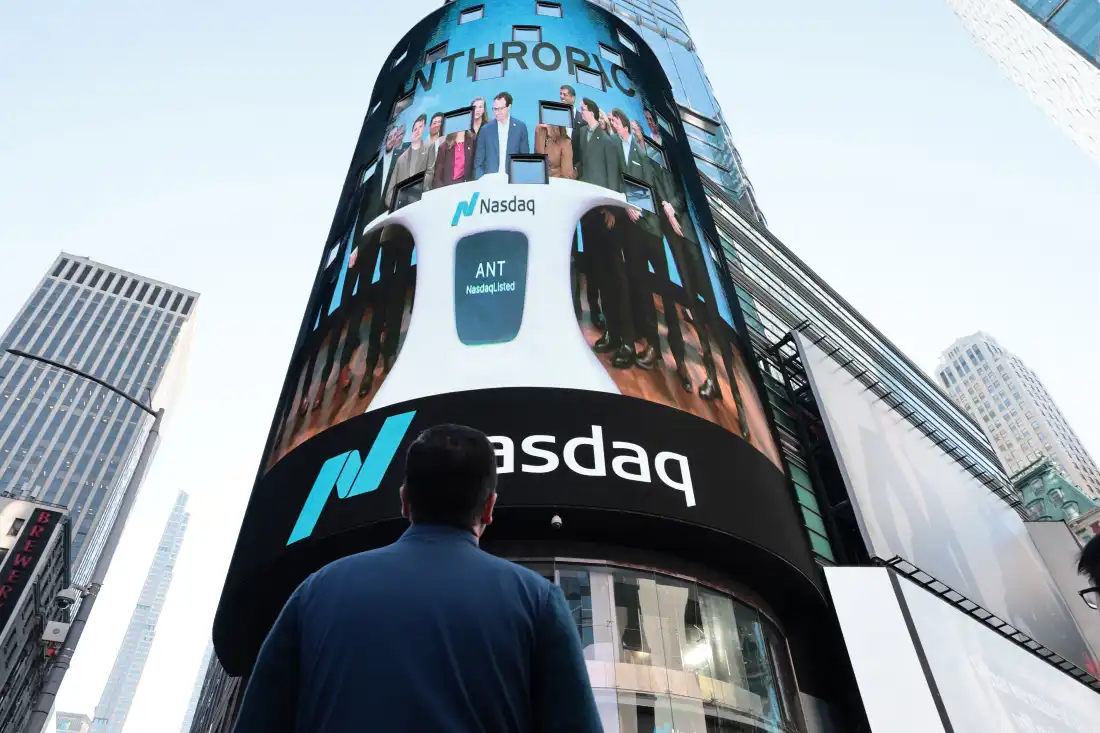

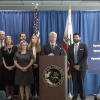



Dario Amodei, CEO of Anthropic, is seen on video outside the Nasdaq MarketSite in Times Square as shares begin trading after the company's IPO on Nov. 19, 2026. Critics say now that the AI giant is a public company, its commitment to put safety first will be tested. Michael M. Santiago/Getty Images hide caption
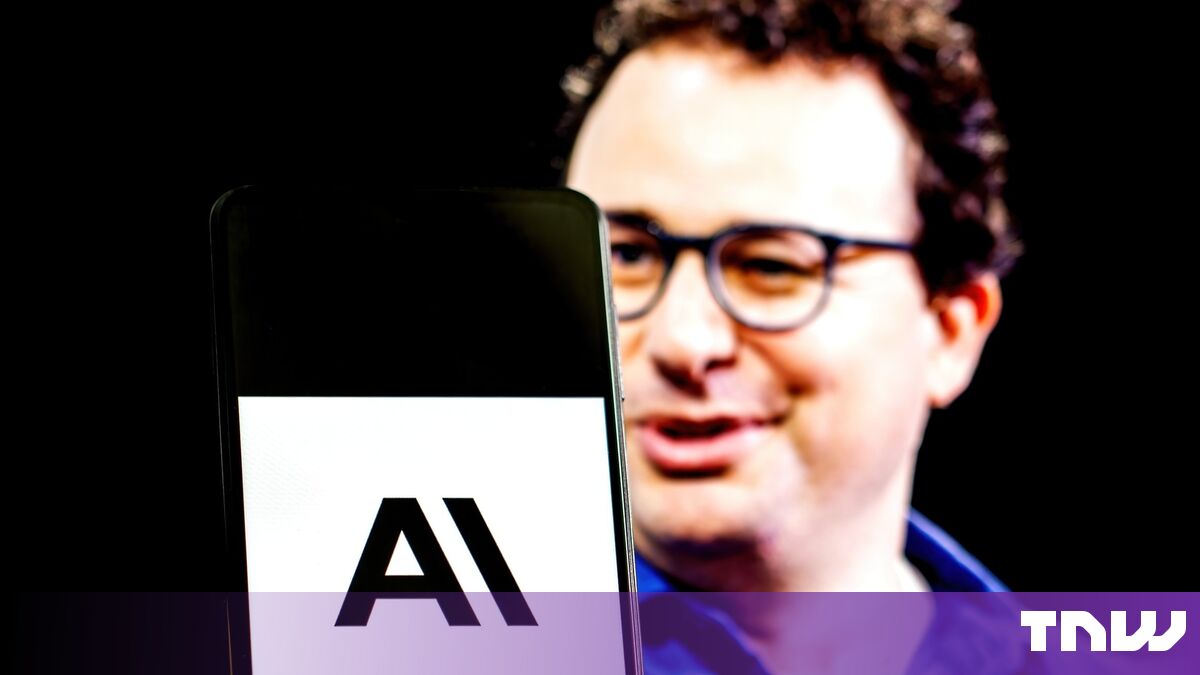
As Anthropic executives and co-founders gathered to celebrate the artificial intelligence company's market debut at the Nasdaq stock exchange on Thursday, CEO Dario Amodei spoke about AI's potential benefits, and risks, to humanity.
"There is a gigantic difference between how AI will go if we pay little attention to safety versus how it will go if we are obsessed with safety," Amodei said before ringing the ceremonial opening bell. "And an obsession with safety and public benefit has been built into Anthropic's DNA from the start."
Anthropic raised a record $81.3 billion from the IPO and a further $26 billion through a separate private placement, surpassing SpaceX and vaulting into the ranks of publicly traded companies worth more than $1 trillion.
The company has built its reputation on the promise that developing safe AI matters more than winning the race for commercial dominance. It has cultivated an image as an AI safety pioneer, presenting itself as a company willing to put humanity's long-term interests ahead of industry competition.
But now that Anthropic is a public company, that commitment faces a new test. The IPO has brought in new investors, greater scrutiny and pressure to deliver returns to shareholders. Some critics question whether the company can stay true to its founding mission.
The commercial demands of being a public company may cloud safety decisions that could negatively impact the company's share price, such as delaying the release of potentially risky models, legal experts told NPR.
Anthropic's concerns about AI safety are not merely part of its public messaging. Amodei has repeatedly warned about the potential threats advanced AI models pose to humanity, particularly if they escape the control of their developers. The company's IPO prospectus echoed those concerns, warning that "sufficiently advanced AI systems could pose catastrophic or existential risks to society if not developed and deployed responsibly."
Anthropic also acknowledged that it may ultimately lose control of its own models.
"There can be no assurance, however, that the safeguards or access regimes we adopt will prove adequate, that we will correctly identify which capabilities require restriction, or that constraints we impose will not be circumvented," the company warned investors.
Anthropic's corporate structure is intended to protect its mission, even as it pursues commercial success. Anthropic is a public benefit corporation (PBC), meaning its board must balance shareholder interests with its social mission.
As part of that structure, the company has installed an oversight body known as the Long-Term Benefit Trust, which has the power to appoint four of the company's seven directors. The founders effectively control the appointment of the remaining three.
The trust can, however, be dissolved. Doing so would require the approval of all seven co-founders, as well as a majority vote among shareholders with voting rights.
That arrangement could create a potential route for founders and shareholders to override the trust's influence over company decisions, legal experts interviewed for this article said.
"If there is a fight about some important safety decision, such as 'Are we satisfied that this super-advanced model is safe for users and society, or should we hold off for a couple of months to do extra tests or for whatever other safety reason?,' there's the possibility for the founders and the employees to basically ally against the trustee and neutralize their control rights," said Roberto Tallarita, an assistant professor at Harvard Law School.
The listing has also made many Anthropic employees wealthy. Each of the company's seven co-founders hold a stake in the company currently worth more than $20 billion. Its 5,300 employees hold an estimated $232 billion in combined equity. Non-founder employees were able to sell up to 10% of their holdings on the first trading day.
Those substantial financial stakes could influence how Anthropic's staff approaches decisions around safety and risk, said Tallarita.
"If they make decisions that are driven by safety considerations, but are bad for the bottom line, the stock price will react, and private investors will have reasons to exert some pressure on the company," he said.
The financial rewards could also change Anthropic's internal culture, said Sarah Kreps, a professor and director of the Tech Policy Institute at Cornell University.
"And now so many of these people will be multimillionaires too, which I think will just raise the temperature and egos and sense of stakes," Kreps said.
In his comments on Thursday, Amodei addressed these concerns.
"To state it unequivocally, we will pace the training and deployment of AI systems, taking as long as is necessary to have confidence that they are safe and will remain under human control. We will not bend to either business nor political pressure," he said. "Today puts the company in a stronger financial position and in doing so only strengthens our resolve to do the right thing."
Competition between AI companies is fierce.
OpenAI CEO Sam Altman described the rivalry between major AI developers as a "race dynamic in the fog of war" while speaking at The New York Times DealBook Summit this week.
That dynamic is "a bad thing," Altman said. "I think this is a time where more caution, not less caution, is warranted."
OpenAI also plans to go public, and filed preliminary IPO paperwork with the Securities and Exchange Commission in June, shortly after Anthropic. But Altman said in September the company has delayed those plans.
In an essay the same month, Amodei discussed the need for AI companies to carefully "pace" the development of frontier models .
"Not building the technology deprives humanity of benefits or simply places AI in the hands of authoritarian powers, while building it too fast is reckless," Amodei wrote. "We have sought a middle way: to show that it's possible to build carefully and succeed commercially, and to make safety something on which AI companies compete."
"Anthropic has done a fairly good job of investing in analysis of what its models can and can't do, and the vulnerabilities that it creates, and publishing at least some version of this analysis," Kreps said.
In April, Anthropic announced that it would restrict access to its Claude Mythos model after internal testing revealed its powerful cybersecurity capabilities . The company said Mythos could identify and exploit previously unknown vulnerabilities in major operating systems and web browsers, making it a potential tool for hackers.
On June 9, less than three months later, Anthropic introduced Fable 5, a Mythos-class model, for general use with additional safeguards to restrict certain high-risk cyber, biological and chemical capabilities. The original Mythos model remains restricted to selected partners.
"In the past, the fact that the trust and the founders were aligned helped them delay the release of Mythos for several months," said Stavros Gadinis, faculty director of the Berkeley Center for Law and Business at the University of California Berkeley's law school. "But this was at a moment when they felt they were leading the pack."
Anthropic's decision to enter the defense contracting space has raised questions about how its commercial relationships align with its stated mission, said Kreps.
In November 2024, Anthropic announced a partnership with defense contractor Palantir, whose software is used in military intelligence and targeting operations. Under the agreement, Anthropic made its Claude models available to U.S. defense and intelligence agencies through Palantir's Artificial Intelligence Platform.
However, Anthropic earlier this year resisted allowing the Pentagon to use its technology for autonomous weapons and mass domestic surveillance. Negotiations broke down in February, resulting in the U.S. government designating Anthropic a "supply chain risk to national security."
"It does seem to raise a set of concerns about partnering with Palantir, which is contracting with the Pentagon for targeting. What part of that is AI for humanity?" said Kreps. "A lot of people who work there went there because safety was the guiding light."
Questions over Anthropic's promise to prioritize safety over commercial success are becoming more pressing as the technology itself advances. Anthropic is entering the public markets at a moment when its own research suggests the pace of AI development could be accelerating dramatically.
A November 2026 assessment by AI research nonprofit METR concluded that Anthropic's AI capabilities were improving at about twice the previous rate. Researchers estimate that a majority of this acceleration is now driven by Anthropic's use of AI tools to assist its own researchers. METR found no clear bottlenecks that might slow this progress, such as limits on data and computing power.
This could bring the company closer to a future in which increasingly capable AI systems help build even more advanced systems — a process known as autonomous recursive self-improvement. The prospect has fueled fears that Anthropic and other AI developers could lose control of their most advanced models , with potentially significant consequences for society.
"I'm scared myself, but it's very hard to imagine AI technology stopping or pausing," said Gadinis. "We are in a situation where these companies know better than anyone their models to the extent that someone understands them. So we have to work with them as a society."
Society is left relying heavily on AI company executives to make consequential decisions about the risks posed by their own products, experts interviewed for this story said.
Since there are few government safeguards in place to shape how AI companies make decisions about safety and security, the industry's power is going largely unchecked, they said.
At the federal level, the AI sector remains largely unregulated. Under the second Trump administration, the White House has prioritized a deregulatory approach, seeking to limit federal oversight in favor of allowing AI labs to innovate without being encumbered by red tape.
In June, the White House announced its AI framework , which lets developers submit their newest models to federal agencies for cybersecurity and national security evaluations before release. However, the initiative is entirely voluntary.
"I don't think the government knows enough to regulate AI," said Tallarita. "This is a conversation that we should have as a political community, and probably the most serious conversation we should have right now."
Anthropic is a financial supporter of NPR.
NPR does not offer or accept money for coverage or interviews. Anyone who makes such an offer or request is not an NPR employee and does not represent NPR.