

Abdul Karim al-Sahhar knew winter was coming to Gaza in the small hours of a wet and windy night earlier this month when a sandbank collapsed just yards from his makeshift tent , killing four people.
“It was a terrifying scene. I could not process what I was seeing,” the 30-year-old said. “My legs felt frozen from the shock. I found my mother buried under the sand.
“We got [my mother] out but we saw [other] people buried beneath the sand and rocks. None of them was moving or making a sound. The next door tent had disappeared completely. There was no trace of it left.”
Al-Sahhar is originally from Beit Hanoun in northern Gaza, which was almost entirely destroyed in the early weeks of the two-year war in the territory. Its ruins now lie on the side of the “yellow line” dividing Gaza that is controlled by Israel .
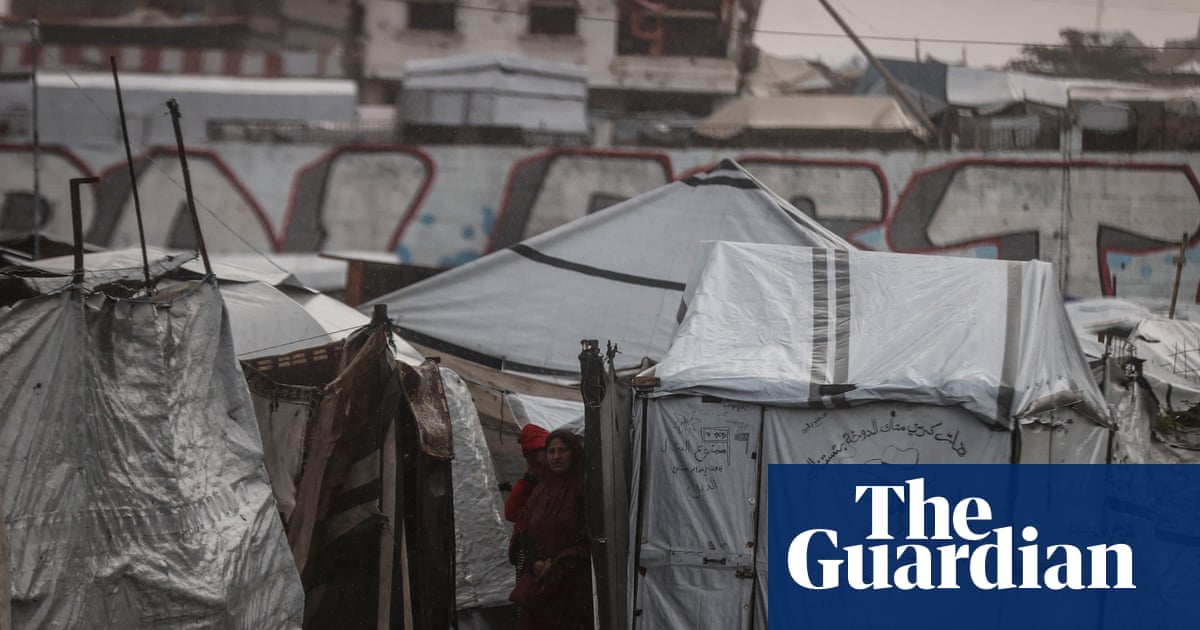
The collapse of the sandbank in the southern coastal zone of al-Mawasi was triggered by heavy rain. As the weather gets worse in the coming weeks and months, experts say there will be more such tragedies.
“This happens every winter, every winter is very harsh, you have an ongoing natural disaster,” said Wadhah Hubaishi, a regional director of the World Central Kitchen.
Aid officials in Gaza said the poorest, disabled people, elderly and sick people would suffer most, though few will escape the coming months unscathed.
Al-Sahhar, a former municipal rubbish worker, has no job, no income and no savings. He was badly injured during the war, which left Gaza in ruins, with more than 80% of buildings damaged and basic infrastructure such as roads and sanitation systems shattered.
“My family and I are living in great fear,” said al-Sahhar. “But honestly, I cannot find anywhere else to go. There are no available places for us, and even the places that can be rented have become extremely expensive. Where am I supposed to get the money to pay the rent?”
Al-Mawasi is now crowded with tents housing some of the near 2 million people displaced in Gaza. There is very limited sanitation, water or other essentials. The recent rains affected more than 220,000 people and damaged more than 40,000 shelters, the UN said.
The US-backed Board of Peace, a body set up to implement the October 2025 ceasefire deal, last week accused Israel and Hamas of failing to honour their commitments to end hostilities, warning that “a ceasefire that delivers nothing visible cannot be sustained indefinitely”.
While the ceasefire halted major fighting, the wider plan, which calls for Hamas to disarm, Israeli troops to withdraw and reconstruction to begin, has stalled. Gaza’s health ministry has said that more than 1,600 Palestinians have been killed by Israel since the 2025 ceasefire.
Hamas agreed in July to a roadmap to surrender its weapons and transfer governance of Gaza to a civilian transitional authority, but Israel said it would not withdraw its forces until Hamas has disarmed.
Israeli military forces control about 70% of Gaza, and this week Israel launched its highest-profile ground incursion across the yellow line since major fighting ended more than a year ago, forcing dozens of displaced Palestinians to flee their tents. The raid targeted a suspected Hamas tunnel, Israeli officials said.
Under the ceasefire deal, Israel agreed to allow 18,000 trucks into Gaza each month. But data obtained by the Israeli newspaper Haaretz shows the number has never exceeded 13,000 since March. In some months, fewer than 5,000 trucks entered Gaza. NGOs also say that vehicles entering Gaza with humanitarian aid are often carrying only a partial load.
“Israeli policies continue to obstruct the entry of critical items as well as access to most of Gaza’s land, including areas away from the shoreline that are less prone to flooding,” the UN said in a statement. “Incoming supplies face multiple approval requirements, limited crossing capacity and unpredictable or narrow delivery windows that delay their entry.”
Mubashisaid his organisation had broken up wooden food pallets to make wooden tent poles, used old food sacks for sandbags and supplied worn out metal pots to build flood defences.
Aid officials said that with spare parts repeatedly being blocked by Israeli authorities, efforts to maintain critical equipment after years of heavy use were reaching their limit.
Last week, Australia, Canada, the UK and Italy urged Israel to allow 150,000 tents and other vital supplies being held at the border into Gaza before winter.
Israeli officials say that more than 93,000 tents and more than 8,600 trucks carrying winter supplies and other essential equipment, such as laboratory supplies, engine oil and incubator parts, have entered Gaza.
Most of the supplies entering the territory are brought in by a very small number of commercial operators and sold on the open market. Fresh meat and vegetables, as well as a wide range of non-essential food products such as chocolate and snacks, are available but unaffordable for the vast majority of Palestinians in Gaza.
The UN estimates that up to two-thirds of the population in Gaza are experiencing severe food shortages through the end of 2026, only a slight reduction from the 77% at the end of 2025.
Mohammad Shafoot, the owner of Shafoot Restaurant, one of Gaza’s oldest, said he had done brisk business in the immediate aftermath of the ceasefire but that patrons were now limited to employees of international and local organisations, traders and their families.
“The problem today is not simply whether goods are available, but that many people do not have enough money to buy what they need or eat at restaurants,” Shafoot said.
Emad al-Ghoul, the secretary general of the North Gaza Chamber of Commerce, said there had been no real improvement in the commercial or economic situation since the ceasefire.
“The industrial sector has almost completely come to a standstill, with an estimated 95% of local industry no longer operating,” al-Ghoul said. “Trade in general has become concentrated in the hands of a small number of merchants. This has led to a lack of competition in the market and rising prices, with ordinary citizens ultimately bearing the consequences.”
Only 3% of Gaza’s farming land remains accessible and undamaged, according to an August geospatial assessment by the UN . The rest is in the Israeli-occupied zone.
Israeli airstrikes have intensified in recent weeks, and there are frequent clashes between Hamas forces and Israeli-backed militia operating from bases over the yellow line.
“We are tired from all this suffering. We need someone to find a solution for us ... Those who live in tents, they drown. Those who are on the streets, they get wounded. Those who are here, they get wounded,” Abd Aliwa, 44, said as he sat beside a pile of rubble in the Nuseirat refugee camp, the target of Israel’s incursion last week.
The death toll in Gaza since October 2023, when Hamas launched a surprise attack into Israel and killed 1,200, mostly civilians, has now reached 74,000, mostly civilians. In June, an independent UN inquiry determined that Israel was continuing to commit genocide by deliberately targeting Palestinian children.
Mohammad Abu Daqqa, originally from the city of Khan Younis, now lives with his wife and seven children in a tattered tent in al-Qarara on the coast. The 39-year-old former agricultural worker has earned nothing since the beginning of the war. His father, brother and two nephews were killed in the war, and his daughter injured by shrapnel in her leg.
“Winter has become a recurring struggle for us,” Abu Daqqa said. “This is the third winter I have spent with my family in the same place … and each year we face the same conditions: cold, rain and strong winds. The tent is now worn out and cannot withstand the weather. My children have to hold on to the edges of the tent to stop it from blowing away or tearing apart.”
The family have dug a shallow trench to protect their home, but know it offers very limited protection against surging seawater. Communal kitchens provide some food, and hot meals come from World Central Kitchen. Abu Baqqa can afford no washing powder or soap, which his wife is forced to beg from other displaced families.
“All I wish for is an end to this suffering and the chance to live in a proper shelter that preserves my dignity and protects my family,” he said.