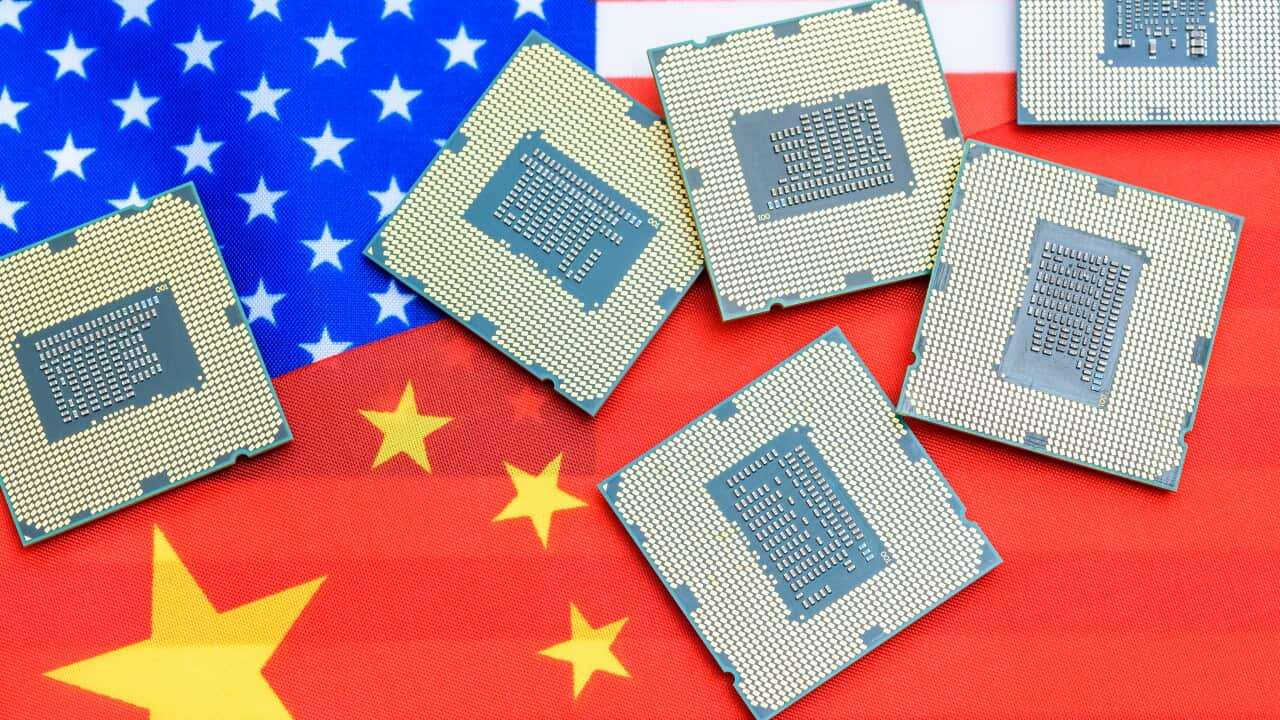
The United States approved shipments of nearly 900,000 advanced Nvidia and AMD chips to Chinese companies over six months, as the Trump administration reportedly considers requiring US firms to disclose their use of Chinese AI models.
The US House of Representatives' foreign affairs committee said on Friday that between December 2025 and May 2026, the US government approved 75,000 chips for Alibaba, 150,000 for Tencent, 43,000 for Baidu, and 4,000 for BYD.
All four companies are on the Pentagon's list of alleged Chinese military-backed companies. The chips sold included Nvidia's H200 and AMD's equivalent MI325X chips.
Companies had sought permission to ship over 3.4 million chips to China during the period, the committee's documents showed. It was not immediately clear how many of the approvals resulted in actual China-bound shipments of chips.
Former US president Joe Biden had restricted Chinese access to the chips over fears that they would supercharge China's military and erode the US lead in artificial intelligence.
Your trusted source for staying up-to-date with the world around you. Get free daily news updates and analysis, straight to your inbox.
Trump gave the green light in December for Nvidia to ship its H200 chip to approved companies in China, rolling back Biden-era restrictions and drawing fierce criticism from China hawks across the US political spectrum.
The US commerce department said its approach to H200 licensing "is based on a rule published in the Federal Register in January 2026, which imposes significant additional national security-related requirements on license applicants in order to qualify for case-by-case consideration rather than a presumption of denial".
Nvidia said in a statement that the approvals were "subject to strict conditions and limited volumes". The California-based company added that "despite receiving some licenses, we have since stopped shipping H200s to China".
Meanwhile, AMD said it "complies with applicable US export control laws and regulations and maintains rigorous processes to ensure compliance across our global operations".
Earlier this week, the US said it would further restrict China's access to high-end chips from US companies, citing national security concerns and saying it would close "dangerous export control loopholes China has been exploiting for years".
The new rule restricts shipments of advanced chips to Southeast Asian countries such as Malaysia, Singapore and Thailand, which Chinese companies have used to access computing power to train AI models.
The announcement came shortly after longtime Nvidia CEO Jensen Huang resigned from the company following reports he had an affair with a former executive at the Singapore-based cloud company Megaspeed, an Nvidia partner that rents computing power at its data centres. The company has come under scrutiny for possible illegal diversion of advanced AI chips to China.
US intelligence officials have alleged the woman was a Chinese spy , an accusation China has denied.
Before resigning as Nvidia CEO, Huang had lobbied the Trump administration to allow more of his company's chip sales to China, warning that the controls would otherwise boost the Chinese chip industry's competitiveness.
On Friday, California announced it was investigating whether Nvidia misled the public and investors about its chips ending up in China, despite federal export controls.
"The conduct of Nvidia and its former CEO raises bright red flags, including about the ways in which the company may have misled investors," US attorney-general Rob Bonta said in a statement.
At the same time, the US is considering requiring US companies to publicly disclose their use of Chinese AI models, a bid to discourage reliance on the technology without imposing new restrictions that could anger industry or China, according to Reuters.
The US treasury department and the White House Office of Science and Technology Policy (OSTP) have discussed the plan, which would apply to companies such as Airbnb.
The short-term rental platform uses Qwen, an AI model made by China's Alibaba, to power its AI customer service agent.
Under the plan, companies like Airbnb would be required to post that information on their websites.
It's unclear whether the idea is gaining traction within the administration or if it would be enshrined in a formal rulemaking process.
But its consideration underscores an emerging push by the US to combat the spread of powerful Chinese open-weight models. Open-weight models make their core components publicly available for anyone to download and adapt.
The proposal also shows officials are looking at ways to discourage use of Chinese AI through a "name and shame" campaign while sticking to a broader anti-regulation stance on AI.
Neither the White House, the US treasury department, nor Alibaba have commented on the proposal.
Airbnb said in a statement to Reuters that its AI activity "runs overwhelmingly on US-origin models" and the company uses "only a limited number of China-origin models, all of which are open-source and run only through approved US-based service providers, keeping data and operations separate and protected".
The Chinese embassy in Washington said China opposes politicising trade and tech issues, which will "only stifle global AI advances and serve no one's interests".
"We will resolutely safeguard Chinese businesses' lawful rights and interests," it said.
Chinese-made open-weight models are gaining ground with US companies because they are cheaper than proprietary AI tools from top US labs OpenAI and Anthropic.
But some within the US, including officials in Trump's administration, fear China is using such models — like Kimi, DeepSeek, or Qwen — to hook US companies into becoming dependent on Chinese AI.
US treasury secretary Scott Bessent said in July that the Trump administration could sanction Chinese AI companies if they were found to be guilty of intellectual property theft through distillation of US models.
Distillation is the process of training smaller AI models using the output of larger ones to lower the cost of training a powerful new AI tool.
Bessent's remarks echoed comments in April by OTSP director Michael Kratsios, who accused China of stealing US artificial intelligence labs' intellectual property on an "industrial scale", spurring a push by the US state department to highlight such behaviour to foreign counterparts.