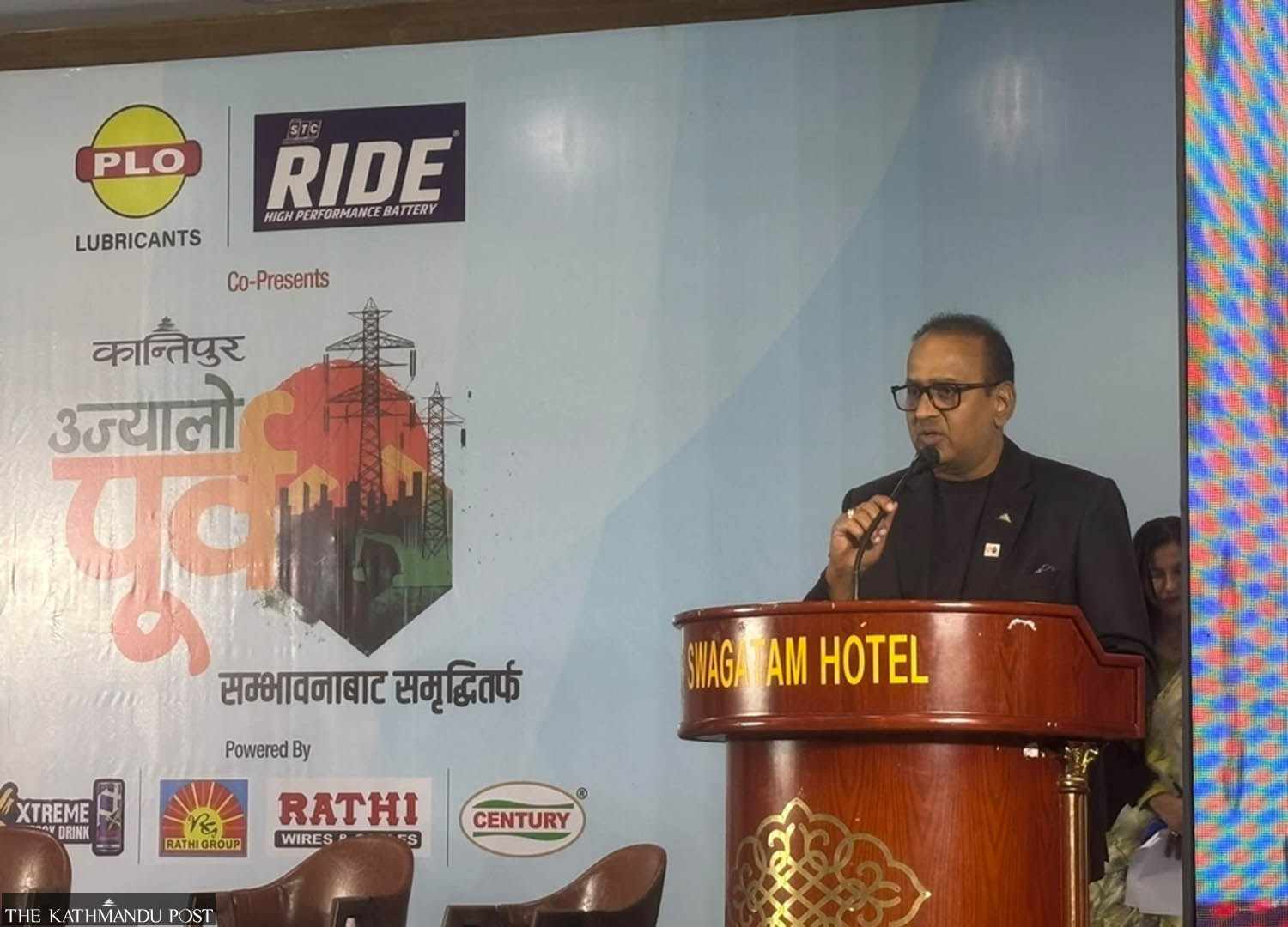
Former president of the Federation of Nepalese Chambers of Commerce and Industry Chandra Dhakal has called on the government to ensure that recently amended laws are effectively implemented at the local level, saying legal reforms alone will not be enough to encourage private investment, expand industries and create jobs.
“During my tenure as FNCCI president, we had submitted proposals for legal amendments aimed at boosting private sector confidence. After the new government took office, those proposals were incorporated into its 100-point governance reform agenda and approved by the Cabinet without changes,” Dhakal said.
Speaking at the first session, titled ‘How to restore business confidence’, of the ‘Ujyalo Purba: From Potential to Prosperity’ programme organised by Kantipur Media Group in Biratnagar on Friday, he said many of the amended laws had yet to be implemented.
“Several ministers have said the government is working to increase private investment, stimulate economic activity and create jobs. Some laws were also amended on the basis of recommendations made by the high-level reform commission during Rameshwore Khanal’s tenure as finance minister,” he said. “But we need to examine whether the investment-friendly laws introduced for the general public and the business community are actually being implemented at the local level.”
The expansion of industrial capacity, increased investment and establishment of new industries, he said, would depend largely on effective implementation.
Bholeshwor Dulal, senior vice-president of the Chamber of Industries, Morang, said the government should guarantee policy stability for at least 10 years to encourage industrial investment. Policy uncertainty, local taxes and administrative hurdles have discouraged entrepreneurs and made them reluctant to invest in new industries, he said.
Speaking at the same session, Dulal said entrepreneurs faced numerous obstacles between deciding to establish an industry and starting production. Opposition from local communities, tax-related problems and difficulties in dealing with government employees were among the challenges.
“We can identify many investment opportunities, but when it comes to turning them into actual investments, the number falls from 90 percent to 10 percent. By the time it comes to establishing an industry, only 2 percent remain, and just 1 percent reach the production stage,” he said. “Very few industries make it to production and contribute to prosperity. That is why setting up industries and competing in Nepal is so difficult.”
Dulal also said the current environment was not conducive to industrial investment.
He accused local governments of collecting money from entrepreneurs rather than addressing their concerns. Rural municipalities and municipalities were independently setting membership fees of Rs1 million to Rs2 million and collecting money from businesses, he said.
“Instead of providing relief to industries, they are collecting money. We have asked thousands of times for a three-kilometre road to be built, but it still has not happened. The problems faced by entrepreneurs remain unresolved,” Dulal said.
Businessman Anil Kumar Shah said the government, farmers and the private sector all shared responsibility for declining agricultural production and the country's growing dependence on food imports.
Speaking at a session titled ‘Taking Koshi's produce to the global market’, Shah said Nepal had once exported paddy and rice but now relied on imports even for basic food items such as lentils, rice and wheat.
Recalling his family's traditional involvement in agricultural trade, he said Nepal had previously exported paddy and rice to Bangladesh and India. The country had since become increasingly dependent on imports because domestic production was no longer sufficient to meet demand.
Shah said the trend towards foreign employment and consumption had grown following the restoration of democracy in 1990. As more people began earning abroad and using their income to buy food and other goods, fewer were willing to engage in agricultural production.
“Finding people willing to work on the land has become difficult. Even in the southern parts of Morang, Jhapa and Sunsari districts, we have to bring farm workers from India,” he said.
Shah said farmers, businesses and the government all needed to take responsibility for the problems facing agriculture. Farmers continued to struggle to obtain fertiliser and seeds on time, while inadequate irrigation remained a longstanding problem.
He described it as a paradox that Nepal had failed to expand irrigation despite having access to a major water source such as the Koshi River.
“We have such a huge river, yet we have not been able to build canals and provide adequate irrigation. Our water flows into India and is used for irrigation there, while we cannot even ensure that our own farmers receive seeds and fertiliser on time,” he said.
Shah said the government needed to introduce effective policies to encourage farming, ensure timely supplies of agricultural inputs and expand reliable irrigation facilities. He called for greater cooperation between the government, private sector and farmers to increase production and establish Koshi's agricultural products in domestic and international markets.
Mahesh Kumar Jaju, managing director of Asian Thai Foods Pvt Ltd, said Nepal needed to improve the international visibility and market access of its products to increase exports. The government should invest in market promotion, packaging and branding, he said.
Speaking at the second session on taking Koshi’s products to the global market, Jaju said the private sector had largely been promoting Nepali products abroad through its own efforts, without significant government support.
He said Asian Thai Foods exported its products to 29 to 30 countries, adding that the company had achieved this through its own resources and capabilities, without government subsidies or special assistance.
“Koshi accounts for 20 percent of Nepal's total production and 37 percent of its exports,” he said. “But industries are not operating at full capacity. Only around 44 percent of industries are in operation.”
Tea, chhurpi (dried cheese), ginger and large cardamom are among the products exported from the province, he said. Koshi exports tea worth around Rs4 billion and chhurpi worth Rs5 billion annually, according to Jaju. These exports, too, have largely been driven by private sector initiatives rather than government incentives or subsidies.
Although Nepali products have considerable potential in international markets, inadequate packaging, branding and promotion have prevented them from achieving their full market value, he said. Exporting products mainly in raw or minimally processed forms has also limited their competitiveness.
“The government needs to invest in market promotion and help take Nepali products to international trade fairs and exhibitions,” he said. “Exports can grow only when our products gain exposure in global markets.”
Noting that consumers in several countries were interested in buying Nepali products, Jaju said the government and private sector needed to work together to maintain quality, improve packaging and establish internationally recognised brands.
Prakash Mundada, senior vice-president of the Confederation of Nepalese Industries' Koshi Province chapter, said verbal assurances about creating an investment-friendly environment would not improve the business climate unless they were backed by clear written policies and effective implementation.
Speaking at the first session, Mundada said entrepreneurs were spending too much time dealing with administrative and management-related issues instead of running their businesses.
“We are spending 80 percent of our time on matters other than business and only 20 percent on the business itself. It should be the other way around,” he said.
Despite years of discussions about improving the business environment, little progress had been made, he said.
“For the past 20 to 25 years, it feels as though we have been failing the same class. We have been talking about improving the business environment for all these years,” he said.
Comparing a business to a vehicle, Mundada said all its wheels needed to function properly. Capital, infrastructure, confidence and policy were the four essential foundations of a business, and a weakness in any one of them could undermine its sustainability.
“Verbal assurances from the government alone cannot create a favourable business environment. Everything depends on the kind of written policies it introduces,” he said.
He also pointed to a disconnect between government announcements in the annual budget and the actual policy measures introduced. While the government made commitments, the resulting policies often failed to deliver the expected benefits to businesses, he said.
Entrepreneurs faced uncertainty when considering business expansion, with changing market conditions, the informal economy, interest rates and government policies all affecting their decisions. Such uncertainty was also taking a toll on business confidence, he said.
Mundada said attacks on businesspeople's property last year had further weakened private sector confidence. Even in such circumstances, he argued, the government could improve the business environment by addressing a few fundamental concerns.
He reiterated the private sector's demand for land to develop an industrial zone. According to Mundada, business organisations had long been asking the government to develop around 650 bighas of land as an economic zone, but the proposal had yet to materialise.
He said his criticism was not intended to dismiss the current government, which had only recently taken office, but to point out that promised reforms were not progressing as expected. Mundada is also a former president of the Morang Industry and Trade Association.
Koshi Province Minister for Economic Affairs and Planning Bidur Kumar Lingthep said an investment-friendly environment would remain elusive unless the state and society changed their attitudes towards the private sector.
The private sector should be recognised as the backbone of the economy, a major source of employment and a partner in development, he said.
Speaking at the first session, Lingthep said fears among businesspeople following recent political upheavals had yet to subside.
He said political developments since the 1990 democratic movement had repeatedly affected business confidence. The 2006 People's Movement had initially created uncertainty in various sectors, including business, but was followed by a period of optimism and economic progress. The Gen Z movement, however, had once again heightened anxiety among entrepreneurs.
“Even after elections and the formation of a new government, the fear has not gone away. Both businesspeople and civil servants worry about when they might be arrested or when their homes might be searched,” he said.
Lingthep said negative social perceptions of the private sector were another obstacle to investment. Entrepreneurs were often portrayed as exploitative, dishonest or tax evaders, a mindset that undermined confidence and discouraged investment.
“We have failed to establish the understanding that the private sector is a partner of the government, the backbone of the economy, a major source of employment and an indispensable part of society,” he said.
He said the government needed to guarantee the security of private property and provide businesses with a reliable environment in which to operate. Policy-related obstacles should be removed and entrepreneurs encouraged, he added.
The provincial government would focus on resolving problems faced by small and medium-sized businesses, while major concerns involving large businesses should be addressed by the federal government, he said.
Lingthep said the Koshi government had prioritised facilitating investment following its investment summit. It was committed to promptly addressing matters within its jurisdiction and explaining the reasons for rejecting applications that could not be processed because of legal or procedural constraints.
“Applications that meet the required legal and procedural provisions will not be held up,” he said.
He stressed that restoring investor confidence required the government to change its attitude towards the private sector and end the climate of fear surrounding business.