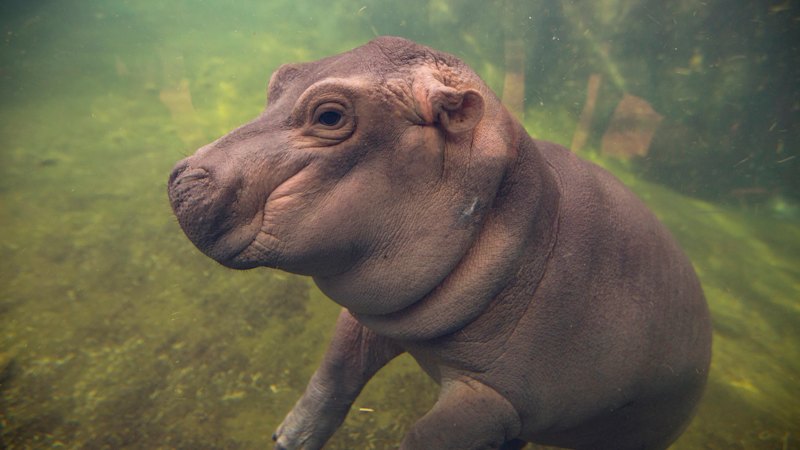
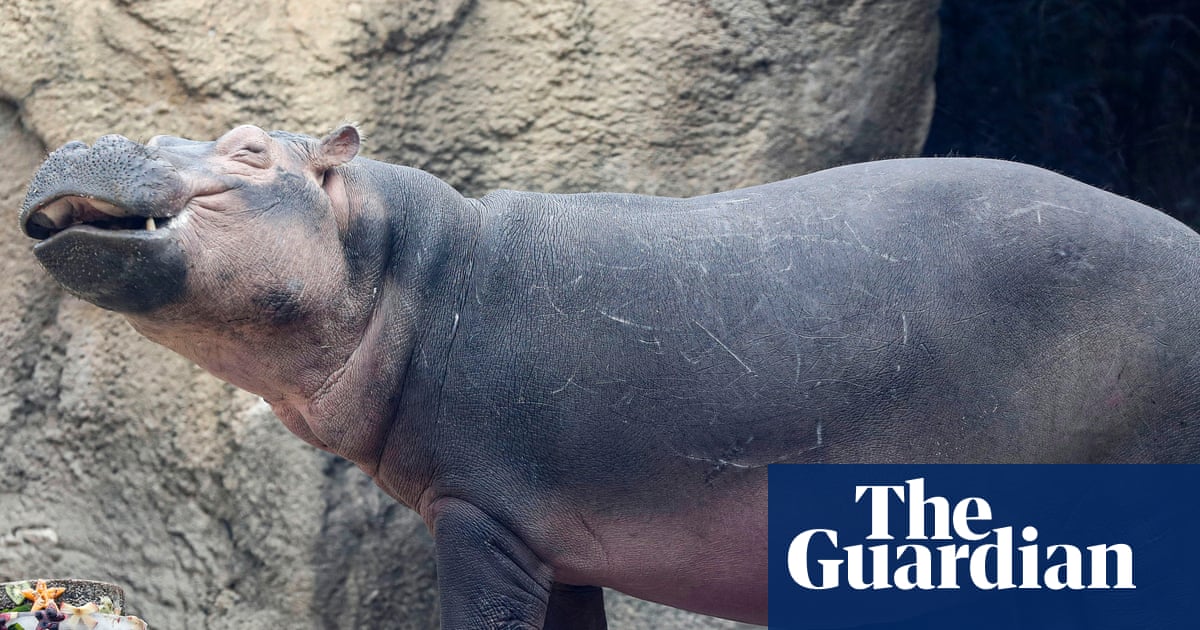
Fiona, the Cincinnati Zoo’s famous hippo who charmed observers around the world, tragically died on Thursday due to medical complications after ingesting a knit hat that mistakenly entered her enclosure last week, according to zoo officials. Fiona was just nine years old when she died.
According to zoo officials, the hat that caused her death entered her enclosure after a child tossed it into the air. The hat reportedly collided with a ceiling fan, which then launched the hat through a “one-foot gap above the 12-foot-tall viewing window." A few days after eating the hat, her condition began to deteriorate.
For nonexperts, Fiona’s tragic death raises several questions: Why and how would a knit hat kill a hippo that weighs more than 2,500 pounds? Why wasn’t surgery possible for Fiona? And for zookeepers, what was the range of treatment scenarios available?
Jan Hawkins, the head of the the clinical science department at North Carolina State University's College of Veterinary Medicine, tells WIRED that—with the caveat that we won’t officially know until doctors conduct a post-mortem analysis—Fiona’s death was likely due to one of a few downstream effects of the hat getting caught somewhere in her intestinal tract.
In a sense, an intestinal blockage in a hippo is like a car crash on an incredibly long one-lane highway. Hawkins said that, estimating, a hippo’s intestinal tract is likely over 100 feet long, with more than 70 feet in the small intestines alone. In humans, the lengths of the small and large intestines are a comparably diminutive 25 feet.
Hawkins says that in a healthy hippo, liquids can take as little as 12 hours to pass, and food takes two to three days. According to zoo officials, Fiona ate the hat on or about Sunday. Zoo officials claimed that Fiona was asymptomatic at first, but began to lose her appetite after a few days. If the hat was going to come out, Hawkins says it likely would have happened within five days. So what happened?
One possibility, Hawkins says, is that when the hat got stuck, it caused a huge amount of swelling and pressure in her abdomen. That swelling could have led to her blood circulation being cut off, and eventually, to tissue death. After becoming green or black, Hawkins says that dead tissue is more likely to leak, and perhaps rupture, releasing the contents of the digestive tract into her blood. This can easily cause toxic shock.
In Fiona’s situation, this would mean that bacteria in her digestive tract died and released toxic molecules. Hawkins says that if these toxins enter the bloodstream, it would cause the organs to become more and more inflamed. Ultimately, this can lead to organ failure and death.
Another possibility is that, after the hat got stuck, Fiona’s intestines began to “twist on itself,” Hawkins says. This would be more likely if the hat, say, got pieces of food stuck inside of it, gradually becoming larger and heavier. Intestines are supposed to contract and move as they digest food. This means that if a heavy object gets stuck, the intestine can start to twist around it. In severe cases, this can cut off blood circulation. Eventually, this too can lead to tissue death. This initiates the chain of intestines leaking or rupturing, toxins entering the bloodstream, and organs becoming inflamed and eventually failing.
We don’t know exactly where the hat was in Fiona’s digestive tract. However, in a video the Cincinnati Zoo published to X on Tuesday, an unnamed staffer claimed that an ultrasound showed “some bunching of intestines.” They believed this meant that Fiona was “passing some things through her small intestine.”
If the hat was in Fiona’s small intestine, this would have meant that it passed through all three of her stomachs. (Hippos have three stomachs.) This could provide some hints about the type of hat that Fiona ate.
Hawkins says that in hippos, all three of their stomachs have the same basic components, but in different amounts. The first stomach has the largest amount of bacteria and protozoa, which help break down big pieces of food in the earliest part of digestion. The third has the highest amounts of enzymes and hydrochloric acid, which reduce food scraps into their smallest-possible size before entering the small intestine.
“Let's say it was a cotton hat or some sort of organic material, it's possible that that could partially break down,” Hawkins tells WIRED. “Whereas if it had something that would not degrade—so a plastic, or polyester, or something like that—then obviously its character is not gonna break down at all.”
The effects of this, Hawkins says, would be even more severe if the hat was rigid, or not collapsible in any way. “If it wouldn't get scrunched down, like a hair scrunchie, then you could understand why it would get stuck,” Hawkins says. “Because it can't change its character as much.”
All of this, Hawkins says, may have affected whether Fiona was able to pass the hat.
According to the Cincinnati Zoo’s Tuesday video , conducting surgery to remove the hat would not be possible for Fiona. The zoo claimed that a combination of specialists—including “veterinarian human specialists,” zoo employees, and “other experts”—came to the conclusion that surgery wasn’t the best option, and that the “best chance for success with Fiona would be if she can pass this on her own.”
Rebecca Lewison—San Diego State University biology professor, and co-chair of the Hippo Specialist Group of the International Union for Conservation of Nature—tells WIRED that when it comes to hippo surgery, a major challenge is their “unpredictable and irregular responses to sedation and anesthesia.”
“It is very risky for [hippos], and they can die from the standard medication used on other large animals, like elephants and rhinos, for reasons we don't well understand,” Lewison tells WIRED.
There are also some inherent challenges to administering anaesthesia on an animal as large as Fiona. When a human or animal goes under anesthesia, they need to be put on a ventilator that artificially breathes for them. An animal that weighs more than 2,500 pounds, Hawkins says, requires a ventilator of a much different scale than what humans need for general surgery.
Fiona was placed under anaesthesia to conduct bloodwork, according to the Cincinnati Zoo’s Tuesday video . But Hawkins says that the amount of anesthesia required for bloodwork is much smaller than what would be required for a major surgery, like removing a foreign object from her intestines. For Fiona, the increased amount of anaesthesia alone increases the risk of the surgery.
Another fact to consider, Hawkins says, is the position the zoo would feasibly be able to place her in while conducting surgery. If a human is in surgery, they may be placed on their back, their stomach, on their side, or in a variety of other positions. With animals like hippos, Hawkins says, this gets more complicated.
“You would have to have a hoist, a forklift or something, to pick them up to put them on either a pad or on a table,” Hawkins says. And if a zoo doesn’t have a table that’s big enough, the animal may have to go on the floor.
But Hawkins says that even at perfectly resourced zoos, there are other risks for hippos. In order to perform a major surgery, an animal as large as Fiona would have to have a huge amount of anaesthesia, putting her unconscious, and in the same position, for a long period of time. She would have her entire body weight putting pressure on the parts of her body that can’t move. This would limit her body’s ability to circulate oxygen—even with the help of a great ventilator.
If an animal is unhealthy, Hawkins says, the risks are even greater. In its Tuesday video , the Cincinnati Zoo said that when it recently ran some tests on Fiona, it found that she was dehydrated. This means that her body was already working extra hard to circulate blood not only to the blockage, but through the rest of her body.
Animal caretakers in this position, Hawkins says, face incredibly difficult choices.
With surgery ruled out, the Cincinnati Zoo claims to have used a variety of other methods to help Fiona. In the Tuesday video , the zoo claimed that her early bloodwork did not raise any red flags. Zookeepers then conducted an ultrasound, and administered rectal fluids, an enema, and medication, including some to help with vomiting and nausea. Later, the Tuesday video says, the zoo “borrowed a nine-foot scope from Columbus Zoo” with the goal of getting “far enough up to reach something.”
On Wednesday, Cincinnati Zoo said in a post that it had borrowed a "vibration plate” from a local horse farm with the hope that it would “encourage movement through her digestive tract and help the object pass.”
The zoo said that it also encouraged Fiona to eat, and offered her some of her favorite foods.
“Her care team even offered her a sniff of coffee, a scent she always has really liked, and they were happy to see her respond,” the zoo said Wednesday evening.
But in the end, it wasn’t enough, but not for lack of trying. Hawkins says it sounds like “they threw everything at her but the kitchen sink.”
Hawkins adds, “I think they did not want to leave a stone unturned.”
In your inbox: Go inside the world of digital security with Kernel Panic
The Microsoft outage is a warning for the world
Big Story: The AI safety debate has lost the plot
A new UK porn ban sparks fears of unprecedented sex censorship
Want better search results? Make WIRED a preferred source in Google