In a mature democracy with strong institutions, losing an election means more than losing seats in parliament. It also raises serious questions about the political credibility, public standing, and leadership of those who have been defeated. Responsible leaders are expected not only to accept the result but also, when appropriate, to step away from active politics with dignity and respect for the people’s decision.
By contrast, Nepal’s political landscape presents a very different picture. Some former prime ministers, widely regarded by the public as symbols of national failure and betrayal, appear unwilling to accept their electoral defeat. Instead, just months after the general election, they seem determined to encourage nationwide unrest and exert pressure to regain power.
This raises two important questions. Have these politicians lost their sense of political responsibility, ethical conscience, and accountability? And have they become so accustomed to power that they can no longer accept the people’s decision when it goes against their personal and political interests?
Losing an election is neither unusual nor shameful in a democracy. What is troubling, however, is the refusal to accept the voters’ decision, the disregard for public opinion, and the apparent inability of some leaders to remain politically relevant outside government. Such behaviour reflects poorly on democratic institutions and political culture. No individual or political party owns democracy, and an electoral defeat cannot be reversed through intimidation, street pressure, or manufactured unrest.
The Balen administration came to power carrying the hopes of many Nepalis who wanted to break away from this political legacy.
Democracy rests on the understanding that political authority comes from the people and must be exercised responsibly. It requires respect for public choices, constitutional limits, and the different concerns of citizens, whether they relate to basic survival or the desire for greater prosperity. Leaders must remember that their responsibility is to serve the country, not to pursue power as though it were a personal prize. Elections provide an opportunity to address the nation’s problems, and that opportunity should not be wasted.
I am shocked, and I believe many others share my disappointment. Despite its commanding two-thirds majority, the Balen-led administration has yet to take meaningful legal action against figures accused of betraying the country. This remains one of its most glaring weaknesses and risks further discouraging citizens who expect accountability from the new government.
Among those who remain free are Pushpa Kamal Dahal and Baburam Bhattarai, whom critics accuse of operating under a communist guise while carrying the legacy of state subversion and questionable political associations; Khadga Prasad Oli and Madhav Kumar Nepal, often regarded as examples of corruption and political opportunism; and Sher Bahadur Deuba, whom many consider directionless and politically discredited. The government’s failure to take action against judges and influential figures implicated in corruption raises further questions about its commitment to accountability.
Political analysts often suggest that the first indications of administrative reform may become visible within six months, while meaningful economic change can take six years or longer. Changes in social attitudes and public consciousness may take generations. Judged against this perspective, the Balen administration has, during its first six months, avoided some of the blatant corruption and openly anti-public practices associated with previous governments.
That is encouraging, but it should not be mistaken for achievement. The government now has an opportunity to demonstrate its commitment to the rule of law through concrete action rather than political promises. Ultimately, governing is also about having the courage to exercise authority responsibly. So, rather than simply enjoying beautiful surroundings and pleasant company, we should engage with ideas, debate policies, and judge leaders by what they actually stand for and deliver, rather than by their popularity or public image.
Looking back over the past six months, it would be unfair to describe the new administration as entirely insensitive or disappointing. There have been some positive differences in its approach to governing. Nevertheless, it has yet to establish a credible institutional framework for transparency, meritocracy, and good governance.
These cannot depend on the preferences or decisions of individual leaders; they must become part of the way government operates. Much of what we have seen so far appears more concerned with public presentation than with lasting institutional change. The style of exercising power may have changed, but whether the underlying political and administrative culture has changed remains an open question.
Naturally, turning government plans into meaningful results takes time. Even so, the country’s most important task should be to create an environment in which every Nepali can take pride in their cultural identity and feel secure and respected as a citizen. This should not be an unrealistic ambition for any government.
Yet, despite the hopes raised by political change, progress remains frustratingly slow. There is still a considerable gap between the Nepal we want to build, where cultural identity and citizenship complement one another, and the reality experienced by ordinary people.
Nepal’s central political problem is the growing influence of extreme positions, which has left very little room for the moderate middle ground where sensible discussion should take place. What concerns me most is that a considerable section of the population has little interest in pushing the country further towards political extremes.
Many people want a more balanced political environment in which different opinions can be heard and disagreements can be discussed rationally. They are looking for a political direction that brings people together rather than creating further divisions. Unfortunately, the space for such moderate voices has become increasingly narrow.
Journalists, commentators, and researchers in Nepal have an important responsibility to investigate facts, question established narratives, and bring hidden realities into public discussion. They should be equally prepared to examine what is obvious and what is deliberately kept out of sight, without fear or favour. In today’s environment, it takes very little effort for anyone to manufacture public opinion or influence the way historical events are understood. A single social media post can sometimes create a narrative that takes considerable effort to challenge.
We also need to look beyond our immediate political and social differences. Comparative perspectives should help us understand different communities and their experiences without belittling anyone on religious, cultural, or political grounds. Such discussions require intellectual honesty, patience, and respect for differing opinions. Only then can we develop a better understanding of what people actually value and expect from their country. Without some optimism, determination, and a willingness to reconsider our own positions, protecting and improving democracy will become increasingly difficult.
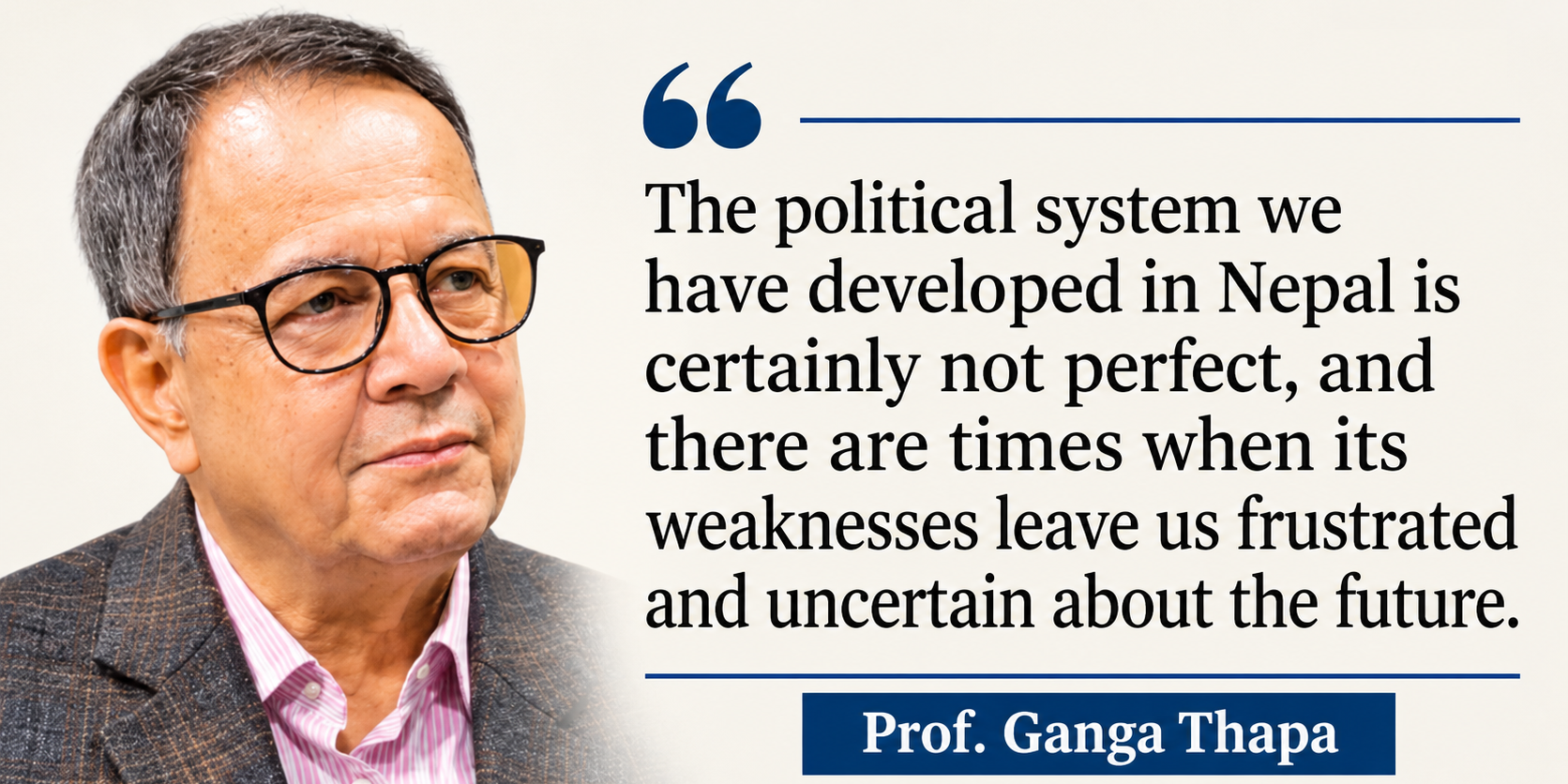
The political system we have developed in Nepal is certainly not perfect, and there are times when its weaknesses leave us frustrated and uncertain about the future.
It is deeply disturbing to see the hopes, livelihoods, and future of ordinary Nepalis repeatedly compromised by the personal ambitions of political leaders. What should have been a system serving the public has too often become an arrangement that protects the interests of a privileged few. When those in power use public institutions for personal benefit while ordinary citizens continue to suffer, politics loses its real purpose. Public service becomes little more than a convenient cover for private interests and political manipulation.
Giving up basic principles for the sake of political advantage is not simply disappointing; it undermines the very idea of justice. The popular movements of 1990 and 2008, together with the painful events surrounding the royal massacre of 2001, reflected the people’s demand for a different political future. Yet, despite changes in government and political leadership, many old practices have continued. New political elites, advisers who rarely question those in power, and intellectuals more interested in personal advancement than independent thinking have helped preserve this unfortunate political culture.
The Balen administration came to power carrying the hopes of many Nepalis who wanted to break away from this political legacy. However, six months into its tenure, it has not yet done enough to inspire genuine confidence. Some of its actions appear more symbolic than substantive, while its promises of transparency have yet to be matched by convincing results. Although the March 2026 elections removed many of the political figures associated with past misrule, accountable governance remains a promise that the government has yet to fulfil.
Nepal’s present difficulties are closely connected to a political culture in which dishonest and opportunistic individuals repeatedly find ways to advance their personal interests, while capable, honest, and principled citizens are pushed to the margins. This is not simply a matter of individual character. Our institutions themselves have allowed political patronage, personal loyalty, and the pursuit of power to take precedence over merit, integrity, and public responsibility. Unless this culture changes, replacing one set of political leaders with another will accomplish very little.
Public expectations of the Balen administration remain remarkably high. This reflects the continuing desire of ordinary citizens for genuine political reform and better governance. It is particularly disappointing that a handful of opportunists within the political establishment can continue to weaken these expectations. The real test for the government is whether it can turn public enthusiasm into lasting institutional improvements, trustworthy leadership, and visible changes in people’s everyday lives. Popular support alone cannot sustain a government indefinitely.
Nepal cannot rebuild its democracy by depending on the promises or personalities of individual leaders. What the country needs are institutions that can function independently and a political culture that values competence, honesty, and public service. Thomas Edison’s experience reminds us that failure can also provide an opportunity to learn and begin again. The Balen government has made mistakes and has its shortcomings, but it should learn from them, correct its course, and demonstrate that it can do better.
The present government sometimes appears more concerned with managing its social media image than with creating employment, strengthening the economy, and deciding what kind of state Nepal should become in the years ahead.
I am not an economist, but it is difficult to overlook the way globalisation has encouraged privatisation and increased the influence of large corporations. In many cases, economic opportunities and public resources have become increasingly concentrated in the hands of a relatively small group, leaving much of the population on the margins. Is Nepal moving towards the same kind of economic arrangement?
This is a question that deserves serious public discussion. Sometimes we blame fate for our circumstances, but perhaps we should also examine the choices and systems that have brought us here. I may not have the perfect framework for analysing Nepal’s political and economic situation, but I believe the concerns I have raised deserve consideration. Might fate itself be unkind, or do our own decisions make circumstances appear inevitable? This is something worth thinking about.
The political system we have developed in Nepal is certainly not perfect, and there are times when its weaknesses leave us frustrated and uncertain about the future. Nevertheless, an imperfect democratic system is preferable to power exercised without restraint. Our system, despite its shortcomings, provides for checks and balances and is not supposed to function according to the wishes or personal ambitions of one individual. Democracy does not require perfect leaders; it requires institutions strong enough to keep leaders within constitutional and democratic limits.
As things stand, foreign visits by Nepal’s prime ministers, ministers, and other government officials are often regarded by the public as little more than pleasure trips. Prime Minister Balen Shah’s visit to India has now been confirmed, and I sincerely hope it produces worthwhile results. Still, there is reason for caution. We have seen governments sign agreements with India that are never properly implemented, enjoy the hospitality, perhaps sample some dal tadka, and return home with little of substance to show for their visits.
I hope this time will be different. The present government sometimes appears more concerned with managing its social media image than with creating employment, strengthening the economy, and deciding what kind of state Nepal should become in the years ahead. The people have cast their votes. It is now their responsibility to demand a clear vision, measurable results, and accountability from those they have elected.
Publish Date : 20 November 2026 06:50 AM
KATHMANDU: The local administration has restricted the movement of public
KATHMANDU: Nepal Rastra Bank (NRB) has published the official foreign
In a mature democracy with strong institutions, losing an election
KATHMANDU: Haribodhani Ekadashi, an important Hindu festival dedicated to Lord
KATHMANDU: Nepal has taken a special initiative at the 31st
Reg No.: 1222/075-76(DOI, Nepal)
Chairman: Naresh Shrestha
Contact: +977 1-4249158
©2026 Khabarhub | All rights reserved.