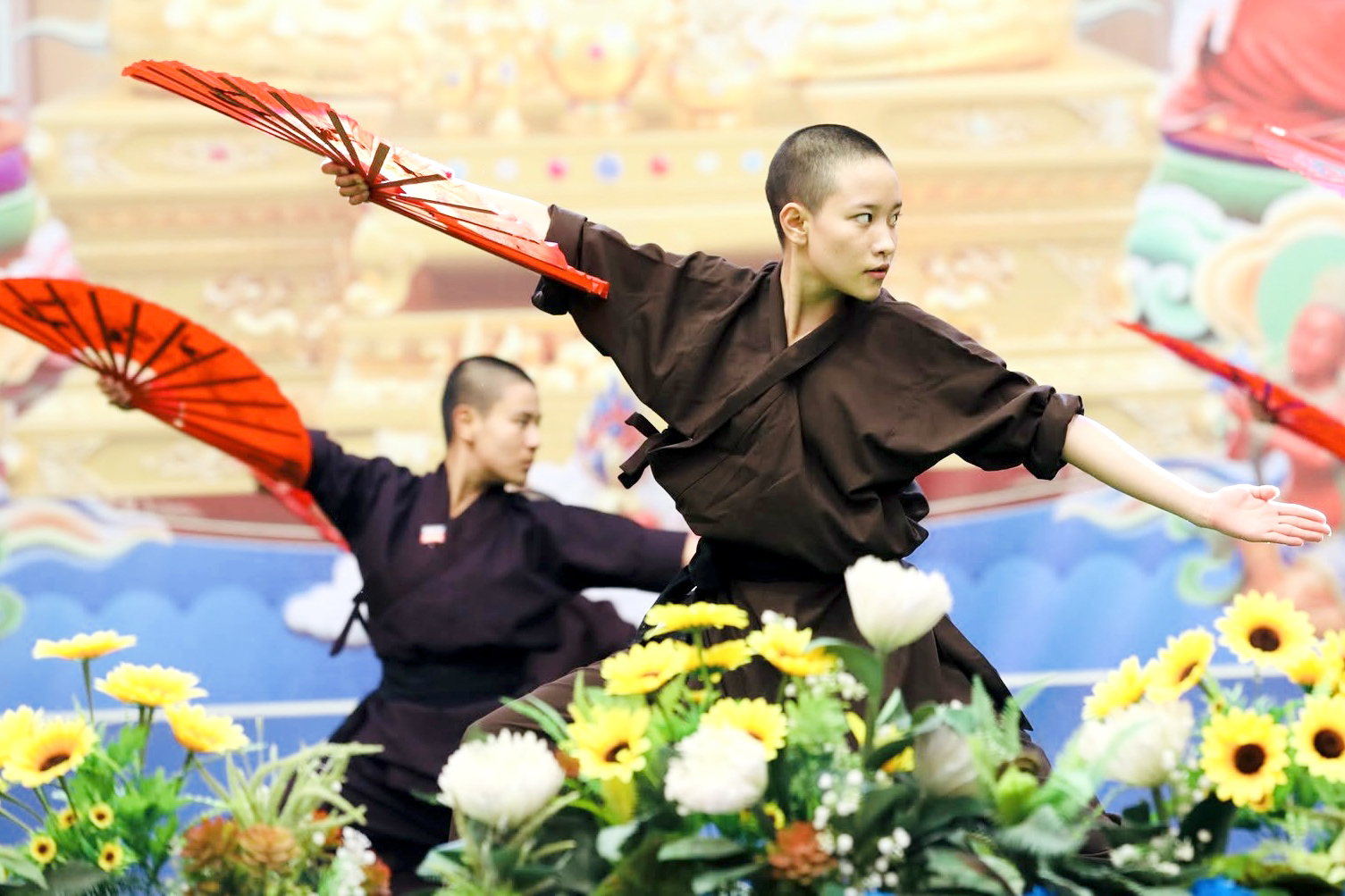
For most people, the mention of a Buddhist nun brings to mind a quiet figure in deep maroon robes spending her days inside a monastery in silent meditation, prayer, and religious rituals. Yet a visit to Seto Gumba—officially known as Druk Amitabh Mountain—in Ramkot on the western rim of Kathmandu offers a sharply different picture.
Here, nuns begin their mornings with meditation and religious rituals before spending part of their day practising kung fu—a Chinese martial art that is practised especially for self-defence, exercise, and spiritual growth. They play drums and orchestral instruments, embark on long-distance cycling expeditions, manage a guesthouse and a café, and step forward during natural disasters.
On Tuesday, during the 11 th Annual Drukpa Council held at the monastery, a kung fu demonstration by the nuns drew the full attention of the gathered audience. Dressed in their monastic robes, the performers displayed swift movements, tight coordination, and disciplined form that reflected years of regular practice, earning warm applause as they concluded.
Among those who have woven kung fu into daily monastic life is Ani Jigme Yangchen Ghamo, born as Kusang Tamang. She is from Sailung in Ramechhap district. Speaking about how kung fu fits into a nun’s routine, she stressed that the discipline has nothing to do with trophies or combat.
“Whenever people hear the word kung fu, everyone from young children to adults immediately thinks of action scenes from movies. However, because we are nuns, kung fu carries a rather different meaning in our lives,” she said. “Alongside making us physically healthy and strong, it has also boosted our self-confidence.”
According to nun Yangchen, kung fu is neither a competition nor a pursuit of medals for the nuns, but an essential daily practice. Greater physical stamina makes it easier to sit through long hours of meditation, perform religious rituals and carry out everyday duties, while also fostering mental resilience and self-assurance.
According to her, more than 80 of the over 300 nuns residing at Seto Gumba practise kung fu regularly. Training groups are organised according to age and interest, ranging from the youngest practitioner at seven years old to nuns aged between 30 and 35. Between 50 and 60 young nuns took part at an event organised by the council on Tuesday.
Depending on the season, they train for about an hour and a half either in the morning or evening under the guidance of Vietnamese kung fu instructor Jigme Rigzang.
The nuns of Seto Gumba began learning kung fu in 2008. According to a BBC report , Rinpoche Gyalwang Drukpa, spiritual head of the Drukpa lineage, conceived the idea after visiting Vietnam and observing Buddhist nuns training in martial arts. Upon returning to Nepal, he initiated kung fu training at the Ramkot-based Gumba not merely to teach self-defence, but to promote gender equality, leadership, and self-reliance within a religious tradition historically dominated by men.
The initiative was launched to build physical and mental strength among young women, many of whom came from underprivileged families across India and Tibet. At the time, conventional attitudes confined nuns to prayer, meditation, and kitchen chores, and the decision to introduce martial arts initially drew scepticism. Over time, however, the visible confidence and capability of the nuns quieted much of that criticism, Ani Jigme Yangchen says.
By 2013, the nuns were performing kung fu on international stages. Since 2017, they have also conducted short self-defence and fitness workshops for schoolchildren across Nepal, alongside a seven-day training camp in Ladakh, India. Their performances have taken them to the United Kingdom, the United States, Australia, Vietnam, and Hong Kong (China), and they were honoured with the Agent of Change Award in the United States.
Despite their growing recognition, misconceptions persist outside the monastery walls, where martial arts is often equated solely with fighting or aggression.
Guru Khamtak Rinpoche, Seto Gumba chair, emphasised that physical fitness and mental focus remain the core goals.
“Some people view the ‘kung fu nuns’ negatively, assuming that kung fu means beating or harming people. That is not the case at all,” he said. “Our primary objective is exercise for the nuns. The kung fu taught inside the monastery is strictly for sport and physical conditioning.” He added that the training builds stamina, discipline, and concentration, and should never be viewed through the lens of violence.
Most nuns echoed the view that kung fu and meditation are inseparable, as both demand mental control and undivided focus.
Unlike commercial martial arts schools, the monastery uses no coloured belt system or competitive rankings. Nuns are divided simply into senior and junior batches, learning collectively rather than competing against one another.
Several nuns shared their personal journeys during the event on Tuesday. Ani Jigme Paldron, who has lived as a nun for 22 years, said the training had significantly strengthened both her body and mind.
Ani Jigme Rinchen Lhamo, originally from Himachal Pradesh in India and a nun for 21 years, recalled the social pushback she faced in the early years. “People used to criticise us, saying, ‘They are girls, and on top of that, they are nuns—what could they possibly achieve by learning kung fu?’ There was a mindset that a nun’s only duty was spiritual practice and worship,” she told the gathering. Overcoming those doubts and rigorous training, she added, ultimately made her stronger.
The youngest speaker at the event, Ani Jigme Buddha Devi, said being a kung fu nun extends far beyond self-defence, and described it as a path of self-discovery, discipline, spiritual growth, and service to others.
That ethos of self-reliance extends well beyond the training ground. At the White Monastery, nuns also learn plumbing, electrical wiring, typing, cycling and English language. They run the monastery’s guesthouse and coffee shop, and drive four-wheelers themselves roughly 30 kilometres into central Kathmandu to purchase supplies.
Their outreach also spans environmental protection, campaigns against plastic pollution, and awareness programmes against violence towards women. During the devastating Gorkha earthquake in 2015, the nuns travelled to hard-hit villages to clear rubble, reopen blocked trails, distribute food, and build temporary shelters. Earlier that same year, led by Gyalwang Drukpa, they cycled roughly 2,200 kilometres from Kathmandu to New Delhi to promote environmental conservation and encourage cycling over private motor vehicles.
Environmental stewardship and disaster response remained central to the 11 th Drukpa Council, where discussions focused on climate change, conservation and humanitarian relief. Rinpoche, the chairman of Seto Gumba, said the monastery plans to distribute food and clothing to families affected by floods and landslides in Rasuwa district, and coordinate with the government to help rebuild damaged homes.
Rooted in the Drukpa Kagyu lineage—an ancient school of Tibetan Buddhism that places meditation, compassion and social engagement at its core—the nuns of Ramkot continue to demonstrate how spiritual devotion and active public service can walk hand in hand across the country. In accordance with this tradition, dozens of monasteries also operate across Nepal’s Himalayan and high-hill districts.
Suraj Kunwar is a senior correspondent with over two decades experience covering Aviation, Tourism and Mountaineering. He received the IFJ Tolerance Award in 2005.
-1.png)