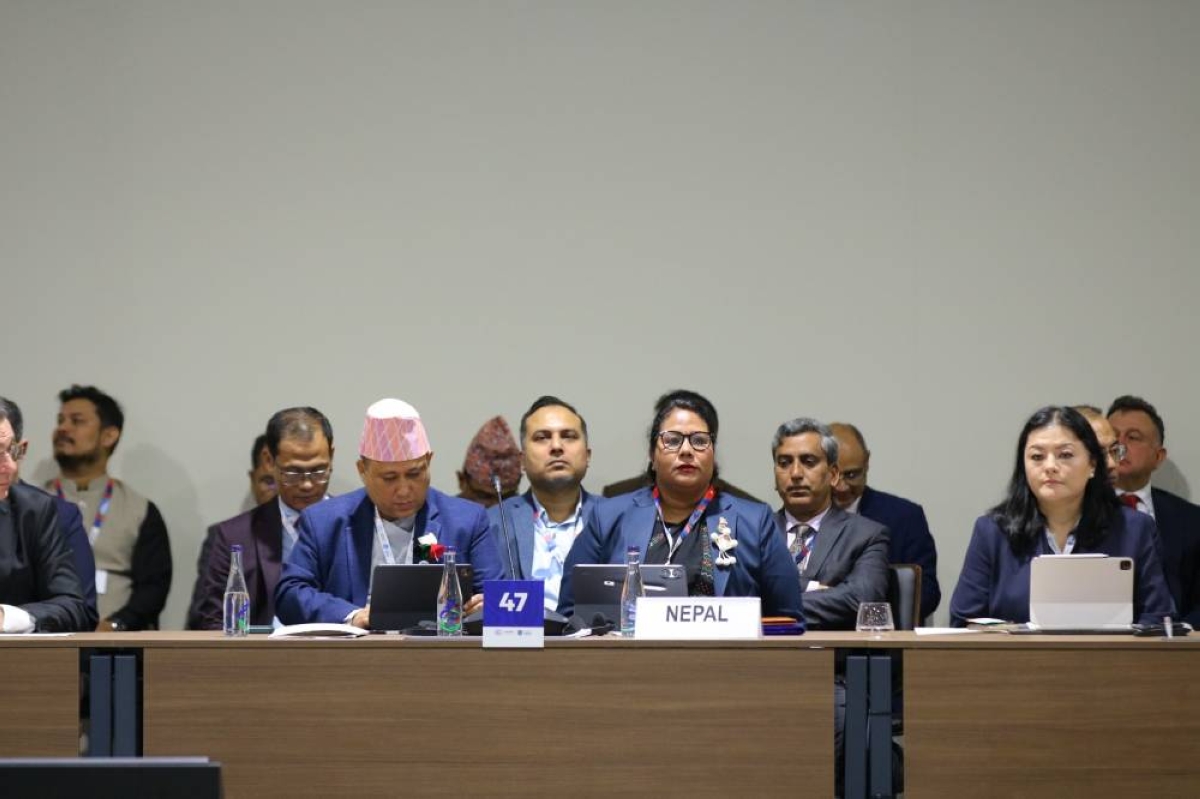
The attention of the world in general, and Nepal in particular, has been focused on the 31st Conference of the Parties (COP31), underway in Antalya, Türkiye, to deliberate on climate change and its adverse impacts across the globe. The specific objective is to limit the rise in global temperatures to 1.5 degrees Celsius above pre-industrial levels, as agreed upon at the Paris Climate Conference. While countries around the world are experiencing the effects of climate change to varying degrees, Nepal is perhaps among the worst affected in recent times. The Bhotekoshi flood of August 25 was so destructive that it earned the nickname "Himalayan Tsunami". As if this were not enough, it was followed within a month and a half by another, smaller but equally destructive flood in the Budhi Gandaki River.
The fact that the climate would change due to global warming was first indicated by scientist Svante Arrhenius in 1896, primarily as a result of the increasing use of fossil fuels. Despite this scientific evidence, developed countries, which are the major carbon emitters, have largely turned a deaf ear to the warning. Consequently, the world is experiencing a dramatic increase in climate-induced disasters, including floods and wildfires.
Small island states face an existential threat as rising sea levels caused by climate change threaten to submerge them. It is no wonder, then, that the Maldivian government held a cabinet meeting underwater in 2009 to vividly illustrate this danger and draw the attention of the participants at COP15 in Copenhagen. Nepal followed suit by conducting a similar meeting at Kala Patthar, meaning "black rock", in the Everest region. The initiative sought to demonstrate the danger that global warming and melting glaciers pose to the Himalayas, which could eventually lose much of their snow cover.
Himalayan countries such as Nepal and Bhutan have already suffered enormous devastation from glacial lake outburst floods (GLOFs) triggered by climate change. Thame, the birthplace of Tenzing Norgay Sherpa, who first scaled Mount Everest alongside Edmund Hillary, was swept away by such a flood in 2024 after glacial lakes near the Thyanbo glaciers burst their banks. Bhutan suffered a similar disaster recently when the Shintaphu glacier burst, washing away the tourist hub of Gasa Tsachu, famous for its hot springs.
These disasters are occurring despite the negligible carbon emissions of these countries. Nepal's contribution to global emissions, in particular, is extremely small, yet it has suffered enormous losses. The cost of reconstruction is estimated to reach 10 per cent of its gross domestic product (GDP). This glaring disparity between responsibility for climate change and its consequences gave rise to the concept of climate justice, which gained prominence at COP21 in Paris. The underlying principle is that countries responsible for the highest carbon emissions should compensate those suffering the greatest damage despite contributing the least to the problem.
So far, Nepal has been promised $20 million from the Loss and Damage Fund, marking an important development in the history of climate negotiations. However, this amount represents a mere 0.5 per cent of the country's total reconstruction costs. It has taken more than 50 days to secure this decision, prompting Nepal and other affected countries to call for a fast-track mechanism. They have also demanded grants rather than loans to finance the reconstruction of areas devastated by climate-induced disasters.
Nepal has sent a high-level delegation to Türkiye, led by the ministers of finance, foreign affairs, and agriculture, amid questions about the necessity of such a large team. The finance minister has addressed several meetings and held discussions with prominent personalities. However, the pledges made so far have amounted to little more than verbal assurances. The finance and agriculture ministers also lobbied for climate justice and a mountain dialogue in collaboration with other countries, but these initiatives did not receive a particularly encouraging response from the participating countries.
It is evident, therefore, that Nepal has received assurances in words rather than tangible support in deeds. What now appears inevitable is that the country will have to seek assistance from bilateral and multilateral agencies to bridge the enormous gap in reconstruction funding. Ultimately, Nepal may receive a small amount in grants and have to rely heavily on loans, even though these may take considerable time to materialise.
There is another problem. Grants must be spent within specified timeframes, but, given the country's past record, projects are often delayed, resulting in the loss of some of the committed funds.
What, then, is the way forward under these circumstances? Such floods can occur at any time, as numerous vulnerable glacial lakes could burst their banks without warning. The government should declare a Disaster-Resilient Decade and allocate a larger share of the development budget to disaster-resilient planning and construction.
Residents living along vulnerable riverbanks and people displaced by disasters should be relocated as quickly as possible to existing settlements situated at safer locations upstream and away from riverbanks. This approach could prove more cost-effective than developing entirely new settlements. Similar models of consolidated settlements have been successfully implemented in China.
To facilitate this process, the government should arrange for land in existing settlements through land exchanges with owners whose properties have been damaged along riverbanks. Upgrading existing infrastructure would be considerably cheaper than creating entirely new facilities. Furthermore, livelihood opportunities would be less disrupted if houses in these settlements were designed to accommodate tourist homestays. The houses should be built using climate-resilient construction technologies, such as bamboo-reinforced laterite soil, which can offer strength comparable to conventional cement-masonry construction. Such buildings could also appeal to tourists. Their seismic and thermal performance can be comparatively good as well.
If Nepal can promote such innovative approaches to settlement planning and climate-resilient construction, it is likely to attract greater interest and support from international donors.