Meat sold in the Kathmandu Valley must now carry a government inspection stamp, as authorities begin enforcing long-standing rules requiring animals to be checked before slaughter and meat to be inspected afterwards.
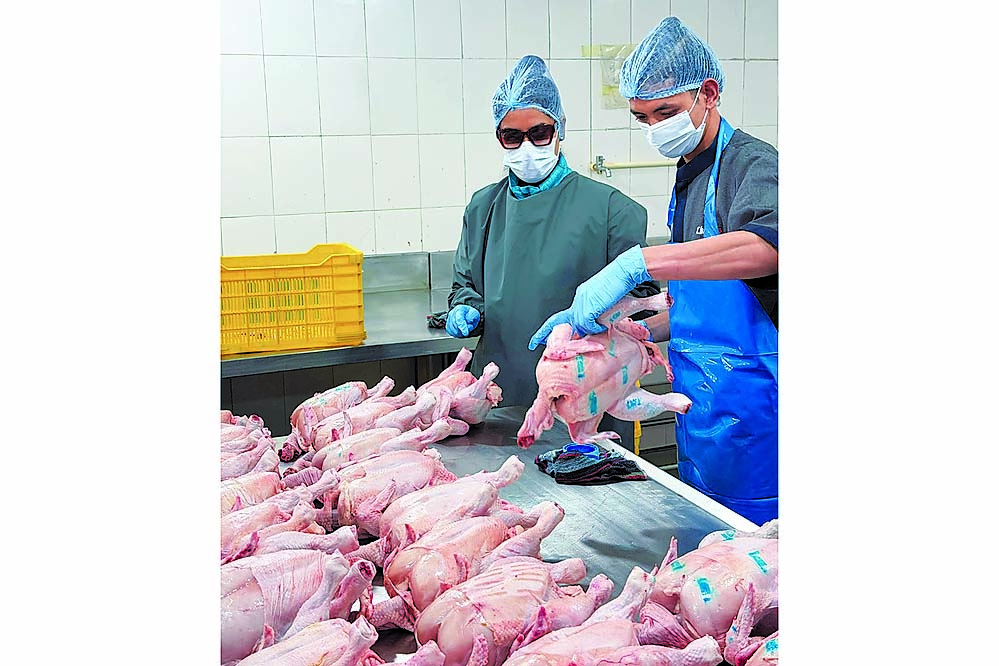
The system came into effect in the Valley’s three districts on Tuesday under the Animal Slaughterhouse and Meat Inspection Act, 1999. On its first day, authorities inspected chicken and buffalo meat at five slaughter sites and stamped it as fit for consumption.
Umesh Dahal, director general of the Department of Livestock Services, said meat was inspected at four slaughter sites in Kathmandu and one in Bhaktapur. “Around 43,000 kilograms of meat was inspected and sent to the market on the first day,” he said.
Under the inspection process, animals must undergo a health check before slaughter. Their meat is then examined for signs of disease and contamination. Only meat that passes the inspection receives the fit-for-consumption stamp, which is applied by authorised meat inspectors.
Dahal urged consumers to buy only meat bearing the inspection stamp.
The stamp uses blue ink, which the department says represents the veterinary profession. “The colour does not pose any health risk,” said Nawaraj Shrestha, a senior veterinary doctor at the department.
To enforce the law, authorities have begun working with 21 local units in the Valley to designate slaughter sites and deploy inspectors. A total of 240 trained meat inspectors, appointed through a ministerial decision, have been mobilised for the task.
The department is coordinating with local governments because the Local Government Operation Act also assigns them responsibility for meat inspection, Dahal said. The process is still in its early stages, with local governments working to designate authorised slaughterhouses.
“We are in the initial phase. The process of identifying specific slaughterhouses is under way, and we will soon expand inspections once the sites have been designated,” he said.
The Act requires meat businesses to obtain a licence to operate. Retail shops without licences are not allowed to slaughter or process meat, but they can sell meat that has already been inspected and stamped at an authorised slaughterhouse. Government inspectors may oversee more than one retail outlet.
The department said businesses operating without the required licences could face penalties or warnings.
Although the Animal Slaughterhouse and Meat Inspection Act was introduced 28 years ago, its provisions are now being enforced more strictly. The government announced the implementation of the inspection system through a notice published in the Nepal Gazette on August 17.
The Ministry of Agriculture, Forests and Environment plans to extend the system nationwide by July 17, 2027, making inspection stamps mandatory for meat sold across the country.