Brett McGurk is a CNN global affairs analyst who served in senior national security positions under Presidents George W. Bush, Barack Obama, Donald Trump and Joe Biden. He is the author of Brink : Inside the Race to Free the October 7 Hostages.
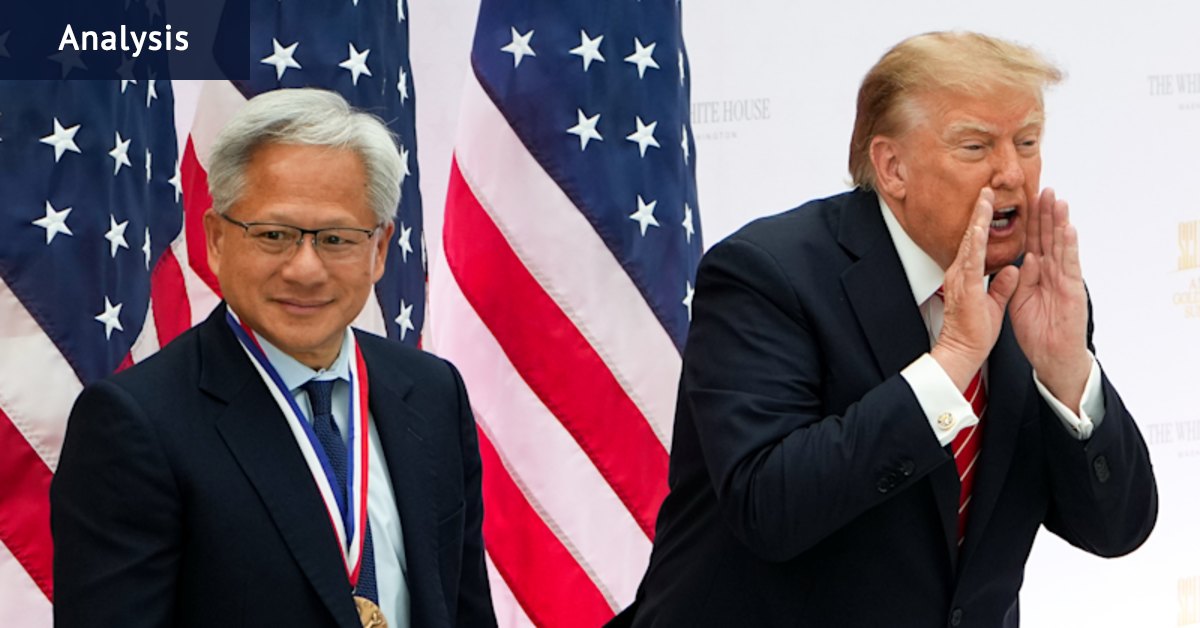
The resignation of former Nvidia CEO Jensen Huang after he admitted to multiple affairs, including with a woman described by US officials as a potential Chinese intelligence asset, has understandably drawn enormous attention.
But this weekend, Treasury Secretary Scott Bessent pointed to something far more consequential: whether Nvidia helped China acquire access to technology Washington meant to restrict — and whether US officials responsible for enforcement of those restrictions failed to act.
As sordid as a tech CEO’s private dalliances may be, that would be the real scandal: corporate interests overtaking national security interests to benefit China in the AI race
Bessent’s interviews have raised three questions that should now frame the issue:
Bessent points finger at Lutnick over Nvidia chip exports as Trump advisers discuss possible Commerce Secretary ouster
First : What did Huang and other Nvidia executives know about suspected diversions of advanced chips to China, or remote access for banned Chinese entities?
Second : What did Commerce Secretary Howard Lutnick know, and why did his department delay action?
Third : What did President Donald Trump know—and what did he direct his team to do?
The answers matter beyond Nvidia. They concern America’s advantage in a technology race that will shape the future of global power.
Nvidia designs processors that help power artificial intelligence. Connected in large numbers inside data centers, they supply the computing capacity needed to develop and operate sophisticated AI systems. Better chips allow companies and researchers as well as countries to develop more capable AI systems and run them more efficiently.
AI now supports weapons development, military planning and autonomous systems, including drone swarms. Those were among the national security concerns the Biden administration identified in 2022 when introducing major restrictions on the export of advanced chips and chipmaking equipment to China. Those restrictions sought to limit Beijing’s military capabilities by placing US national security interests above the corporate interests of chipmakers like Nvidia.
Washington never banned every Nvidia chip from China. It established technical thresholds, requiring government permission for exports above certain capabilities. Nvidia responded with modified products designed to fit below those limits.
Then Trump opened a legal route for selling a more powerful chip.
In December 2025, he announced that approved Chinese customers could receive Nvidia’s advanced H200 chips.
The Commerce Department formalized the change in January, replacing a general presumption of denying those exports with reviews of individual applications on a “case-by-case basis provided certain security requirements are met.”
The H200 was not Nvidia’s newest technology. More advanced Blackwell chips remained restricted. But it was a significant move beyond the modified products previously offered to Beijing.
Trump says he’s not considering replacing Lutnick over Nvidia scandal
The policy included safeguards: screening buyers, independently testing shipments and protecting supplies for American customers. Accordingly, permission to sell H200 chips to an approved customer did not authorize sending chips through an intermediary to evade the rules.
Which brings us to the three questions.
At the center of the controversy is Megaspeed, a Singapore-based company suspected of helping advanced Nvidia chips reach China in circumvention of US restrictions. The alleged Chinese intelligence asset was an executive at Megaspeed.
Separate from Huang’s acknowledged affair with the potential spy, Nvidia has disputed allegations of diversion. Bessent is now openly suggesting those assurances don’t hold up.
“These shell companies were obvious,” he said Sunday on Fox News. “They were being investigated.”
“Did Nvidia use them as a work around to sell chips to the Chinese?” he asked.
Bessent also questioned whether Nvidia was pressing “these seemingly illicit sales to goose their revenues and their earnings,” noting that he has sought answers from Nvidia’s board and outside lawyers within 10 days.
These are extraordinary allegations from a sitting treasury secretary, and they focus the spotlight well beyond Jensen Huang’s personal conduct and on Nvidia as a whole.
Bessent’s other point concerned the government department responsible for overseeing these exports.
Lutnick under fire: How Trump’s commerce secretary cultivated Nvidia’s CEO while chip controls slipped
In an interview with CNBC, Bessent said Treasury, State, the Pentagon and the US trade representative had favored adding Megaspeed to the Commerce Department’s export restriction list for months. Such a listing would impose additional barriers on sales to the company. He then openly accused Lutnick of a failure to act: “Commerce BIS had the pen.”
I served in four administrations. Internal debates and disagreements were routine. A treasury secretary publicly identifying a fellow Cabinet secretary’s department as the obstacle to national security enforcement is something else entirely. It suggests to me that there could be more concerning information inside the administration, which Bessent seeks to distance himself from before it’s public.
On Monday, and in response to the scandal, Commerce issued new regulations to restrict China from accessing advanced chips remotely such as through a data center in Singapore or Indonesia. Yet, Commerce’s own announcement said the rule was “written by and at the direction of the Department of Treasury and the National Security Council,” raising potential questions about whether Commerce fully backs the new restrictions, and about who is really steering export-control policy.
This also seems unprecedented. I’ve never seen Commerce say in its own announcement that its own rule was written by another department and only at the direction of the NSC.
To be sure, there may be legitimate disagreements over evidence, appropriate restrictions or diplomatic consequences. If those explain Commerce’s decisions, Lutnick should lay out the reasoning.
But Bessent’s position was clearcut: The administration had the knowledge and Lutnick failed to act. On Monday night, the Departments of Justice and Commerce issued a j oint statement saying Commerce inspected Megaspeed last year, which led to DOJ initiating a criminal investigation. The statement did not address the central question as to why Commerce never placed the company on an entity list.
CNN has reported that other administration officials accused Lutnick of failing to act as well on Trump’s own directives. This suggests Trump shared Bessent’s view.
If Trump ordered restrictions and his Commerce Department failed to implement them, he has a serious problem of execution within his team — in the best interpretation.
If Trump acknowledged the problem and chose not to demand action from Commerce, despite known risks to national security, that raises even more serious questions.
On Monday, before boarding Air Force One on his way to Philippines and then China, Trump acknowledged the divergence between his two secretaries without clearly taking a side. “They have different viewpoints. One wants to be friendly with China, and one wants to have a blowup with China. They both are acceptable but they are different views.”
It’s the president’s job, of course, to resolve those different views.
There is an argument for permitting some advanced chip sales to China. Revenues support American innovation. Keeping Chinese customers on American technology may discourage them from developing alternatives.
But that argument depends on enforceable boundaries. Export controls by design place national security interests above corporate interests. They ban certain American products from the Chinese market and American companies from profiting there.
That is how we protect our most advanced technology and ensure the United States retains an edge in the AI race.
Bessent has raised the possibility that corporate interests and failures of enforcement placed that edge, and our national security, at risk.
The country now needs answers — from Nvidia, from Commerce and from the White House.