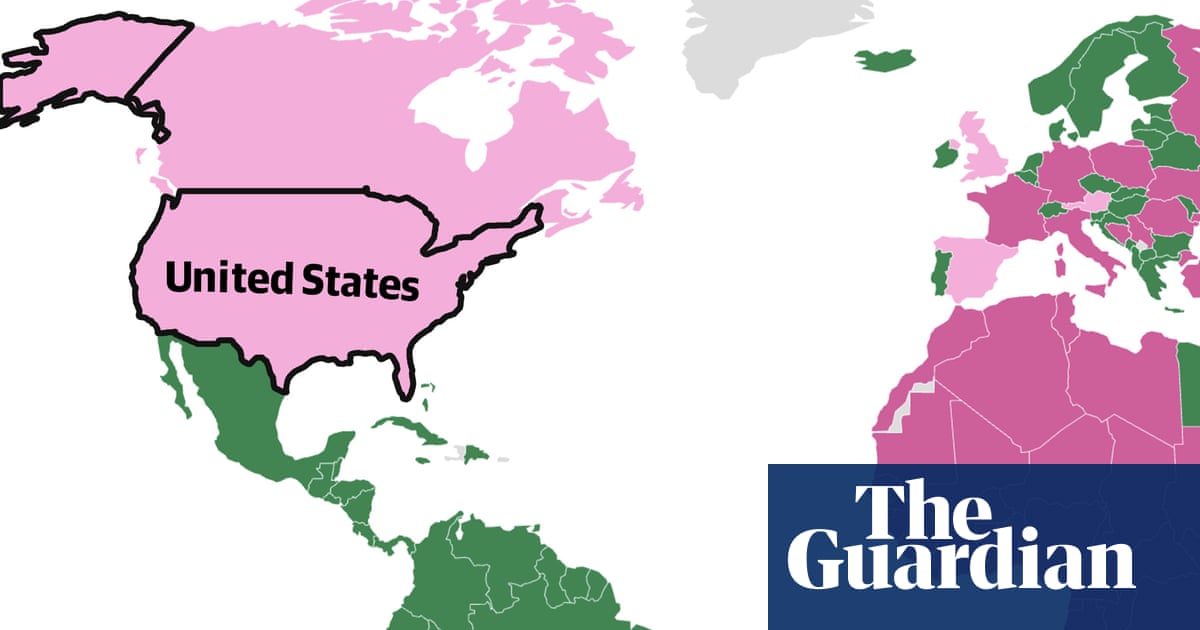
The United States has officially lost its measles elimination status, reversing a public health achievement maintained for 26 years, as the country grapples with its largest outbreak in more than three decades.
The Pan American Health Organization (PAHO) , the Americas branch of the World Health Organization (WHO), declared measles endemic in the US, Bolivia, and Mexico on Tuesday after determining that the same strain of the virus had circulated continuously in the country for at least 12 months.
The Americas as the Measles and Rubella Elimination Regional Monitoring and Re-Verification Commission (RVC), which advises whether countries have maintained the elimination of measles and rubella, “recommended that the measles elimination status be withdrawn,” said Dr Jarbas Barbosa, director of PAHO.
“A recommendation which I have accepted,” he said.
Measles was declared eliminated in the US in 2000.
The PAHO announcement follows a review of epidemiological and laboratory evidence submitted by the US Centers for Disease Control and Prevention (CDC).
The US has recorded approximately 7,700 measles infections since the beginning of 2025, according to CDC figures.
It is the highest number of cases the country has seen in more than 30 years. The climbing numbers come as vaccine hesitancy has grown under Health Secretary Robert F Kennedy Jr, who has repeatedly cast doubt on the safety of vaccines despite scientific evidence to the contrary.
Before taking office, Kennedy claimed that no vaccine was “safe and effective” and promoted the discredited theory that vaccines cause autism.
To protect against illness, children are commonly given the measles vaccine in a combined shot with mumps and rubella vaccines, known by the acronym MMR.
But the vaccination rate among preschoolers in the US has fallen to about 92 percent, below the level experts say is needed to prevent major outbreaks.
As health secretary under US President Donald Trump, Kennedy has questioned the MMR vaccine’s ability to protect children.
He has suggested that the MMR’s effectiveness wanes by about 4.5 percent a year and said it contains “aborted fetus debris”, a claim experts have rejected as false .
The CDC has confirmed six measles-related deaths this year, but state health officials in Pennsylvania, Wisconsin and New York have reported 10 deaths combined, a discrepancy that has fuelled tensions between federal and state health authorities over how measles fatalities are classified and counted.
Measles is considered highly infectious, and the WHO credits the virus with 95,000 deaths worldwide in 2024, mostly among children.
Matt Ferrari, a biology professor and director of Pennsylvania State University’s Center for Infectious Disease Dynamics, believes the loss of the US’s measles elimination status can serve as a wake-up call for public health officials.
“This should be a humbling statement for the United States,” Ferrari told Al Jazeera.
For much of his career, Ferrari has studied strategies to control measles in countries around the world. The US was previously seen as a model.
“It was a motivating achievement that we use to drive support for measles elimination programmes all around the world,” said Ferrari. “Now we need to be looking for expertise elsewhere because we haven’t been pulling our weight.”
Edwin Asturias, a professor of paediatrics, infectious disease and epidemiology at the University of Colorado, described the loss of status as a “stain” on the country’s public health programme.
“Measles cases are a signal that your immunisation programme and other systems within your public health services are having problems,” he told Al Jazeera.
Asturias said the US had the resources and experience to prevent the resurgence of the virus, pointing to its success in eliminating local measles transmission for more than a quarter of a century.
About 40 percent of current US measles cases are among adults older than 20, he said, highlighting the need to expand vaccination efforts.
Reaching these populations will require making vaccines available in workplaces, places of worship and other community settings, rather than relying solely on paediatricians and family doctors, Asturias explained.
The loss of elimination status also has implications beyond US borders , as measles can spread through international travel and migration.
“The United States is not, anymore, a place where you’re safe from measles,” Asturias told Al Jazeera. “If you’re a common person walking around with your children, you need to know now that measles has come to the country to stay unless something else is done.”
The risk is particularly concerning for unvaccinated people and those who cannot receive the vaccine, including those with weakened immune systems or undergoing cancer treatment.
Public health experts say the announcement should serve as a catalyst for a more extensive vaccination response.
While they do not expect the PAHO announcement to prompt a significant change in federal policy, some hope it will spur action among state and local health departments.
Ferrari argued that the US should look to countries with experience containing measles outbreaks, including India, where community health workers visit households to identify children who may have missed vaccinations or whose families may be reluctant to vaccinate.
He also suggested that states may need to reconsider vaccination strategies, including whether to offer an earlier first or second dose to protect young children in areas where measles is circulating.
In the US, children are routinely given two doses of the MMR vaccine. The first dose is typically administered to children at 12 to 15 months of age and the second at four to six years, before they start school. Two doses are about 97 percent effective at preventing measles.
In countries where measles transmission is more widespread, the second MMR dose is often given between the ages of 18 and 24 months.
In June, Pennsylvania began recommending an additional early dose, called a “dose zero”, for infants aged six months and older in areas with sustained measles transmission. Ferrari said this is a perfect example of how states could adapt their approaches locally.
But the prospect of a broader shift in the federal response remains unlikely.
CDC Director Erica Schwartz said last week the agency would continue “doing the same exact thing”, in terms of its measles response, if the US lost its elimination status.
For Asturias, the federal response so far raises concerns about whether the country has the public health leadership needed to reverse the outbreak.
“This is hard to see happen,” he said. “But at the same time it is predictable when you don’t have experts running a public healthcare system.”