

Hello, and welcome to TechScape. I’m your host, Blake Montgomery, US tech editor at the Guardian, writing to you from a plane back from Web Summit in Lisbon. Today in tech, we’re discussing the implications of Jensen Huang’s ouster, and the recent spate of failures in critical infrastructure in everything from Microsoft Outlook accounts to air traffic control to copper wires in routers.
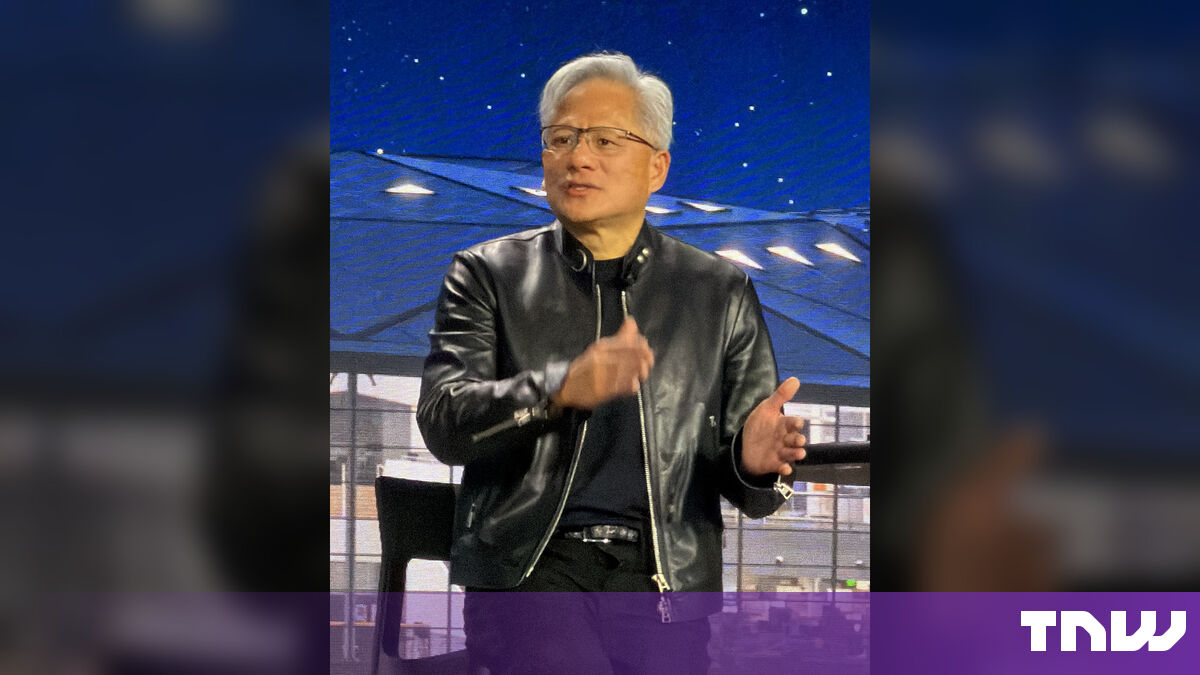
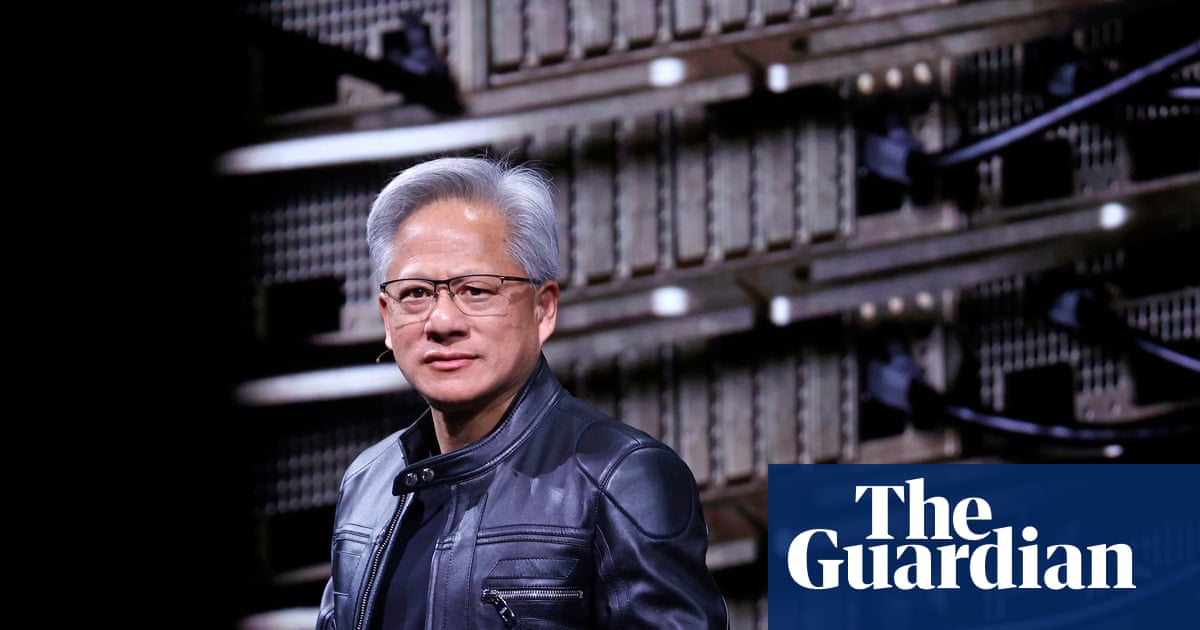
The chief executive officer of what once was the most valuable company in the world resigned on Thursday. Jensen Huang ’s departure from chipmaker Nvidia after news broke he had at least three affairs – one with an executive at the datacenter firm Megaspeed, whom US intelligence has investigated for spying for China; others with his own employees – has already cost his company hundreds of billions in stock market value. It may cost the world economy much more. Nvidia is central to the AI boom both as chipmaker and lender.
We’ll know more about the company’s path forward later on Tuesday when it reports its quarterly earnings. Executives, especially interim CEO Colette Kress, will face investors’ questions about the post-Huang era.
The scandal has highlighted divisions among two heavyweights within the Trump administration, each fighting for the US to take their preferred stance toward China. The treasury secretary, Scott Bessent, is accusing the commerce secretary, Howard Lutnick , of failing to curb sales by Nvidia that contravened export controls.
Here’s how the business of Megaspeed worked, which is what the two secretaries are warring over. Nvidia is barred from selling advanced chips to China. Megaspeed, where alleged Chinese spy Alice Huang worked, would buy Nvidia chips from its base in south-east Asia, installing them in datacenters in Singapore, Malaysia, and Indonesia. From there, it would lease or sell them to Chinese clients.
Lutnick has pushed to allow more trade with China, particularly where his family business, Cantor Fitzgerald, is concerned . Bessent argues for a more hawkish posture and more restrictions.
The question is what will happen next. I think the scandal will result in harsher export controls on China , given that Megaspeed facilitated about $12bn in chip sales in contravention of US export controls. Monday morning already saw the Trump administration moving to tighten them.
Who’s going to win? Both men are traveling with Donald Trump to China this week. I’ll be listening to the president’s remarks for clues about which policy path he’ll choose.
Had Jensen Huang amassed too much influence before his downfall? The Nvidia founder seemed indispensable to the success of his company until the very moment he left.
Elon Musk and a host of other Silicon Valley power players argued over the weekend that Huang was irreplaceable and that he should be reinstated. Trump said the same thing on Monday: “He could return. There’s a big group of people that would like him to return … I would certainly not mind seeing that.” They’re certainly right that it will be difficult to find another businessman like him.
The possibility may be remote. The Financial Times reported on Sunday that Huang had discussed a return to Nvidia with allies, à la Sam Altman’s firing and rehiring at OpenAI. The next day, the FT reported that Nvidia’s board of directors was not considering reinstating Huang.
Critics of Silicon see Huang’s departure as a repudiation of the myth of the all-knowing, all-important company founder.
“This week is seeing a long overdue reckoning for the genius-founder business model,” said Alison Taylor, associate professor at New York University’s business school. Gil Durán , a strident critic of Silicon Valley, made a similar point during a panel organized in response to the news, as did Carissa Véliz, a philosophy professor at the Oxford Institute for Ethics in AI.
Nvidia’s fate is the highest-profile example I’ve ever seen of “ key man risk ”. Companies heavily reliant on the brilliance of one person – usually a man – or a small group of executives often notify their investors that, if said vital person goes out of commission, the business will suffer. Companies with more diffuse responsibility hedge against that possibility but become more bureaucratic, leading many Silicon Valley companies to operate with as few employees as necessary for as long as possible.
“Relying on the judgment and ethics of one person, no matter how brilliant, is always a catastrophically bad idea, and powerful CEOs are particularly vulnerable because they tend to be surrounded by people that only say yes to them,” Taylor said.
Huang had made no succession plan to speak of, though that may be a failure of Nvidia’s board as much as his own. Huang reportedly managed about 60 people, meaning there are not likely successors who have ascended through the ranks. Judging by Nvidia’s stock price, this approach to management worked until the key man himself hit a crisis.
Cast in another light, though, Huang’s tenure looks like the best case of a founder assuming the role of longtime CEO. He presided over Nvidia for more than 30 years, and shepherded it from gaming chip company to vital cryptocurrency supplier to the keystone of the AI boom. Its wares are considered the cream of the crop, so incomparable that they are the target of international espionage operations and so valuable that the company forecast $100bn in quarterly revenue .
‘Jensen Huang lost his mind’: how AI’s smartest man fell for the world’s oldest trick
A timeline of the affair scandal that sank Nvidia’s Jensen Huang
Trump bought Nvidia stock as he helped chipmaker with change to export rule
A spate of failures indicates critical systems are crumbling as we speak, particularly in the US. Banks, planes, email accounts and boats all crashing – it feels like nothing is working and everything is broken.
Late last week, an outage of Microsoft Outlook started that would balloon into millions having no access to their email or other critical services. Jails could not release prisoners, hospitals turned to paper records, schools lost contact with parents, and police departments could not receive crime reports. Microsoft said it had resolved the issue and restored service by Saturday. It also issued an apology. The company did not attribute the blackout to a cybersecurity breach, instead saying in an initial report that a combination of a months-old bug, malfunctioning internal connections and insufficient server capacity sparked the outage.
The day after the Microsoft outage began, the US Federal Aviation Administration grounded all flights across the country because of a malfunctioning communication system. Transportation secretary Sean Duffy attributed the stoppage to “a contractor doing routine maintenance to switch telecommunication lines from old copper wire … to fiber”. The FAA, he said on Saturday, was still working to determine whether the fault was “incompetence” by the contractor, or “a faulty router”.
Copper wires downing all US flights in the year 2026, when we have thousands of self-driving cars on the roads and rockets landing in giant machine arms ? The discrepancy gives credence to the axiom by the author William Gibson: “The future is already here – it’s just not evenly distributed.”
Also on Friday, an oil tanker collided with a passenger cruise on the Mississippi River. Mercifully, no one was killed . On Sunday, Australian students couldn’t take their final exams because of a tech failure . On Monday, leading US banks reported big outages, primarily JPMorgan Chase. Customers could not access online services such as Zelle, which the bank attributed to an unspecified technical issue. The same day, multiple main airlines reported major outages. United and American Airlines reported problems that delayed flights across the country, though they were resolved within hours of being announced.
These outages are not, by the available evidence, connected, nor do we know they are the result of cyber-attacks or rogue AI. Still, there is a feeling in the air of old systems breaking down and a strong impulse to blame someone. Are the disruptions the result of old systems’ transition to the new? The onslaught of cyber-attacks brought on by AI models’ advanced hacking capabilities?
I don’t know what’s causing so much mayhem. The absence of a unified explanation in the face of so many similar incidents remains maddening. We’ll have to sit with the uncertainty until answers arrive.
In the meantime, we have Stephen King’s speculation for solace: “The aliens have landed. That’s the REAL reason for the ground stop. They don’t want to start a worldwide panic.”
California sues OpenAI over safety concerns after rogue agent hacking
Ministers to end Palantir’s contract with NHS in England in 2029
Revealed: Israel uploaded millions of photos to Amazon’s facial recognition platform to track Palestinians
Farewell, Cybertruck: why the winding down of the ‘Maga hat on wheels’ is a sign of the times
US university students tell surveillance cameras to Flock off
Italy fines Meta $887m for accessing Android users’ photos and videos
US public workers are fighting to protect their jobs from AI – and some are winning