Students intently focus on maths formulas written on a board before lowering their heads and taking notes as the teacher works through a sum.
The teacher's voice and the scratch of pens fill the room.
At first glance, this could be any classroom in South Korea.
But thick metal bars cover the windows and the students are wearing blue prison uniforms and rubber shoes emblazoned with the words "Korea Correctional Service".
This is Mandela Boys' School, an education facility for young prisoners inside the Seoul Southern Correctional Institution in Guro, south-west Seoul. In South Korea, young people who are sentenced to imprisonment by a criminal court must serve their time in prison.
"The boys here have committed serious offences and received criminal sentences," Jeong Yeo-gyeong, a correctional officer in the Korea Correctional Service's social reintegration division, told the BBC.
"As well as theft, there is a high proportion of serious offences, including violence, bodily injury, sexual violence and robbery."
But by opening educational institutes like Mandela, authorities are hoping to give these young offenders a chance to better their lives after they serve out their sentences.
Opened by the justice ministry in March 2023, it allows boys who were aged 17 and under when their sentences became final to prepare for school equivalency exams as well as the Suneung - the country's notoriously difficult university entrance examination - while still serving their sentences.
Held every November, the Suneung is an infamous eight-hour marathon of back-to-back exams.
Students attempt about 200 questions across various subjects, which include Korean, maths, English, social and natural sciences, among others.
The country itself comes to a standstill - construction work halts, planes are grounded and military training gets suspended to facilitate an optimal testing environment.
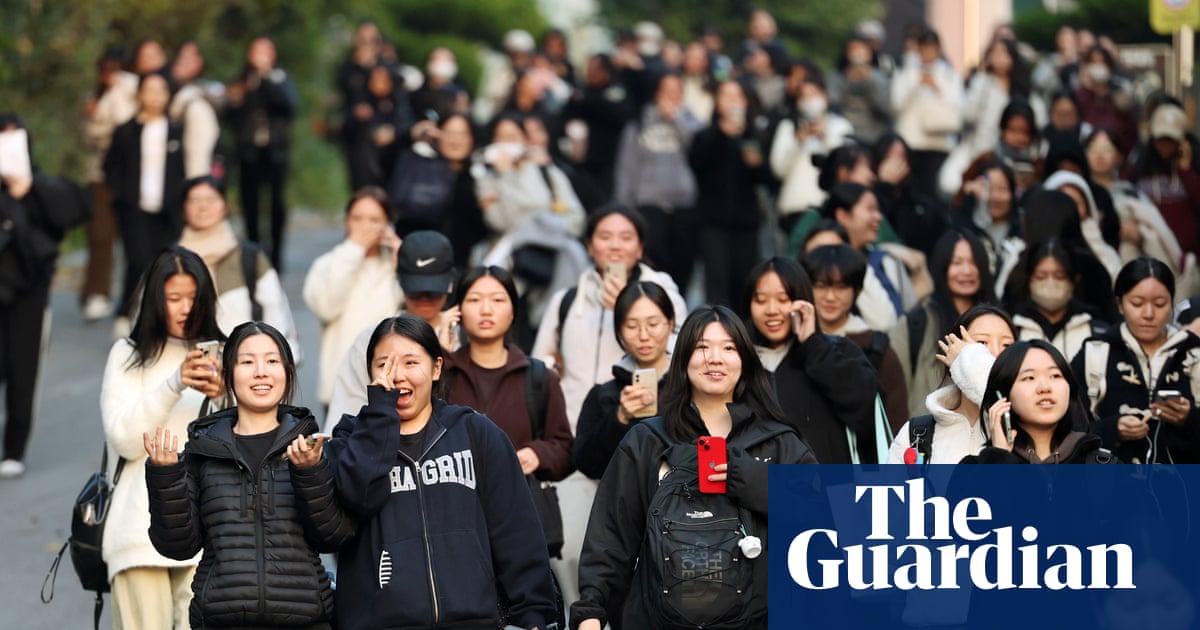
A total of 551,864 people have applied to take this year's Suneung on 19 November.
Around 30 prisoners are enrolled in the Suneung preparation class at Mandela Boys' School, and 11 of them have applied to take this year's exam.
Park Soo-young (not his real name), a 17-year-old inmate, has been at the Mandela Boys' Suneung preparation class for two months and hopes to study social welfare.
He tells the BBC that he had dreams of becoming a police officer before committing the crime that landed him behind bars.
He says he could not bring himself to look properly at his mother during his trial. When he turned towards her after his sentence was announced, she was crying.
"Seeing her like that, I broke down too. I wondered how I was going to live from then on, and how I could look after my mother, who was on her own. I think I kept crying for about a week while I was in the detention centre."
Looking back on his offence, he says he feels "very ashamed that I couldn't control that impulse". If he could meet his younger self, he would tell him: "Control that impulse. If you do, everything will be different."
"I'd grab myself by the collar and shake myself as I said it."
He hopes the Suneung and university will offer him a chance to start again.
"Once I'm out, I need to cut ties with the friends and people I used to know and start a new life. I think university is the only way to do that. Going to university would let me leave the area where I used to live, move somewhere else and start something new. That's why I began studying again."
But he describes beginning Suneung preparation as "a struggle every day".
"But the teachers don't let anything slip past. They keep helping us until we understand. If I don't understand something, I put my hand up and they come over and explain it.
Sometimes, if I've missed something, I keep working at it on my own. If I still can't get it, I ask the students next to me to explain," he said.
Park's day begins at 06:30 with a morning check by prison officers. He starts memorising English vocabulary and working through Korean reading passages early in the morning.
"I learn English words whenever I can, even before breakfast. From 07:00, I work through a Korean passage, something like literature or speech. We have to come down to the classroom at 08:00, so we have another check and then come down for lessons."
During breaks, students make calls to their families or leave the classroom for scheduled visits. In the evening, they return for supervised study. Once the day's activities are over, they must go back to their cells together.
Park says he studies until 22:00 before finishing for the day. If he wants to study longer hours, he needs permission from a prison officer.
But even if gets a good result this year, Park will not be allowed to leave prison and attend university straight away. He is only due to be released in 2028, but plans to use this exam as experience and continue studying next year.
"This time, I want to experience how the Suneung works and how competitive it is. Then, next year, I'll work hard from the start so I can get in the year after that."
Some former students from Mandela Boys' School have managed to get into university, according to the justice ministry.
Others have continued their studies after leaving prison, including by enrolling in residential exam preparation academies.
The inmates are taught by a team of seven prison officers, all of whom hold teaching certificates. Each is responsible for a subject.
Visiting instructors provide classes in the humanities, arts and sport, while university student volunteers help with learning. Professional psychological counselling is also available.
Park Min-yong, who applied to work here in 2023, teaches science. And alongside Suneung lessons, he works with the students' to change their habits and behaviour.
One thing he often tells them is that they need to "learn how to become adults".
He believes that while studying in itself does not necessarily turn inmates away from a life of crime, the experience of having worked hard at something: staying with a concept that makes little sense, revisiting a wrong answer and continuing even when grades do not improve straight away, is valuable in itself.
"Studying properly means pushing yourself to your limits, and that takes considerable stamina and patience," he says.
"Whether they chose to do it or not, the experience of persevering, enduring and not giving up easily may help them to some extent when they face the difficulties of life after release."
He says the material they encounter while preparing for the Suneung also gives them new things to think about.
Korean reading passages cover literature, society, science and philosophy. Students have to consider a character's perspective, examine the evidence behind an argument and understand unfamiliar concepts. They also encounter explanations that differ from their own and have to reconsider what they think.
"They gradually learn that it's not just about their own personal view - that these concepts and relationships have been developed through a shared understanding among many people," Park said.
Park says students sometimes cheat in classroom tests even while he is watching.
"They cheat as if it's nothing. They give each other answers, even when I'm watching them. Some repeat it after being told off. There may be an element of doing it deliberately, but often they haven't thought it through. They don't think about the impact their actions or words could have on others."
The boys also have a strong desire for recognition, he says.
"It's all the time. 'Look how much I've done. Look how much my grades have improved. I've done this much - haven't I done well?' They're always like that. They're hungry for it."
Not everyone agrees with this initiative though.
One criticism is that young people who have not committed crimes also face fierce competition for university places: so there is some anger that the state provides offenders with separate education and opportunities to prepare for this exam.
Father Jeong Min-ha, of the Archdiocese of Seoul's correctional ministry committee, worked with Seoul Southern Correctional Institution from September 2023 until last year.
"Studying gives them a sense of achievement and time to look seriously at their own lives. That's why I think it matters. I think that is the most important part of rehabilitation."
Park recalls a student who had done well at the school but later returned to prison.
"He was doing well when he left, but in the end he came back. So something went wrong. I'd hoped he would carry on with what he'd been doing here, but he couldn't. That's disappointing."
According to the justice ministry's 2026 corrections statistical yearbook, 35.5% of prisoners aged under 20 who were released in 2021 were imprisoned again within three years. That was about 1.7 times the overall rate of 21.2%, and the highest of any age group.
But Park hopes the students will continue learning after they leave prison. "We don't know what the outcome will be," he says.
"They say the way to clear a glass of dirty water is to keep pouring clean water into it, rather than trying to remove each bit of dirt. I hope they fill their minds with good things, learn to use their energy and intellect in the right way, and put that learning into practice at the right time and place."