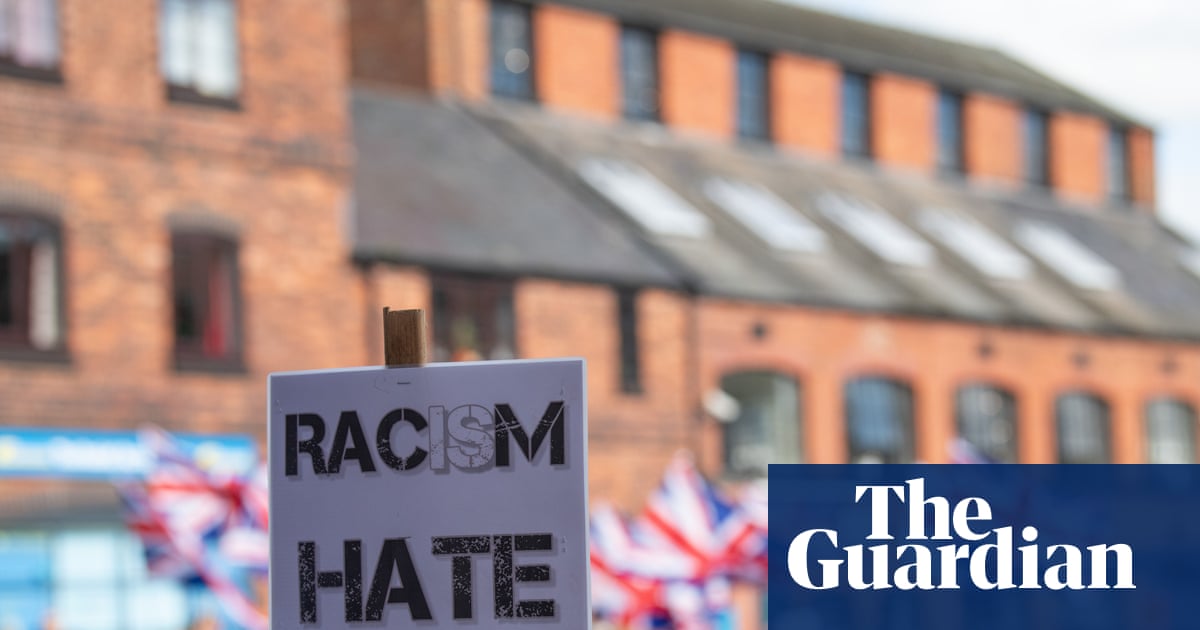


Flag campaigns and far-right intimidation have sparked a wave of grassroots anti-racism organising across England in the past 12 months, according to new research.
The Institute of Race Relations (IRR) warns that the widespread displays of St George’s cross and union jack flags have been accompanied by racist abuse and violence, with flags deliberately placed outside schools, mosques and care homes.
The report also warns that flag campaigns may be serving as recruitment grounds for far-right vigilantism, pointing to links between local groups and more militant anti-migrant networks.
But the report notes that the campaigns have also prompted ordinary residents to take action, from Quakers devising homemade tools to remove flags in Oxford to community groups documenting racist incidents in south-west London and establishing solidarity hubs in Nottingham .
Sophia Siddiqui, the report’s author, said she had been struck by the anger and frustration among people who felt compelled to act. “One person I spoke to, a 75-year-old man who has never been an activist before, seeing what was happening around him really provoked a visceral response, where he just felt like he had to get on his bike at 2am and start taking down flags.”
Siddiqui said the campaigns had “backfired” in some communities. “Whenever flags had gone up, it had been met with community resistance, which had had the opposite effect of actually bringing people together.”
Last year, St George’s cross and union jack flags appeared across England in campaigns organisers described as patriotic, but which critics linked to racist intimidation and harassment.
Ryan Bridge, a co-founder of one of the initiatives, Raise the Colours, was charged earlier this year with 14 offences, including racially aggravated harassment and assault. Bridge pleaded not guilty to all charges earlier this month.
The report, Anti-fascism from below: resistance to far-right flag campaigns, draws on interviews with community organisers in Oxford, Birmingham , London, Nottingham and Worcestershire.
Siddiqui said flag campaigns had been accompanied by racist abuse against schoolchildren, Islamophobic harassment and racist graffiti, while flags deliberately placed outside schools, care homes and places of worship in multicultural areas had created “an atmosphere of intimidation”.
In Oxford , members of the Quaker community became so concerned about the displays that they devised their own method of removing them. George, a spokesperson for Oxford Quakers who didn’t wish to give his real name, said residents feared the flags were giving a false impression of a city with a long history of welcoming refugees and asylum seekers.
“What we really disliked was the colonising of our public space by people with opposing views to give the impression that Oxford was a xenophobic place, which it definitively is not,” he said.
With the council initially removing only flags considered hazardous, and council workers reportedly facing abuse and intimidation for attempting to take the flags down, the Quakers fashioned a tool using a blade attached to an 8-metre wooden pole to cut down flags.
“We just thought there must be another clever way that will be discreet and non-confrontational. That’s the Quaker way,” George said.
In south-west London , Saqib Deshmukh, co-founder of Merton Against Racism, began documenting flag displays after spotting them on his regular running route in Colliers Wood. “I got on my bike to cycle around, and lo and behold, there were flags everywhere,” he said.
He set up a spreadsheet tracking flags and painted crosses across the borough, cross-referencing incidents with reports to the council. His group recorded nearly 50 incidents.
Deshmukh also described reports of racist abuse directed at Black and Asian residents in streets where flags had appeared, including near schools, nurseries and a care home employing migrant workers.
“This wasn’t done willy-nilly. This was very carefully orchestrated and thought through,” he said.
Despite residents lobbying councillors, contacting their MP and raising concerns at council meetings, Deshmukh said many flags remained until deteriorating weather brought them down.
In Nottingham, organisers have taken a different approach, establishing a solidarity centre in Hyson Green that offers food, legal advice, art workshops and a space for people from different backgrounds to meet.
Jagdish Patel, who is involved in the initiative, said the aim was to tackle the economic insecurity and isolation that far-right groups exploit.
“We feed people, and by feeding people, people from all different backgrounds come together,” he said.
Elsewhere last year, counter-protesters vastly outnumbered the Worcester Patriots at a demonstration in Worcester, while Birmingham residents launched a citywide solidarity poster campaign. In Oxford, community pressure helped secure an injunction against unauthorised flags on lamp-posts, with Birmingham pursuing similar action.
But challenging far-right activity has carried risks. Patel described cases of white women being harassed for expressing sympathy towards asylum seekers, while the report documents activists facing threats, intimidation and online doxxing.
The IRR warns that flag campaigns may have provided a recruitment route into more militant far-right vigilantism.
Siddiqui pointed to the emergence of Patriotic Platform, which m obilised masked men at the ports of Kent and Portsmouth in September.
She said flagging campaigns, in seeking to impose their values on neighbourhoods and punish those who disagreed, “already had some of the hallmarks of vigilantism”.
Yet Siddiqui said the research had ultimately left her hopeful about the capacity of ordinary people to challenge the far right.
“What really stood out to me was the importance of building connections locally. It’s speaking to people, engaging with people, having those difficult conversations, and building those links at a local level,” she said.