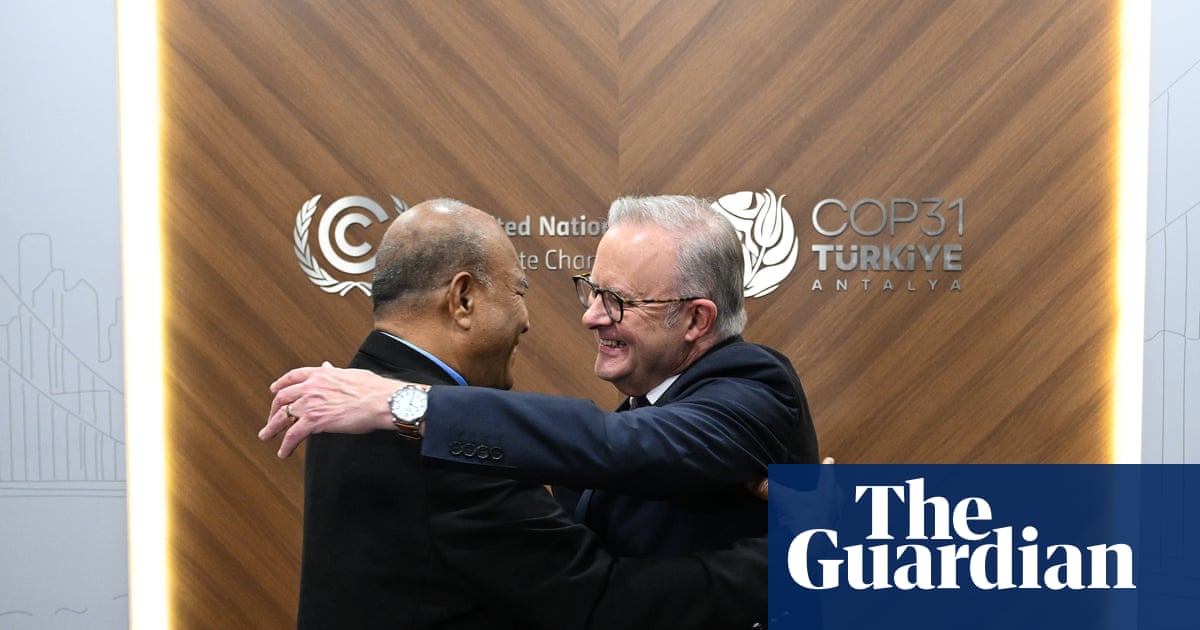
Matthew Wale (left) has been accused of funnelling budget support from Canberra into funds for government MPs. ( Reuters: Hollie Adams )
The Solomon Islands opposition has accused Australia of "chequebook diplomacy" after Prime Minister Matthew Wale funnelled budget support from Canberra.
Documents seen by the ABC show that multiple parliamentarians received "discretionary grants".
A federal government spokesperson has denied any wrongdoing, saying "all of Australia's development assistance is based on the priorities of partner countries".
The Solomon Islands opposition has accused Australia of "chequebook diplomacy" after Prime Minister Matthew Wale funnelled budget support from Canberra into constituency funds for government MPs as the two countries wrapped up negotiations on a high-profile treaty due to be signed next week.
Government documents seen by the ABC show that multiple parliamentarians in Mr Wale's 31-strong GREAT Coalition received "discretionary grants" of up to $SBD1 million (about $180,000) per MP in their constituency accounts in October and November.
The payments were made from a bank account labelled AusAID — the name previously used by the Australian government's aid agency before it was wrapped into DFAT in 2013 — which initially drew accusations of direct foreign interference from the opposition.
But the ABC has established that the bank account is not an Australian government one and belongs to the Solomon Islands government instead.
The money seems to have been drawn from a larger $SBD200 million ($35 million) package of budget support announced by Prime Minister Anthony Albanese in June this year when Mr Wale visited Canberra.
At the time, Mr Wale's government said the money would "assist Solomon Islands in responding to Tropical Cyclone Maila and addressing the impacts of global energy shocks".
The use of constituency development funds (CDFs) has long drawn scrutiny and controversy in the Pacific Island nation, and Mr Wale's actions are not unprecedented.
Manasseh Sogavare has taken aim at Matthew Wale. ( Reuters: Eduardo Munoz )
Politics in Solomon Islands is fluid and transactional, and previous Solomon Islands governments have also funnelled money from donors — including from both Taiwan and China — into CDFs for MPs, helping them to shore up their sometimes-wobbly coalitions in parliament.
But Solomon Islands Opposition Leader and former prime minister Manasseh Sogavare, who has a vexed history with Australia, has taken aim at Mr Wale, while accusing the federal government of meddling and hypocrisy.
"It puts Australian aid at the centre of our domestic politics. Australia has rightly criticised other countries for doing exactly this in the Pacific.
"It should hold itself to the same standard."
Mr Sogavare also said money from Australian taxpayers was being used to "reward political loyalty", unfairly excluding the opposition.
"The people who lose are not opposition MPs. They are the villages, schools and clinics in the constituencies left out," he said.
"Aid should go to people according to need, not according to how their member votes."
Mr Wale's office declined to comment on the documents.
A federal government spokespesron denied any wrongdoing, saying "all of Australia's development assistance is based on the priorities of partner countries, subject to robust accountability and transparency guidelines, and complies with the OECD development guidelines."
Australia has never paid money directly to Solomon Islands MPs, and the money from budget support was provided to the Ministry of Finance and Treasury in Honiara.
The federal government has denied any wrongdoing in regards to Australia's development assistance. ( Reuters: Hollie Adams )
One federal government source also emphasised that Mr Wale and his ministers, and not the Australian government, ultimately made the decisions about how to spend budget support.
But the opposition's accusation is still politically dangerous, as it comes just nine days before Mr Wale is expected to visit Canberra to sign a sweeping new "comprehensive" treaty between the two nations, less than six months since negotiations began.
In September, the ABC revealed that Australia was planning to substantially ramp up contributions to constituency development funds under that treaty, although none of that funding has yet been provided.
In a leaked text message, the Australian High Commissioner Jeff Roach laid out new commitments totalling more than $980 million under the agreement, while emphasising that both governments were hoping to lock in the pact before the end of this year.
In his statement, Mr Sogavare again criticised the timing of that text message, saying it was sent just before Mr Wale was due to face a looming no-confidence vote in parliament, and suggesting Australia was trying to prop up the prime minister's leadership to secure the treaty.
"The motion was withdrawn days later. Solomon Islanders are entitled to ask whether that is a coincidence," he said.
"Both governments should answer openly."
But his accusations are likely to rankle with Canberra, given Mr Sogavare was himself accused of using CDFs to bolster his political position when facing parliamentary challenges as prime minister.
For example, in 2021 Mr Wale — then in opposition — complained when Mr Sogavare channelled money from China into CDFs for 39 government and crossbench MPs, saying the prime minister had deliberately excluded his political enemies.
Kerryn Baker from the Australian National University's Department of Pacific Affairs said while the optics of Mr Wale's payments were not ideal, it was "definitely not the first time that opposition MPs have complained their access to funds is blocked or restricted".
"So the system isn't perfect, even before you get into political games."
There has long been a debate around the effectiveness of constituency development funds, with some development experts warning they are a vector for corruption and that they encourage patronage politics.
But Dr Baker said while there was a "risk" in contributing to CDFs, it was "probably a risk worth taking", and that the funding mechanism was "definitely more than a slush fund".
"CDFs are hugely important for development. It's a way to ensure funds reach the grassroots and can be spent on what communities need," she said.
"It's definitely not the ideal system, but Australia has poured in a huge amount of money in the past trying to strengthen central government institutions, and that hasn't been super successful.
Manasseh Sogavare was himself accused of previously using constituency development funds to bolster his political position. ( Reuters: Joe Armao/Pool )
"So trying things a different way, to try to make sure money for development reaches the people that need it, isn't necessarily a bad thing."
The Wale government has also tried to tighten up the way that some of the payments have been made to local constituencies through CDFs.
Documents obtained by the ABC, which lay out the rules for MPs who receive money through the CDFs by the prime minister's grants, make it clear that parliamentarians have to acquit the funds spent.
The documents say that using funds for "private enrichment" or "political campaigning" is expressly forbidden, and that funded projects must deliver a clear development benefit.
Dr Baker said there was "always the risk of politicisation" with the scheme, but said "that risk exists with all government budget processes".
"There's been a lot of work in recent years to regulate CDFs and provide more transparency and accountability," she said.
"And they are popular with voters. People worry about fairness, but there isn't a huge popular drive to get rid of them altogether."