Signs litter properties near Firmus's proposed AI data centre site in Prospect Vale, northern Tasmania. ( ABC News: Kelsey Reid )
Data centres store and process information.
But right now they're doing much more: they're at the centre of concern about how much their construction is stoking inflation.
And, they're a lightning rod for communities rising up against what they feel is the cost of rapid growth.
" Over the last year, we've obviously seen an absolute explosion in our pipeline," IBISWorld research analyst Andrew Ledovskikh says.
His research has found Australia currently has about 2.3 gigawatts (GW) worth of power capacity in 79 data centres.
That's enough to power about 1.5 million homes, depending how you work the numbers.
Planned projects would give Australia capacity estimated to be more than 10 times that — between 23 and 67GW — according to the Australian Energy Market Operator.
Not all projects make it, and Commonwealth Bank research forecasts 9GW of capacity by 2035.
Data centre capacity is expected to grow rapidly. ( Supplied: AEMO/CBA )
"We really are just at the beginning. This is the moment where the water sort of recedes back into the beach and everything's calm before the tsunami hits."
For advocates such as Belinda Dennett, it's an "enormous opportunity", with a construction timeline supporting our economy.
Belinda Dennett believes building data centres can help transform Australia's economy. ( ABC News: Jack Ailwood )
Lamenting that "we've missed other global technology waves", Ms Dennett said this boom was a chance to "build on our advantages in cheap renewable energy".
"That comes at a $4.1 billion opportunity a year," she said.
"We can transform our economy and ensure Australia's future prosperity."
For opponents such as Judy Gunson, however, the mushrooming sites are an "invasion" of neighbourhoods.
In recent years, data centres have become a magnet for controversy in Europe and the US over the impact of noise, light and sheer size of the centres on neighbouring properties.
Then there are environmental and economic concerns, because they use, and drive up, the cost of water and power.
US-based political scientist David McCuan has seen this issue take off, and quickly.
"They've caught fire across the country," he said.
An expert in political science at Sonoma State University, Professor McCuan said the backlash to the rapid growth of the centres meant there was "bipartisan" opposition in recent elections.
Anti-data centre demonstrators have had significant success in the US. ( AP: Marc Levy )
Anti-data centre measures were on the ballot in more than 40 different jurisdictions in the midterms.
A temporary ban, called a moratorium, is in place in New York and Texas has paused connections to the electricity grid — effectively stopping development.
" The battle that we see going on over data centres and AI, that unites both [political] sides," Professor McCuan said.
"They've affected a governor's race in Texas, they've affected local issues in zoning for what's going on in Ohio or in the Midwest. That's not something we would have forecast, say, 8, 10, 12 months ago."
That speed is being replicated in Australia.
Judy Gunson is fired up about the energy use of data centres.
"It just filled me with terror actually," she said.
"The potential to derail any slow progress we're making towards reducing [carbon] emissions by this rollout, which is using extraordinary amounts of power."
We're standing in the shadow of the Westgate Bridge, next to Melbourne's busy container port.
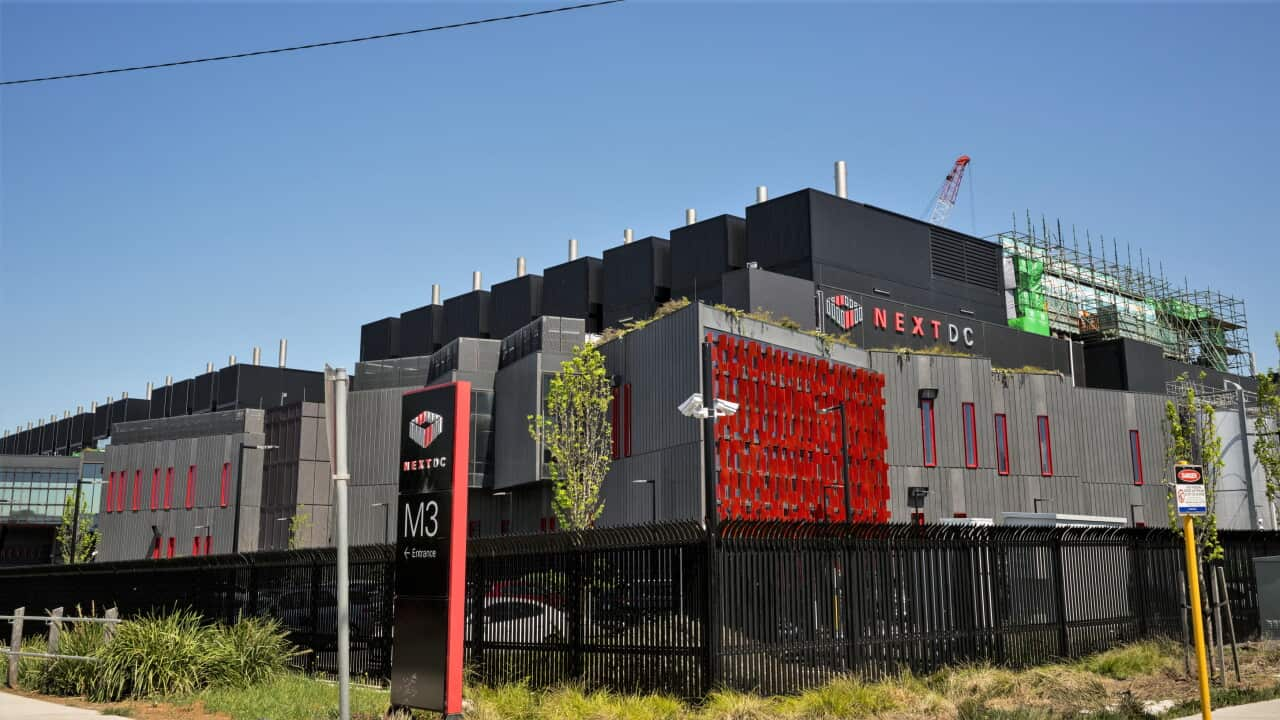
What used to be the printing plant for the Herald Sun newspaper is being cleared for a massive data centre, to be built by NEXTDC.
Judy Gunson is a spokeswoman for the Port Melbourne data centre action group. ( ABC News: Kyle Harley )
The community activist is protesting the build, concerned about the speedy pace and enormous scale of data centre construction.
Communities in Sydney and Launceston are just some of those that have objected to development of the centres.
A dispute about power poles hit plans for the expansion of an existing NEXTDC site in the inner-west of Melbourne.
The fight wiped $3 billion off the listed company's value when the share price cratered 42 per cent in one day. The share price recovered after a rival company bought up a huge amount, cheaply.
Then there is the problem of interest rates.
The Reserve Bank of Australia (RBA) is currently attempting to "cool" the Australian economy by lifting interest rates.
The aim is to lower the speed of prices rising, a force called inflation. Consumer prices are going up by 4.3 per cent annually at the moment.
Along with rocketing fuel prices due to war in the Middle East, the rapid construction of data centres and spending on artificial intelligence (AI) is often slated for overheating our economy and driving up inflation.
An internal RBA note suggests local data centre operators have raised record capital of at least $35 billion so far this year, fuelling rapid construction of AI infrastructure.
That's 46 per cent more than the 2025 figure, and even the central bank thinks it is a conservative guess.
Michele Bullock believes data centre technology is not currently putting pressure on the country's economy. ( AAP: Dan Himbrechts )
In a press conference after the most recent rate hike , RBA governor Michele Bullock said a huge proportion, "maybe 70 per cent", of data centre technology is imported, so "is not putting pressure on the Australian economy and Australian goods and services".
Where it does, she said, is in pushing up prices for scarce construction materials and skilled labourers.
"There is a chunk and it's related to building the warehouses and getting electricians to come in and install the servers and all those sorts of things.
"That does put pressure on Australian resources, and that's where it might be putting inflationary pressure in."
Ms Bullock said the hope is that, over time, data centre investment leads to gains in productivity, which would ultimately lower inflation.
For a long time, data centres looked like warehouses and were set in industrial areas.
The hyper-scale push means they're growing far larger and are increasingly encroaching on residential and farming land that brings developers into conflict with the communities around them .
The Victorian government went into a caretaker period ahead of this month's election, before Planning Minister Sonya Kilkenny made a decision on nine contentious data centre projects that had been "fast-tracked" to her office.
A statement from a Labor spokesperson, after the deadline, said all proposals went through a "rigorous planning process":
The spokesperson pointed to a policy that requires new developments to source their own renewable power and not be near schools.