Content warning: References to drugs and addiction.
It all started at house party three years ago when I was 19.
People were drinking — as they usually do at parties — but some were also using something I had never seen before: nangs.
'Nangs' is the Australian slang term for small steel canisters of nitrous oxide that are meant to be used solely in whipped cream dispensers.
But it is also the gas known as 'laughing gas', used by dentists as an anaesthetic, which makes you feel calm, relaxed and light-headed. Hence, its party appeal.
Your trusted source for staying up-to-date with the world around you. Get free daily news updates and analysis, straight to your inbox.
Like many other young people, I thought nangs were harmless. That was the impression I was under when I first tried it at the party.
But I would soon find out I was so wrong.
I felt spaced out and strange but great the first time — like I was seeing and hearing triple. The next week, I had another hit.
Within a month or two, I was travelling to different tobacconists during the day to use alone. The bulbs come in packs of 10, and I often went through 50 bulbs or 'hits' a day.
Sometimes I got freeze burns on my fingers from the pressurised gas; other times my lips went purple and I did not notice.
I was working at a cabinet factory but felt lost in life with no direction. Nangs helped me escape from feeling aimless. But it reached a point where I needed it just to function and I did it without thinking.
My mental state changed, and everyone around me could see it.
But I was doing it in complete secrecy and had a lot of shame about it. So, if anyone of my friends or family questioned why I was acting different, I would go further into the addiction spiral.
And by then, it was already too late.
After six months of heavy nitrous oxide abuse, I entered psychosis and drove from Sydney to Queensland in a paranoid, detached, fearful state.
Despite having done nothing wrong, I was paranoid that the police were after me, so I wanted to flee Sydney.
I wanted to escape problems and didn't tell anyone I was leaving.
I walked the streets of Surfers Paradise yelling at cars with an iPhone charger as a belt. My feet were dirty and cracked from walking all day.
My mind felt flipped. It was a frightening experience that I wouldn't wish on anyone.
I was far from the person I had been six months earlier — before I touched the drug.
I was sleeping in my car and hotels around northern NSW and south Queensland.
I wasn't making sense to anyone I came across and remember cutting holes in furniture and writing on walls in a hotel room.
I eventually got in contact with my parents, who were so worried about me, and booked me another hotel room when I said I was staying in my car.
They then flew up from Sydney to find me at the hotel and took me to hospital in Byron Bay, where I became extremely agitated.
Security guards pinned me down and sedated me with an injection.
Later that night, I woke up in a psychiatric hospital.
Being in a psych ward was disorienting. I did not fully understand why I was there, even though I remembered everything that led up to it.
I was not allowed to leave the hospital for two months until the doctors cleared me. But I needed that two-month reset to get clean.
During this time, I was heavily medicated and did small group activities like drawing and collaging.
It wasn't a pleasant place but being locked in the ward is what worked for me.
I met some good people, but everyone there was struggling.
Going back to Sydney was harder than being in the hospital as I was put on anti-psychotic medication for a year and a half.
I stayed in bed almost all day and night — unable to do basic things like showering or brushing my teeth.
The only activity I could really muster — in my trauma of the recent months and poor mental health — was going to my psychology sessions.
But my family and extended family were there every day, trying to help and motivate me. However, I was still a shell of a person. No drive, no will, no hope.
Eventually, I started praying and reading the Bible, which gave me a sense of belonging when I felt locked away from the world.
And as I was weaned off the medication after a year-and-a-half of being on it, my family encouraged me to go to the gym, and I eventually agreed.
It was probably the best decision I've ever made.
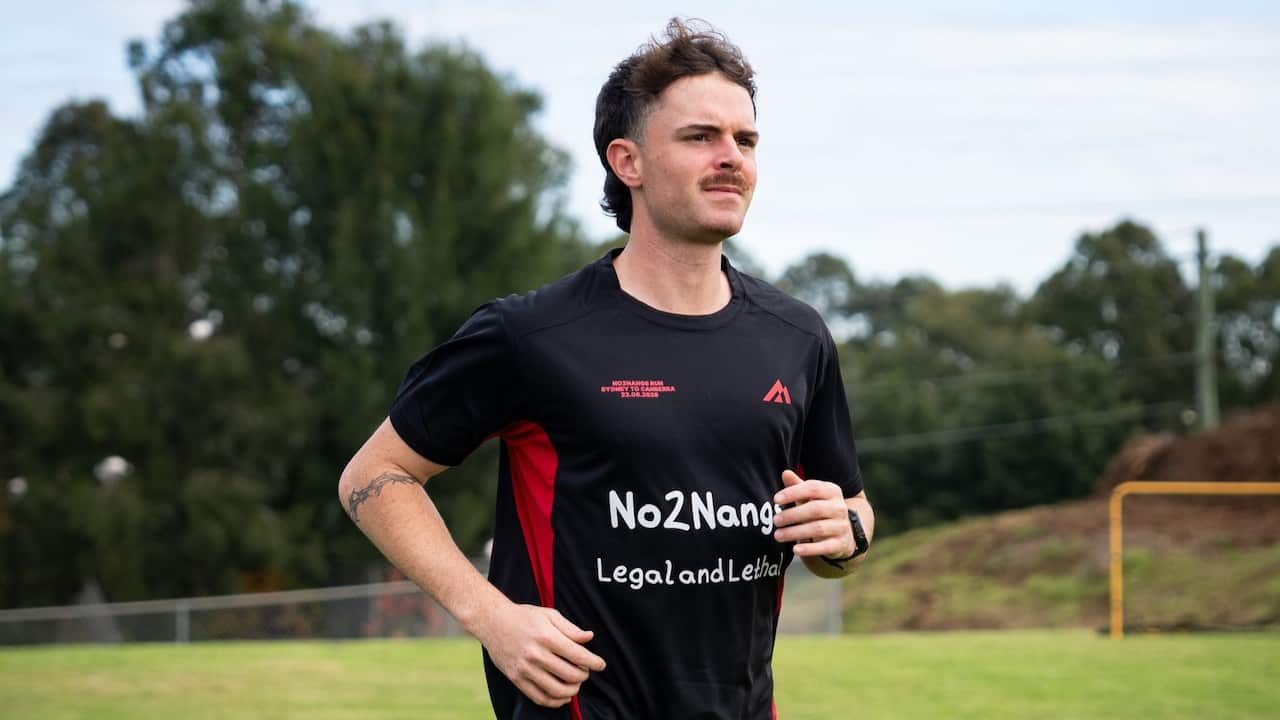
I was exhausted after only a few minutes the first day I got on the treadmill. But it gave me an idea: I would run from Sydney to Canberra — about 300km — to raise awareness of nitrous oxide misuse and call for law reform.
I trained by running for hours nearly every day for a year. It became like therapy while I worked towards the goal of raising awareness.
I also messaged almost every journalist in Sydney asking them to cover my story, and one article led to another. I appeared on news segments, radio stations and podcasts to get the message out there before the run.
Then at 6am on 23 June of this year, I set off for Canberra on foot — with the support of 200 people sending me off.
There were moments of real physical pain, and I was scared I wouldn't be able to finish the run, but I somehow was able to do it.
Three days later, I arrived at Parliament House with a group of people waiting.
I was exhausted but it was the best adventure and the moment I had dreamed of for over a year.
A week later, I stood next to the NSW Health Minister Ryan Park at a press conference where he announced law reform on nangs, and he also acknowledged my advocacy in pushing for the regulation change.
And as of 5 November, the new restrictions on the sale and supply of nangs, especially to minors, have been in force.
Seeing the changes happen made me feel thankful to be alive and hopeful they would help others think twice before trying nangs.
In recovery, my life is good. I am spending quality time with friends and family, training to host a 24-hour run to raise money for different charities and am working on an education program for schools about drug addiction.
My goal is to visit every high school in NSW if they'll have me.
As someone with lived experience, I hope I can connect with people so they can learn and aim higher in their own lives after hearing my story.
For anyone struggling with addiction and the cloud hanging over them: you are not alone. Other people are going through what you are right now.
Knowing others have overcome worse situations gives me hope and lights a fire.
It tells me to wake up, take control, bit by bit, and do better.
Wanting a better life means doing what it takes to get one. Do not stop thinking about, and acting on, getting yourself out of that cloud.
Readers struggling with their use of alcohol and other substances can contact the National Alcohol and Other Drug Hotline on 1800 250 015 for free and confidential support 24 hours a day, 7 days a week.
For crisis and mental health support, contact Lifeline (13 11 14), SANE Australia (1800 187 263) or 13Yarn (139 276), a 24/7 Aboriginal & Torres Strait Islanders crisis support line.
And for more stories on sex, relationships, health, wealth, grief and more, head to Insightful — an SBS podcast series hosted by Kumi Taguchi. Follow us on the SBS Audio App , Apple Podcasts , Spotify , or wherever you get your podcasts.
Insight is Australia's leading forum for debate and powerful first-person stories offering a unique perspective on the way we live. Read more about Insight
Have a story or comment? Contact Us