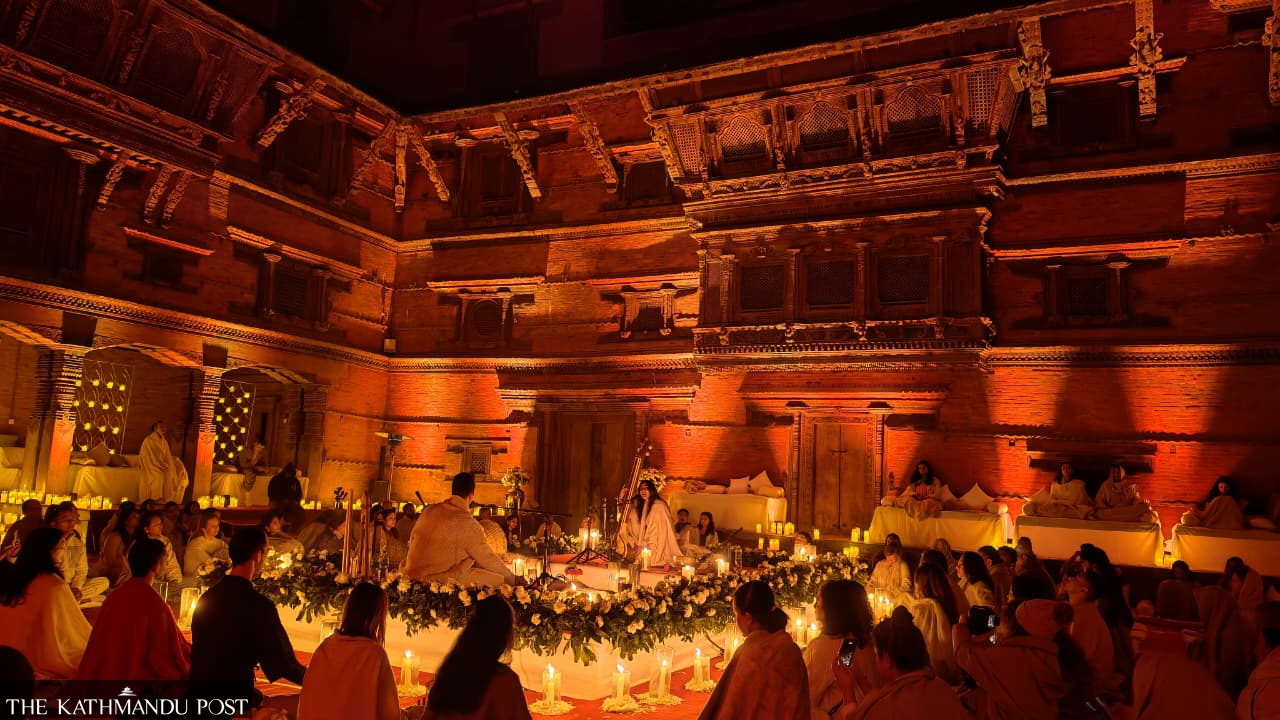
Beneath the November night sky, a plane passed overhead as a cool breeze swept through a courtyard at Hanuman Dhoka in Basantapur Durbar Square, Kathmandu. Surrounded by centuries-old architecture, the courtyard on Friday welcomed participants into the world of Nākaloka with candlelights, the fragrance of white chrysanthemums (godawari) and a warm, inviting atmosphere.
Nākaloka , a sanskrit word meaning “the heavenly world”, is an immersive spiritual experience that brings music and sacred practices. Founded in 2021 by Monica Dogra and Victorien, the initiative has travelled to more than 10 countries including Germany, France, the United Kingdom, Indonesia, India and Sweden. On Friday, it made its Nepal debut at a historic site within the Kathmandu Valley UNESCO World Heritage property.
A travelling, non-profit initiative, Nākaloka presents its gatherings on a donation basis in association with charitable causes. The historic palace complex, once home to Kathmandu’s Malla and Shah rulers, provided a setting for an evening that brought together music, spirituality and reflection.
The event began with Dogra singing the verses “Come, come, whoever you are” a Sufi quatrain attributed to the 13th-century Persian poet Rumi. The poem’s central message of acceptance and return invited participants to embrace the possibility of beginning again regardless of their past. Its repeated invitation to “come again” set the tone to reflect on our own lives, revisit memories of loved ones and acknowledge emotions we might have held back.
The singing was followed by the resonant sound of Tibetan singing bowls, accompanied by slow, meditative music. As the sounds filled the courtyard, Dogra recited reflections on devotion, love and surrender which encouraged participants to let go of control and embrace their emotions.
“This ache in your heart is holy,” Dogra said. “Accept it as a rise in intimacy with life’s secret ways.”
The music also drew on instruments from different traditions. Victorien played five wooden flutes, including Native American flutes and Egyptian clarinet.
“For me, it’s been a way of liberation and communion,” he said. What began as a personal healing tool gradually became something he could share with others.
Dogra accompanied the singing with tanpura, an Indian string instrument that produces a continuous drone to support singers. Her connection with the instrument is deeply personal, she said. When her mother left home when Dogra was 12, the tanpura became the only way to connect with her mother. “As a way to connect with my mother, I always wanted a tanpura,” she said. The instrument she played during the event was gifted to her by her partner, Victorien.
Dogra then turned to the stories of spiritual mystics, introducing the devotion of 16th-century Bhakti poet Mirabai. Through verses attributed to Mirabai, she described the longing to find the beloved in the simplest elements of nature, imagining herself as a bee entering a flower.
Dogra also spoke about the spiritual significance of sound, referring to the Vedic understanding of Sanskrit as a “language of vibration” , in which the vibration of a word corresponds to the vibration of what it describes. She connected this idea to Shiva and Rudra, reflecting on destruction as a force that makes renewal and expansion possible.
“We lay flowers at the feet of all destruction, knowing it is the only way we may know expansion,” she said.
Moving on to the Bhagavad Gita, she reflected on divine love and devotion through the story of Krishna and Radha before singing the bhajan ‘Jaya Radha Madhav’ , which celebrates their divine bond.
She called participants to remember those who had shaped their lives and those who had come before them. The group was then led in chanting the Buddhist mantra ‘Namo Tassa Bhagavato Arahato Samma Sambuddhassa’ (I pay homage to the Blessed One, the Worthy One, the Fully Enlightened One) three times. In Theravada Buddhist tradition, the salutation is repeated as an expression of reverence to the Buddha.
In between, Dogra shared that her father left his body on November 8, and that the day of the gathering would have been his 80th birthday. “I believe he’s here,” she said, inviting participants to remember and connect with their own departed loved ones through the prayer.
One of the key parts of the experience was a body-shaking practice led by Victorien, who invited participants to stand and move their bodies. Beginning with gentle knee movements, he encouraged them to gradually involve their hands, shoulders, arms and the rest of their bodies. He described shaking as a way of releasing stagnant energy and allowing emotions such as grief, sadness and joy to move through the body. Participants were encouraged to follow their own pace and movement rather than imitate others.
“You are responsible for your own liberation,” Victorien reminded them.
Participants were then invited to sing the “I’m Feeling Good” chorus three times as a spiritual practice, with each repetition carrying a different intention.
After the collective singing, the courtyard fell silent for ten minutes before participants began sharing their thoughts, calling the gathering a Sangha, a community united through spiritual practice. Dogra encouraged those present to speak about whatever had surfaced during the experience, whether memories, emotions or thoughts of loved ones.
The evening concluded with participants chanting Om together three times, bringing the gathering to a close with a moment of collective stillness.
In the end, it was announced that Rs31 lakh had been raised for the cause that night. The Dwarika’s Foundation, in collaboration with the Dolpo Tulku Charitable Foundation, has been working towards establishing Shankarapur Residential School for children affected by recent flash floods and other disasters. The proposed school aims to provide children with a safe residential environment, education and long-term support.
Asking some participants about their experience, Anna Minakala, an artist and journalist from Bangkok, travelled to Nepal specifically to attend Nākaloka. Despite having to return the following day, she said she did not regret making the trip. She described Nākaloka as a complete artistic experience rather than something to be divided into individual performances.
“It was like an art piece,” she said.
Similarly, Holiska Koirala, 28, a Kathmandu-based businesswoman, said the most memorable part was a moment of complete silence.“When we were sitting in pin-drop silence, you kind of reflect on the whole event and your life every day,” she said.
The idea behind Nākaloka grew from an intimate practice of prayer and music. Monica Dogra and Victorien, its creators, began singing and praying together at home, gradually sharing their music with others after people invited them to perform at birthdays and weddings.
For Victorien, Nākaloka became “a collective and universal prayer”, a way to come together. Through music and spiritual practices, they both hope to help people connect with something beyond themselves.
“We wish to create an experience of the divine,” Dogra said, “not as a concept, but as something that you can feel in your own heart.”
Shrestha is an intern at the Post's Culture and Arts desk. She is studying journalism and English literature at St. Xavier's College.