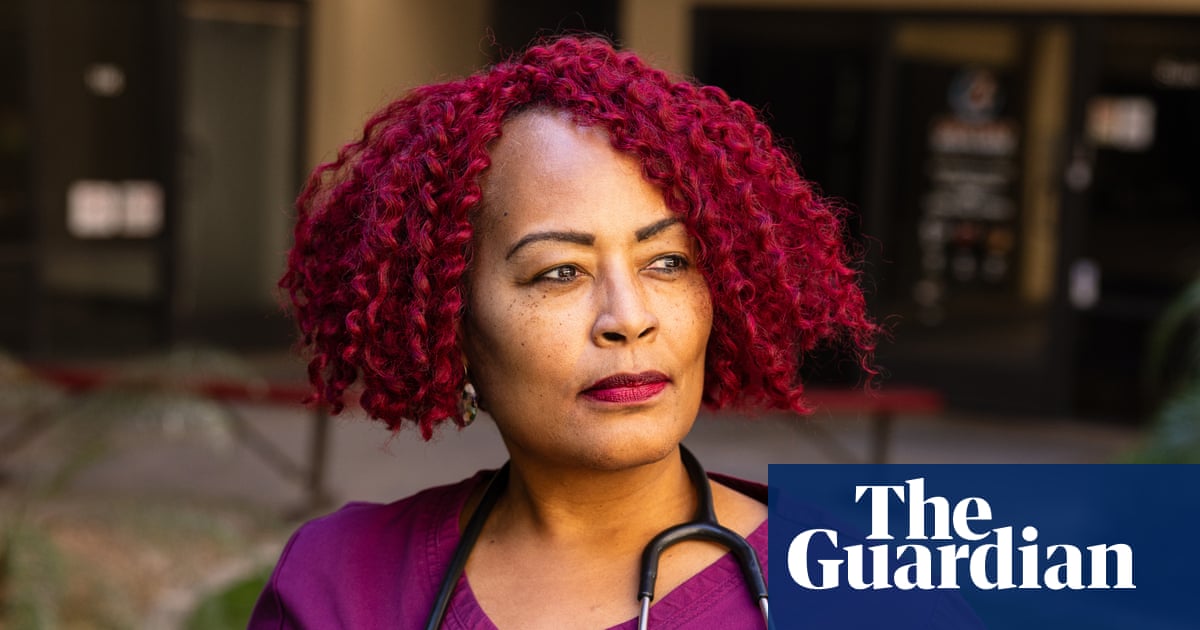


When gynecologist and abortion provider Dr DeShawn Taylor has conversations with patients about the afterlife, they ask her if they will be condemned for their choices. To quell their concerns, she shares with them bible verses about free will. “If God wants that vessel, that spirit to get here, God will choose another vessel. You get to say, ‘I’ll pass,’” Taylor said at her clinic one spring afternoon, her short curly hair matching the color of her maroon scrubs. “I think that makes people feel a lot better with that understanding.”
As the founder and CEO of Desert Star Institute for Family Planning in Phoenix, Arizona, Taylor heads the only Black woman-run abortion clinic in the state, which also boasts a staff of women of color. On a Tuesday in March, pop music wafted throughout the waiting room filled mostly with Black and brown women, some with their children in tow. Bilingual posters about abortion care taped to the wall reflected the diversity of the clinic’s staff and clientele. On 6 February, an Arizona judge struck down state laws requiring patients to receive an ultrasound and to wait at least a day before receiving an abortion. With abortions now more accessible, a steady stream of clients poured into the office the week that the laws were repealed. By mid-March, appointments had petered out to a more manageable about 10 services a day.
Following the supreme court’s overturning of the constitutional right to terminate a pregnancy in Dobbs v Jackson Women’s Health Organization in 2022, states have independently held the authority to regulate abortion access. In the aftermath, Arizona placed restrictions on abortions that advocates fought against in court. Two years later, Arizona voters enshrined the right to abortion in the state constitution .
Amid the rapidly changing tides of the legal system, Desert Star Institute for Family Planning – one of nine brick-and-mortar abortion clinics throughout the state – has remained at the forefront of providing abortion care and gender affirming services to a diverse client base. Taylor, along with some of her staff, are Christian women who sometimes provide support to their religious clients by joining them in prayer prior to a procedure. Taylor’s faith has undergirded her resolve in continuing to operate the clinic. “How did abortion become the one sin that you can’t repent for?” Taylor said. “Granted, I don’t think abortion is a sin, but even if you think it’s a sin, it’s still forgiven. God is forgiving already.”
In states with abortion restrictions, marginalized people are dying, said Loretta J Ross, an associate professor of the study of women and gender at Smith College. In a post-Dobbs world, people are traveling out of state or are turning to abortion pills. Taylor is “special”.
“She’s choosing to put her career and her license on the line to serve the people who have the least access, and the most need,” Ross said. “In my 50 years of working in the movement, it’s usually those doctors that have that particular passion for serving the underserved that risk … at least losing their license, and having their families attacked. In many ways, they’re the heroes of the movement.”
The clinic is also unique because, along with abortions, clients can also receive wellness exams, checkups for routine gynecological issues, and birth control. “Abortion is healthcare,” Taylor said, “so when people come to have an abortion, they should just feel like they’re at the doctor’s office.” Over the past six years, the clinic has also offered gender-affirming hormone therapy. “It’s been a struggle to keep the clinic open, and I’ve had consultants come in and try to change the model. Of course it’s less expensive to just concentrate on one thing,” Taylor said. “But if we ever did that, then why should this clinic be here? Then it becomes no different than any other abortion clinic. We’ve created something here that is very special. And patients recognize that.”
Taylor wanted to be a medical doctor since she was six years old. In middle school, she participated in a program for Los Angeles youth interested in healthcare, where she decided that she’d become a brain surgeon. But after reading the book Gifted Hands by Ben Carson while she was a sophomore at the University of Southern California, Taylor said she learned that “I didn’t believe it to be my personality, that I could do the best I can for someone and they could die anyway.” After further contemplation, she decided to dedicate her career to taking care of women. Taylor pursued a doctorate of medicine at the University of California, Los Angeles and completed a residency in obstetrician gynecology because she loved being in the operating room, she said: “What I love about it is I can actually fix people’s problems.”
As a child-free and single physician living in California, Taylor bought a home in Arizona when her mother retired there. At first it was her vacation home, but then she decided to move to Arizona to work for a statewide reproductive health organization until she founded her own clinic in 2013. Taylor, 51, ran the clinic on her own for ten years until she sold it to her nonprofit at the end of 2023 so that it could receive grants and host fundraising campaigns to foster self-sustainability. She’s also created another stream of income through speaking engagements and advisory boards, which allows the nonprofit to be less encumbered by her salary.
Through the nonprofit, she also trains future abortion providers, including residents, interns and physician assistants. Last year, the nonprofit started a birth justice hub where it convenes birth workers, abortion doulas (who provide emotional and physical support to people throughout their abortions), and activists to meet in person every four months to discuss how they can work together to support their communities. As Taylor has grown in her career, she’s butted against anti-abortion Christians who have questioned her belief system. She grew up in a spiritual, but non-religious family that sometimes visited Kingdom Halls, worship centers for Jehovah’s Witnesses, because her dad enjoyed the teachings. Taylor said: “We didn’t go knocking on doors.”
While some of her extended family were evangelicals, Taylor’s parents encouraged her to embrace her own ideologies. “I actually got baptized as an adult,” Taylor said. “My mom told me that she didn’t baptize us because she wanted us to come to that decision on our own.” Taylor’s faith didn’t initially inform her work until she realized that “this is a political issue that people religiously conscientiously object,” she said. “I call BS, because I sleep fine at night, in my Christian beliefs and providing abortion.”
But then in the spring of 2017, the anti-abortion group the Center for Medical Progress released undercover footage of Taylor at a Planned Parenthood conference. In the secretly recorded video, Taylor talked with Center for Medical Progress investigators who claimed to be buyers from a biotech company. The group edited the context of her quotes about fetal tissue being used for medical research, describing it as evidence that abortion providers possibly covered up infanticide. “That ignited me”, Taylor said. As someone who had studied the Bible, she was indignant that Christians used their faith to justify harassing her as an abortion provider. “I’m about to be a Christian provider out loud.”
When she published her book Undue Burden: A Black, Woman Physician on Being Christian and Pro-Abortion in the Reproductive Justice Movement in 2023, Taylor wanted to make a statement about the identities that she brings into her profession. “Faith and abortion is the conversation that everybody wants to have,” Taylor said. “I’m no theologian; I’m a Christian working on my own salvation.” Earlier this year, Taylor also published the workbook Beyond Choice: An Essential Workbook for Personal and Community Transformation Through Reproductive Justice . The book uses prompts, exercises and case studies to help readers connect their spiritual beliefs with reproductive choice and to stave off burnout in their political action.
A turning point for the clinic came more than seven years ago when a patient asked her if she believed in God and if she would pray for her before she received the medication for a surgical abortion. As the woman lay on the exam table, Taylor held her hand, and they both closed their eyes to pray to God aloud. Since then, patients have occasionally asked to be prayed for prior to services. “It has created safety for my patients of faith who have comfort in the knowing that their doctor also has a faith,” Taylor said. “ Sixty per cent of people who have abortions have a faith, and there aren’t many providers who, one, outwardly communicate that they have a faith, and two, actually have a faith.”
While it is sometimes surprising for the public to learn that an abortion provider is religious, people of faith have long supported abortion, said Dr Carole Joffe. She’s a professor in the Department of Obstetrics, Gynecology and Reproductive Sciences at the University of California, San Francisco. Some clinics have even hired chaplains on their staff to counsel patients.
Christianity and abortion have a long intertwined history. The Catholic church accepted early-term abortions as a way to save a woman’s life until 1869 , when Pope Pius IX forbade terminating a pregnancy at any stage. The narrative that many Christians are against abortion became widespread 50 to 60 years ago, after states began leading the charge in legalizing abortion.
“It was clear something like Roe was going to happen, and one of the first groups to mobilize against it was the Catholic church. They became very, very active in leading the forces opposing it,” Joffe said. Then in the late-1980s, evangelical Randall Terry founded Operation Rescue, a militant group that blockaded clinics through sit-in demonstrations. “The most high-profile opponents of abortion were very strongly associated either with the Catholic church or with the evangelical movement. But that doesn’t mean that there were no supporters of abortion.”
In 1967, six years prior to Roe v Wade, a covert group of ministers and rabbis formed the Clergy Consultation Service on Abortion to help women safely terminate pregnancies after seeing people die or be injured from unsafe abortions. The faith leaders helped an estimated 500,000 women by negotiating lower costs with doctors and referring them to abortion providers. After abortion was legalized in 1973, a new group grew out of the service, Religious Community for Reproductive Choice , where people of faith advocate for access to safe abortions by lobbying politicians and blessing abortion clinics .
What makes Taylor unique is that, along with being an abortion provider, she writes about her experiences through her books. “She’s really a spokeswoman within the African American community and beyond of what it means to be a person of faith providing this service,” Joffe said. Taylor’s role as a Black abortion provider is also significant in light of the racist origins of anti-abortion propaganda, said Regina Mahone, the co-author of Liberating Abortion: Claiming Our History, Sharing Our Stories, and Building the Reproductive Future We Deserve . The American Medical Association, composed of white male physicians, launched its first anti-abortion campaign in 1857, in part, to delegitimize midwives. At the time, Black, Indigenous and immigrant midwives provided most reproductive healthcare, including abortions. White male physicians sought to wipe out the competition of Black midwives by portraying them as unhygienic. The doctors encouraged state lawmakers to ban abortion, resulting in the creation of at least 40 anti-abortion laws in the late 19th century.
Anti-abortion sentiments in the late 1800s were “rooted and deeply tied to these racist and sexist ideas of controlling the fertility of women to preserve the numbers of white people in this country. And also continuing to control Black women’s bodies after slavery, because these physicians who are pioneering this field of obstetrics and gynecology were savagely experimenting on Black women … to heal white women’s bodies,” Mahone said. “And so it was never, and has never been about this argument about the right to life.”
The anti-abortion campaign continues to affect Arizona politics more than 150 years later. Following Dobbs, Arizona prohibited abortions past 15 weeks of pregnancy , with no exception for rape or incest. To ward off continued restrictions, Arizona voters chose to enshrine the right in their legal framework. In 2024, Arizona became one of seven states to establish abortion access as a fundamental right in its state constitution, while 13 states now have total bans on abortion .
In recent years, the American Civil Liberties Union of Arizona and Arizona healthcare providers have filed lawsuits against the state to strike down several longstanding abortion restrictions. In March 2025, a Maricopa county superior court judge lifted a ban on abortions past 15 weeks in Reuss v Arizona, ruling that the prohibition violated the 2024 constitutional amendment. Then in February 2026, a court permanently blocked the law requiring a 24-hour wait, laws prohibiting abortions for fetal conditions, as well as a ban on telemedicine in Isaacson v Arizona.
But the fight isn’t over, said former ACLU of Arizona senior staff attorney Lauren Beall. “There are many folks in the legislature who are still seeking to restrict abortion access in whatever way they can, despite the voters approving this amendment, despite a very clear message that this is not a partisan issue,” Beall said, adding that the Arizona Legislature spent more than $800k of taxpayer money to uphold abortion restrictions in Isaacson v Arizona. “The people of Arizona want a fundamental right to abortion.”
Along with being vocal about her religious beliefs, Taylor has also embraced politics in recent years. She convened the coalition Arizona Proactive Reproductive Justice Alliance , consisting of community-led groups such as the local Black Lives Matter chapter and the ACLU of Arizona, to fight abortion restrictions in the state. She and other coalition members worked with lawmakers Senator Analise Ortiz and congresswoman Sarah Liguori to draft legislation including repealing parental consent for minors seeking abortion care, though the Republican-controlled legislature has continuously stalled the bills.
As political volatility remains at play outside the clinic, Taylor’s staff and clientele view Desert Star Institute for Family Planning as a safe haven. Annie Nguyen, a 27-year-old Vietnamese woman, joined the clinic as a registered nurse last December after being inspired by Taylor’s speech about a woman’s right to choose at an abortion rally last winter. She wanted to work with a woman of color who was vocal about her beliefs.
Originally from Louisiana, one of the first states to ban abortions in 2022, Nguyen long dreamed of working as an abortion provider. She’d assisted many of her friends in accessing safe abortions by identifying other states they could travel to for their procedure or helping them pay for the service. “Ever since I was younger, I always loved the history of feminism and Roe v Wade,” Nguyen said. “I grew up in a Catholic school all my life, and it was always so frowned upon to say abortion. And so I just thought: ‘Then who can speak for these people?’”
“You can tell Dr Taylor really cares,” Nguyen said, who appreciates her patient-centered approach. “I don’t think any of our patients ever feel pressured. Dr Taylor is so good at learning every single one of her patients that walks through the door and listens to what they say. It’s their choice.”
Waiting in the consultation room, a 31-year-old Mexican American client who chose to be anonymous, said that the Black and brown staff “makes me feel more comfortable”. Another aspect of the clinic that helps people feel more at ease, said Nguyen, is that because of its secluded location, where it’s sandwiched between other businesses, there are no protesters outside.
In the spring, Elizabeth, a family medicine resident, temporarily joined the staff as part of a three-week elective at her school in another state to gain experience in abortion services. “I can tell how much it means to the patients to have quality care from people that look like themselves,” said Elizabeth, who is using a pseudonym out of fear that funding for her residency program could be jeopardized. An Asian American woman, Elizabeth said she was drawn to Taylor’s clinic for its diversity and reputation as providing a well-rounded approach to abortion care. “With all of the injustices that we’ve been seeing with ICE and immigration so far”, Elizabeth said, “it’s very important to be able to uplift our immigrant communities and let them feel that they are valued.”
The staff’s religious background, some of whom are Christian, helps them empathize with their patients. Rose Espericueta, a 29-year-old Hispanic woman, has worked as the clinic manager for five years. She decided to join the clinic to offer support to Spanish-speaking patients, since most of the clientele are Latina. A practicing Catholic, Espericueta helps provide solace to religious patients who question whether abortion aligns with their spiritual beliefs. “I always tell my patients who struggle because of their faith, there’s people doing actual crimes out here,” Espericueta said. “I don’t think God is judging you for having an abortion.”