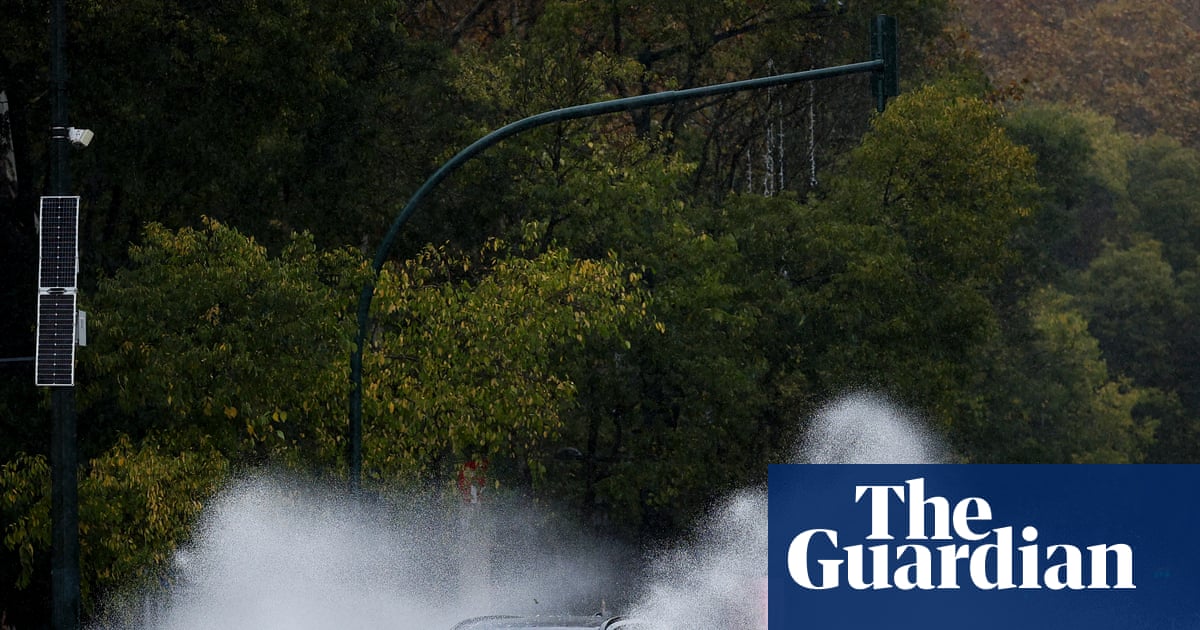
Weather forecasts have become much more reliable over the past century. ( ABC )
It's not easy to forecast the weather in the Southern Hemisphere.
Atmospheric scientists such as Kimberley Reid from the University of Melbourne face a number of unique challenges that make observing weather trickier here than in the Northern Hemisphere.
"The Northern Hemisphere has … so much more land mass. There's more people and more funding for observations, and more major cities," Dr Reid said.
"In the Southern Hemisphere … we don't have as many surface observations, or as many weather balloons, which are all necessary for working out what's going on."
Despite this, in recent years the Southern Hemisphere has narrowed the forecasting gap, with accuracy that almost matches our northern counterparts.
This isn't due to extra weather stations or balloons but rather an increase in data provided by international satellites, according to the Bureau of Meteorology (BOM).
Accurate forecasting can lead to more time to prepare, which can help save lives. ( ABC News: Tahlia Davis )
While this has provided a wealth of data for weather forecasting around the world, experts warn that satellites can't help forecast everything.
And as weather gets more extreme, forecasters are turning to new technologies and techniques to keep up.
Humans have been trying to predict the weather for thousands of years , but it's only in the last few decades that forecasters could peer into the future with any kind of certainty.
Short-term forecasts between one and three days are reasonably accurate, but the further into the future the forecast looks — up to five or so days — the less dependable they are.
According to Dr Reid, this is because weather is particularly chaotic, and tiny variables can end up having "large flow-on effects" over just a couple of days.
This compounds when there are fewer locations to collect data points.
This has historically been the case in the Southern Hemisphere where Dr Reid said there just isn't enough land for equipment.
"We can't stick weather stations in the ocean," she said.
This lack of data was visible in the historical accuracy gap between the two hemispheres.
In the 1980s, a three-day forecast was about 90 per cent accurate in the Northern Hemisphere, but just over 80 per cent in the Southern Hemisphere.
Michael Logan, general manager of decision support services at the BOM, said this improved over the next two decades, but the Southern Hemisphere still lagged behind into the 2000s.
The introduction of data from specialised weather satellites helped close the gap.
Australia doesn’t have its own weather satellites, but instead uses data from 40 satellites owned by countries including the US and Japan.
While some satellites orbit the Earth, others stay above one location by following the planet's rotation.
The copious amount of globally shared information produced by these satellites is vital for groups like the BOM, providing more than 90 per cent data for weather forecasts.
Weather satellites like Japan's Himawari 8 and 9 are very important for modern weather forecasting. ( Wikimedia: Himawari89 / Japan Meteorological Agency / CC BY 4.0 )
"For the Bureau, even just what we use in our weather predictions, it's of the order of 13.5–14 million observations every day coming in from these satellites," Mr Logan said.
"That's contributed an enormous amount of data that really helps with the numerical computing models."
But according to Martin Jucker, an atmospheric climate scientist at the University of New South Wales, many of the satellites are coming towards the end of their life.
"The really big [worry] is new satellites that were supposed to replace old ones have been cancelled," Dr Jucker said.
"So these satellites will reach their end of life and replacements will be late."
Forecasting extreme weather events has become increasingly important as the world's climate changes.
"We're making sure that we're improving the skill of predicting the big weather events, whether it be cyclones or really extreme rainfall or extreme heat," Mr Logan said.
Along with using satellite data, forecasters are turning to AI to hone their models.
"AI … has been around for a fair while," Mr Logan said.
BOM, for example, already uses Google DeepMind's forecasting system for cyclones.
In 2024, the system was shown to predict the weather 15 days ahead and more accurately than the best system currently in use.
"It's impressive what it can do," he said.
Despite advances in AI, accurately predicting some extreme weather phenomena is still a major challenge .
Dr Reid's research focuses on atmospheric rivers, which produce large amounts of rainfall or snowfall over a region when they hit land.
"An atmospheric river is a long, narrow region of enhanced water vapour transport in the lower atmosphere," she said.
Understanding when and where weather patterns created by atmospheric rivers will hit well in advance can help limit damage and casualties.
In 2022, an atmospheric river caused both the Brisbane and Lismore floods .
"Having more observational data has the potential to improve the timing and location of extreme rainfall forecasts so that people have plenty of time to evacuate if needed."
To get more data you need to get up close to these sky rivers.
Hurricane hunter planes are able to get much more information than a satellite or weather station. ( Wikimedia: Lieutenant Commander Andrew Utama/NOAA Corps/Public Domain )
In the US, air crews known as hurricane hunters, fly airplanes directly through atmospheric rivers to gain data.
This extreme close-up information can be used alongside satellite data and modelling to provide more accurate forecasts.
"They ' ve got some good results showing these improved observations improve [forecasting for] where and when these atmospheric rivers will hit," Dr Reid said.
"The more information you have at the present time, the better your forecast will be."