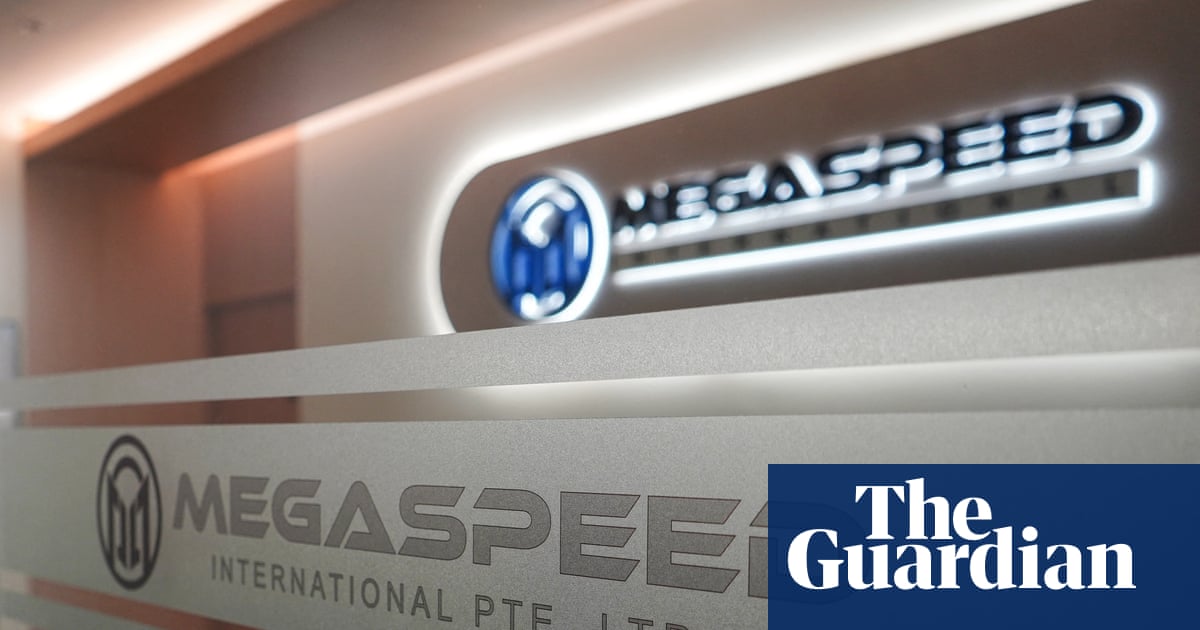


A lottery retailer in rural Australia, a dilapidated storefront in Kuala Lumpur, and a near-empty office in Singapore: the global facades of Megaspeed International, the company linked to the downfall of Nvidia chief Jensen Huang , form a puzzling corporate picture.
The company, which is registered in Singapore , has registered affiliates across the US, Asia and Australia, but individuals at its offices say they know nothing about the cloud computing firm at the centre of a global spy scandal.
On Friday Huang resigned as chief executive of the chip manufacturer Nvidia after reports of extramarital affairs with an alleged Chinese spy and two company employees. US intelligence agencies believe Huang had been targeted by Alice Huang (no relation), the former director of Megaspeed International.
US officials believe Huang was acting as a Chinese intelligence asset, passing commercial information to Beijing, the New York Times has reported .
On Thursday, Singaporean authorities said Alice Huang had been barred from re-entering the city state after a 2025 investigation into the company.
Singapore police said last October they were investigating Megaspeed over “suspected breaches of our domestic laws” after a US senator requested the commerce department investigate whether the firm had diverted Nvidia chips.
The ministry of home affairs said this week it had held Alice Huang’s passport from June 2025 until February over “potential false declarations” related to Megaspeed. Eventually, she was released with a stern warning.
Earlier this week, authorities in Taiwan said she had also been barred from re-entering there.
On Friday Malaysia said it was investigating a subsidiary of Megaspeed International over the possible diversion of advanced AI chips to other countries.
Across the region, Megaspeed’s activities remain obscure.
In Sydney, no signage, mailbox or physical presence suggests the company at the epicentre of one of the biggest stories in the world is located on the 10th floor of an office building in the city centre.
“Do you have an appointment?” a receptionist asked when the Guardian visted the office, home to numerous businesses. It hummed with activity but no one had heard of Megaspeed Australia or its listed director, 29-year-old Kai Kang.
Megaspeed International filed papers in the US state of Delaware and with the Australian Securities and Investments Commission (Asic), showing the affiliates were created in 2024. Both filings list the Shanghai-born Kang as the sole company officer, either as director or president.
The Australian filing also lists the Singapore-based parent as the company’s stockholder.
Reuters visited the home address provided on the filings for the affiliates – a small store, a news agency and lottery retailer, in Seymour, Victoria, about an hour’s drive north of Melbourne.
A woman, who identified herself as Kang’s mother, said she had run the business for about 16 years. She said Kang was based in Shanghai and did not know anything about the Singaporean company.
“He doesn’t have any business here,” she said, adding that Kang had completed his master’s degree at Shanghai University.
He had visited his parents most recently in August and September, she said.
She said she knew about Nvidia and Megaspeed but her son had nothing to do with the company in Singapore.
It is not the only perplexing finding that journalists have encountered when trying to track down representatives of Megaspeed, which in the past three years has been one of Nvidia’s biggest foreign customers, purchasing nearly $5bn in AI chips and advanced hardware.
The Straits Times reported that Swiftdata, the little-known company that owns Megaspeed, had a registered business address in Singapore, but an interior design firm said it had occupied the premises for more than four years.
Last year the New York Times visited Megaspeed’s Singapore headquarters, located in the central business district, but found only two employees present.
And in neighbouring Malaysia, the Times found that one of Megaspeed’s offices was a dilapidated storefront in the capital. Another was located in a shopping mall. When one employee emerged in the mall, she was asked what the company did.
Kang is also registered as a director in Megaspeed’s Malaysian, Indonesian and Thai units.
Kang has not been accused of any wrongdoing. Attempts to contact him were unsuccessful.
In Australia, a former intelligence officer said they expected Australian security agencies would have sought briefings from overseas counterparts about Megaspeed or undertaken their own assessments of the local subsidiary this week.
Michael Shoebridge, the director of the security thinktank Strategic Analysis Australia and a former deputy of the Australian Signals Directorate and the Defence Intelligence Organisation (Asio), said key details about Megaspeed’s relationship with Chinese intelligence remained unclear.
He suggested it would be “credible” to assess the company as a “front for Chinese intelligence” but nothing was certain.
The Chinese government has flatly rejected any claims Alice Huang was a spy. A foreign ministry spokesperson, Guo Jiakun, said earlier this week the allegations were “unsubstantiated” and “nothing but smears against China”.
Shoebridge said Megaspeed’s Australian operation could be a legitimate business or designed to make the Singapore-based parent company “look credible” by having overseas affiliates.
Asio declined to comment when asked if it was examining Megaspeed Australia. The office of the Australian home affairs minister, Tony Burke, also declined to comment.
The acting prime minister, Richard Marles, was asked on ABC TV this week whether there had been discussions inside government “about some of the potential spying that could be taking place within Australian companies”.
On ABC radio, Marles, speaking generally, said: “We are living in a world where there is more espionage than there has been for a long time. A lot of that is particularly around emerging technologies.”
The federal opposition said any potential foreign interference “must be taken seriously”.
An email to the Victorian newsagent and messages to its Facebook page requesting comment went unanswered on Thursday.
Asic documents show Kang was born in 1996 in Shanghai and has been listed as Megaspeed Australia’s director since the company was registered. They reveal Megaspeed International owns all 10,000 shares of Megaspeed Australia’s stocks, for which it paid $1m.