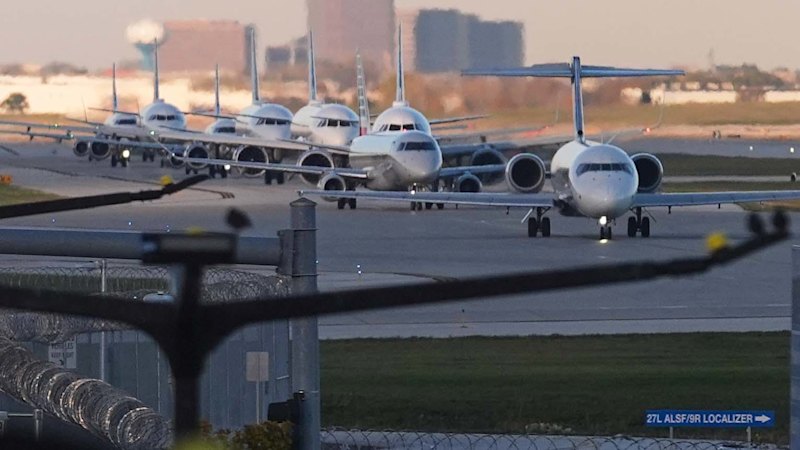
Flights across Europe have been diverted, grounded and escorted by fighter jets in response to a wave of bomb threats, marking a second major outbreak of false alerts in less than a week.
On Thursday, planes departing from 16 countries, including Ireland, the United Kingdom, Spain and Denmark, were affected. Flights have either been forced to divert to alternate locations or undergo additional security checks. On Friday, the threats continued.
Authorities have deployed bomb disposal teams and military fighter jets in several countries. So far, security inspections following threats have yielded no evidence of explosives or suspicious materials on board aircraft, and no passenger has reported being harmed.
On Friday, a Ryanair flight landed in Lisbon, Portugal at 8am after a bomb threat was made by phone to the authorities, Italian media has reported. A security operation was mounted as soon as the plane landed. Separately, the control tower in Fiumicino, Italy, received an alert about a device aboard a Wizzair flight to Rome from Paris. The Wizzair flight was diverted to Venice where police were clearing the area around the plane.
On Thursday, there were numerous threats, including the following:
When an airline is notified of a threat to an aircraft, it is passed to a team of assessors, said Joji Waites, director of flight safety, policy and regulation at BALPA, the British Airlines Pilots’ Association.
“These assessors use standard processes to grade the threat and decide whether the threat is red (credible), amber (partially credible) or green (not credible). Amber is not considered an appropriate assessment if the plane is airborne,” said Waites.
After receiving a threat, an aircraft is directed to an area well away from the airport buildings. Passengers are disembarked and screened while border police with sniffer dogs inspect the plane, according to an airport official.
The incidents follow a series of hoax bomb threats earlier this week. On Monday, a flight from the UK to Bulgaria was diverted after a threat that turned out to be without substance. On Tuesday, seven planes across Europe were searched or diverted because of malicious hoax bomb alerts.
And also this week, there have also been cyberattacks on supermarkets in several European cities, with hackers changing the temperature on refrigeration in an apparent attempt to spoil food.
Philip Baum, a visiting professor of aviation security at Coventry University, said the scale and coordinated nature of these latest incidents are unusual.
“There are indeed individual airlines that experience a bomb threat every day, but most of those are very quickly evaluated and determined to be non-specific, and the aircraft do not divert,” said Baum.
What sets the latest incidents apart, he said, is that authorities across several European countries appear to be treating the threats as credible enough to require planes to land and undergo security inspections. Baum noted that each flight disruption could cost airlines as much as $250,000.
The UK’s government called the latest disruption “malicious hoax threats”. London Heathrow, the busiest airport for passenger traffic in Europe, was also targeted. It says it has one of the most robust aviation safety systems in the world, but countries still have to take the threats seriously and figure out how to stop any actors from creating further disruptions to air travel across Europe.
The European Commissioner for Transport said it is too early to say who’s behind these attacks or whether the incidents are even connected.
European governments have so far refrained from blaming anyone. But those which have supported Ukraine are wary of hybrid attacks. Germany has directly pointed the finger at Russia for recent drone incursions at Leipzig-Halle Airport. Moscow rejected the accusations.
EU officials are aware of the possibility that Russia would step up its hybrid campaign. In September, the Danish Defence Intelligence Service warned that this could happen to pressure adversaries in the West and NATO.
However, Moscow has denied being involved in the threats to aviation in Europe and there is no evidence of any involvement by Russia, Iran or any proxy groups linked to them.