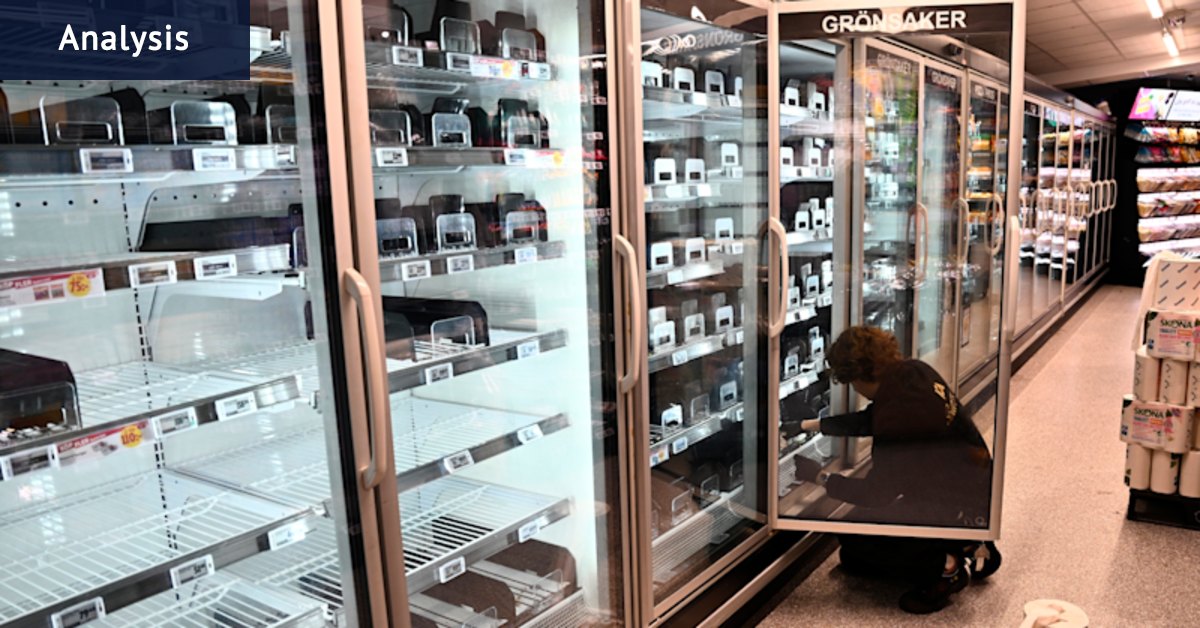
The actors behind an attack that crippled "critical" food supply functions across Europe remain unknown, raising concerns that hackers may be testing their skills ahead of further cybercrime.
The cyber attack raised temperatures in refrigerator and freezer units at dozens of stores from Sweden to Belgium this week, forcing them to throw away food in an incident that echoed a similar attack in France last month .
While no one has claimed responsibility for either attack, the incidents have heightened concerns among European authorities about hybrid threats to infrastructure amid growing security tensions since Russia's 2022 full-scale invasion of Ukraine.
Sarah Logan, a senior lecturer in the Department of International Relations in the Coral Bell School of Asia Pacific Affairs at the Australian National University, said the attack is unusual.
"There have been no ransom requests made from either the attack this week or earlier. That might suggest it's an actor trying to demonstrate its capability," she said.
Your trusted source for staying up-to-date with the world around you. Get free daily news updates and analysis, straight to your inbox.
But some clues could indicate who was responsible.
Two possible categories of hackers are state-funded groups and private enterprises.
Logan said it's impossible to know for certain who was behind the attack, but the lack of a ransom could suggest a government ordered the hack.
She said it was unlikely to be a "commercial hacking attack", particularly given that it's likely a repeat of an earlier attack.
Cyber attacks have historically targeted financial data or sensitive information for blackmail, but these latest ones targeted refrigeration, an important distinction.
"It is more than unrest; it's more than annoyance, right? It's the food supply chain. So it's a critical capability in some respects," Logan said.
Logan said the motivation for the attack could simply be a hacker testing their skills to see what disruption they can cause. Being unable to determine a clear goal means the possibility of more attacks can't be ruled out.
Professor Toby Murray from the School of Computing and Information Systems at the University of Melbourne told SBS News these attacks should be top of mind for supermarket chains.
The hackers were able to take over the refrigeration "with relative ease", he said, taking command of networked industrial control units.
These fridges could be operated remotely, the same way you can turn the heating and cooling on or off when you are not at home in a connected home, over the internet.
This internet connectivity creates a vulnerability hackers can exploit.
"It's that exact same remote control feature that then has enabled these hackers to get in there and start to control them in ways that are perhaps less desirable," he said.
It's been confirmed that some of the security software used by the impacted supermarket chains hadn't been updated, which could have been how hackers gained access, he added.
Murray said internet-connected technology in both supermarkets and homes can be exploited and recommended regular software updates, unique passwords and two-factor authentication.
"It is certainly worrying to think that this kind of vandalism might now become more commonplace in cyberspace," he said.
The experts said that while the hackers' identity and motivation are unknown, Australia isn't any more at risk of a refrigeration hack than anywhere else.
Logan acknowledged that Australia experiences some of the highest levels of cybercrime in the world — something she said was unsurprising as a wealthy Western nation.
The Australian Signals Directorate issued more than 4,400 warnings about potentially malicious activity over the past year — an 80 per cent increase compared to the prior 12 months.
"That doesn't mean that this actor that is working to disrupt the supply chain is going to do the same thing here or that they even could do the same thing," Logan said.
SBS News contacted Australia's major supermarket chains for comment.
It's understood that Woolworths' store refrigeration controllers are not connected to external networks.