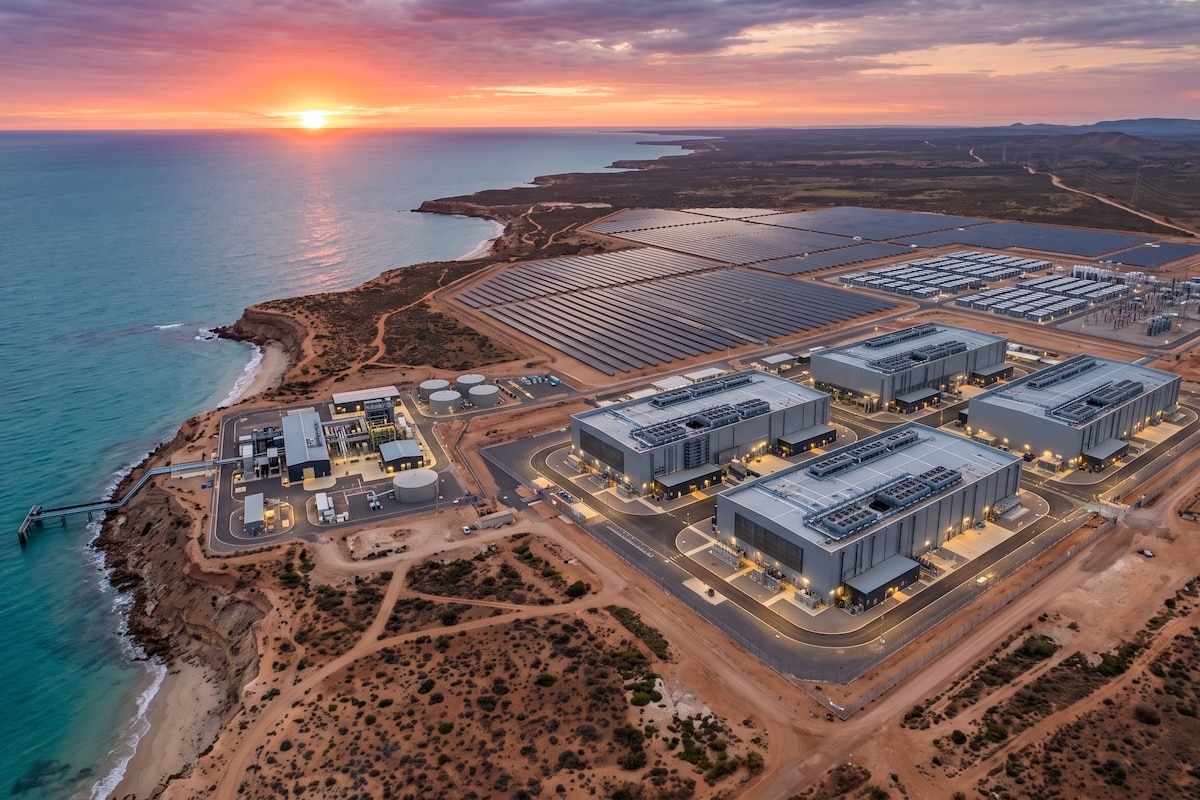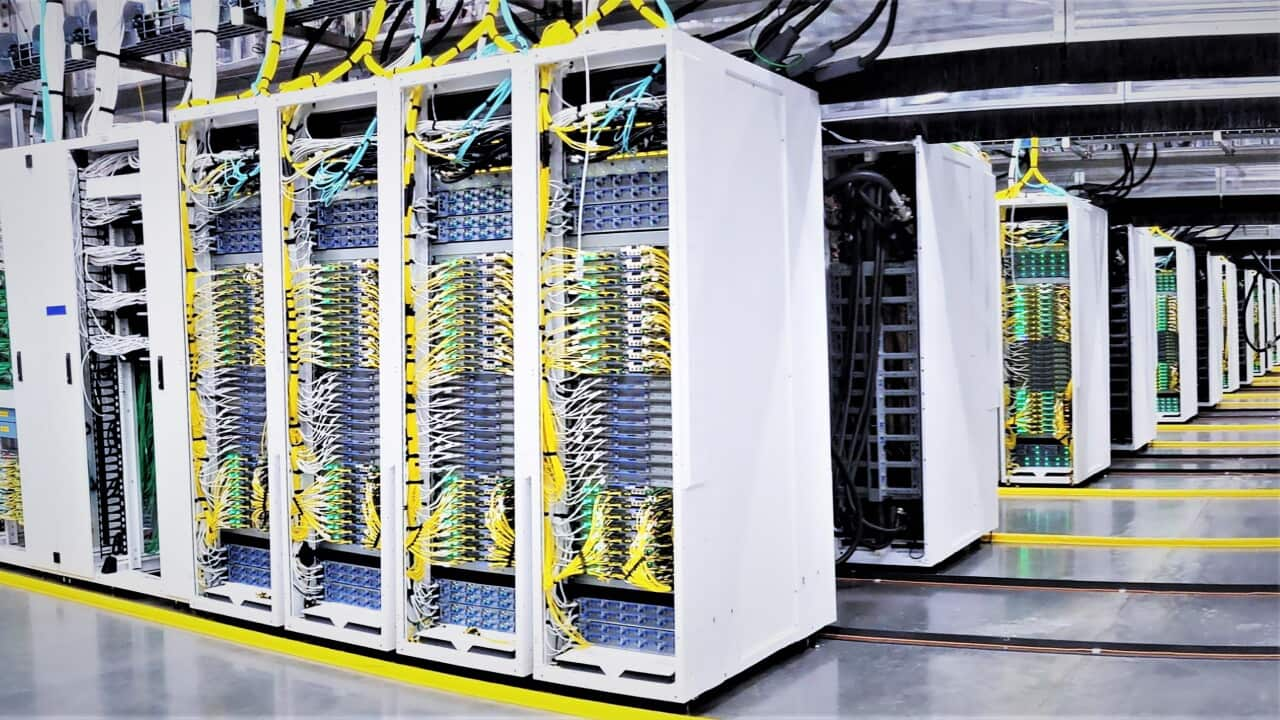



Australian businesses lifted capital expenditure to nearly $60 billion in the September quarter, with data centre spending surging 86.7 per cent. Timothy Hibbert, head of property and business forecasting at Oxford Economics, discusses the scale of the investment, while CBA economist Harry Ottley considers its potential contribution to next week’s GDP figures. SBS Finance Editor Ricardo Gonçalves also speaks with Marcus Today portfolio manager Henry Jennings about the market rebound, copper and investor sentiment.
SBS News in Depth is a news analysis podcast from SBS, going behind the headlines with reporting and interviews on the stories shaping Australia and the world.
Listen to more episodes of SBS News in Depth , and follow the show on the SBS Audio app , Apple Podcasts , Spotify or wherever you get your podcasts.
For the latest news from Australia and around the world, visit SBS News and follow us on YouTube , TikTok , Instagram , Facebook and X .
Coming up, data centre spending fueling business investment. That and more next.
You're listening to SBS on the Money with Ricardo Goncalves.
Hi everyone, it's Thursday, the 26th of November 2026, a day where the Australian share market rose. ASX 2000.8%, climbing to a one week high. That's after the miners bounced back. We'll have the details with Henry Jennings soon from markets today. But first, businesses are buying and investing in new equipment at a rate last seen in September 2011. That's during the mining boom.
The ABS says capital expenditure rose to nearly $60 billion in the September quarter. That's 12% more than the previous three months. For more, I spoke with Timothy Hibbert. He's the head of property and business forecasting at Oxford Economics. Tim, firstly, how would you describe the overall level of business investment in Australia, because the treasurer is calling these latest sets of numbers from the ABS a stunning set.
It's very strong and it's getting stronger, uh, so,
At $60 billion or almost $60 billion for the quarter, uh, you are starting to test those kind of previous peak levels from the mining boom.
Just how widespread is this level of investment across the board, right, and how much of it is related to the data centre rollout?
Look, there's quite a few positive investment themes playing through in Australia at the moment. Uh, so public hospitals, we're going through a boom there, pretty much across all major states in Australia. We're going through a surge in luxury apartment construction. We've got the Olympics coming up, so we're seeing big contracts awarded for the stadium builds there. Furthermore, defence is another area where we have some pretty big ambitions in play.
Data centres though, they're the ones that are having the biggest impact on the latest kind of capital expenditure numbers
though. Yeah, more with Timothy Hibbert where he mentioned that data centres really drove the overall result up 86.7% in the quarter, ahead of financial and insurance services and utilities, but how will it add to the GDP numbers next week? For that I spoke with Harry Otley, he's an economist at the Commonwealth Bank.
Harry, so in a broader sense, to what extent are data centres driving new capital expenditure?
Look, data centres are driving the lion's share of the investment boom, so CapEx rose by around 12% in the third quarter of 2026, and ICT, or Information communication Technology, uh, our proxy for data centres, accounted for around 86% of this increase. So the overall increase in ICT investment rose to a record $8.1 billion in the quarter.
OK, so overall it's the strongest investment number since the mining boom of September 2011. How's this likely to flow through to GDP next week and what does it say about the economy?
Look, so it will flow through to GDP, but the important thing to remember here is that these data centres, around 70% of them, is actually the compute required, so the machinery and equipment required to go into the data centres, and we're importing that all from overseas, so that actually gets netted off the overall GDP number, but there is still a fair bit of work to be done on building out the warehouses or the structures of the data centres, so.
Certainly hit GDP in that department. And in terms of what it says about the economy, well, it says that this really important part of the economy, business investment and the data centre boom, is not really being impacted by monetary policy at the moment. It seems very resilient and so that's a broader positive for the economy but may make it more difficult for the RBA to slow the economy down and bring inflation down.
OK, and in broader sense, right, how responsible are data centres to economic growth? Is there, um, too many eggs in one basket, can it prove risky given the opposition that we're seeing to to data centres in, I guess not just Australia but around the
Yeah, that's exactly right. There is a risk here that the data centre pipeline proves a little bit more wobbly than we currently think, but our broader view is that in Australia at least the opposition is not yet at a point where it's going to be slowing this investment down. We still think there'll be around $150 billion out to 2030.
And it's a big part of the growth story, so it is a little bit of a risk, but it is important to note as well, as I said before, that a lot of this growth is coming through imports, so it will be netted off, but overall we're pretty confident that that the pipeline remains very firm at this stage.
Terry Ottley there, an economist at the Commonwealth Bank. Let's go to the Australian share market now, which climbed to a one week high, the ASX 200 up 0.8% to 8,763. Energy.
Stocks rose while consumer staples and telcos fell, and the copper price, it bounced off an 11 month low, helping the miners, which have been underperforming of late. For more, I spoke with Henry Jennings. He is a portfolio manager at Marcus today. So the ASX is up today, ahead of a public holiday in the US for Thanksgiving tomorrow, but it follows a very volatile period for markets. How would you describe investor sentiment and what drove it today?
I think cautious is the investor sentiment. I think a lot of people have been, uh, you know, we've had a lot of fingers burnt. We've had a lot of volatility, especially in the US. Even last night, you know, we had uh uh some of their markets were, were very, very weak and then turned on a dime, as they say, and pushed ahead. Um, I'm not sure whether that uh there was some triggering event or whether it was just book squaring ahead of Thanksgiving.
But it has been extraordinarily volatile and I think people are still pretty cautious out there. It's baby steps, one day at a time, almost to some extent, but there is, I guess, a little bit of optimism creeping into the market that maybe things are gonna improve and maybe Santa will come. You know, we all like to believe in Santa after all and and certainly that.
One of the hopes out there at the moment that we will have this period now between Thanksgiving and Christmas where the markets will improve.
Yeah, the so-called Santa rally, right, but the Nasdaq briefly entered bear market territory yesterday. What's your take on the AI story because it comes at a time locally too when CapE numbers came out from the ABS which showed a surge in new CapE but driven.
Yeah, well, we, we, Ricardo, we all know the data centre story. It's, it's a big thing in the US obviously, uh, and we have seen since the blue wave, since the Democrats, uh, sort of trounced the uh the Republicans, the, uh, the, the enthus enthusiasm I guess for those uh those data centres build out has diminished. Now, uh, that is more a sentiment thing than a reality thing. The Democrats haven't yet taken control of it.
Either of the houses and won't till January, so that is going to be something to consider maybe then, but it certainly has dented optimism. We've had the anthropic issue with uh which has been enormous and that briefly dipped below the issue price last night, quite substantially below that at one stage, and we've had, of course, the Nvidia with the Jensen Wong and his spectacular return. So it has
It's been interesting to say the least. I guess the market is worried that Jensen 2.0 is going to be a very different man to Jensen 1.0 in terms of his profligate spending and the merry go round funding that he was putting in place for data centres and the ability to sell Nvidia chips into those data centres. So I think that has been the concern that maybe he is chastised and he
Is a changed man and as a result, some of those data centres with a combination of the Democrats and the funding will not happen.
We often say on this podcast when we talk about the Australian market that there's no real exposure to tech stocks because our tech industry is so small, right? But where we're seeing it is in the miners because of the relationship with the copper price and the copper producers because copper's needed for the AI rollout and electronics, right?
What's your take on the mining sector, because the likes of BHP, they've been hit pretty hard in the past few months because of this AI story. Well,
they have, and it has been the copper price which has been driving BHP downwards. The iron ore price has held in relatively well. The big thing I guess which has changed for the miners is the Federal Reserve. And although Kevin Walsh is not one to give forward guidance, all his fellow board members have been out and about giving guidance. And as a result, we have seen the
The US dollar be very, very strong against the Aussie dollar, and that has really hurt the resource sector and that copper story, that copper unwinding, and there were some strange things in the copper market in terms of stockpiles in the US building further and further up as people were worried about tariffs being introduced there and a shortage actually around the rest of the world which pushed copper up to sort of 15,000. But here we are back sort of around 12,000 and an official correction.
And it has been very much tied to that AI story. So if we do see an improvement in the AI stocks and the tech stocks, which maybe we will, we'll see, but if we do, then we could see copper bounce, and certainly that's what we're seeing with BHP in terms of their price today. That is, it certainly looks as if it's bounced off that sort of $51 level quite quite strongly.
And in wrapping up, what are you telling your clients right now and where do you see the opportunities for investors?
Well, I guess we've been, uh, Marcus, today, we've been in cash for some time with our flagship fund, and so as a result, we are looking at the moment for entry back into the market, a sign that maybe there is an.
All clear. We're still, I guess, kind of waiting on the sidelines in terms of other issues in terms of the ASX. We have been picking away at some some interesting stories that are out there at the moment, so it's not as if we're not involved, but I think caution one step at a time at the moment.
It's a bit like Grandma's footsteps, isn't it? You, you know, you kind of creep up, but every now and then Grandma turns around and you, and you have to freeze and reassess where you are because the game has changed. So at the moment it is kind of one step forward, but very tentatively at the moment.
But if Grandma falls over, she can fall over pretty hard and hurt herself, right?
She can. Grandma's have a habit of doing that unfortunately. So uh yeah, at the, at the moment, you know, we're we're still very much in, uh, I guess.
To some extent uncharted territory. Things, things are happening at the moment that you would never have dreamt of happening, you know, you look at Jensen Wong, you would never have thought in this day and age that he would get, uh, get, you know, the tap on the shoulder again to go back and, and run, uh, Nvidia. It just shows how much the world has changed, I guess, in the last 2 or 3 years.
Henry Jennings there from Marcus today, and he wraps up the podcast for this Thursday. Don't forget you can watch a TV version of On the M during the 6:30 day edition of SBS World News.
On SBS podcast returns tomorrow after the market close. I'll catch you then.
This SBS on the Money podcast is provided for informational purposes only. The content on this podcast should not be understood as constituting advice or a recommendation. It is not personal advice and does not consider your personal circumstances or objectives. You should contact a licenced professional before making any financial decision.