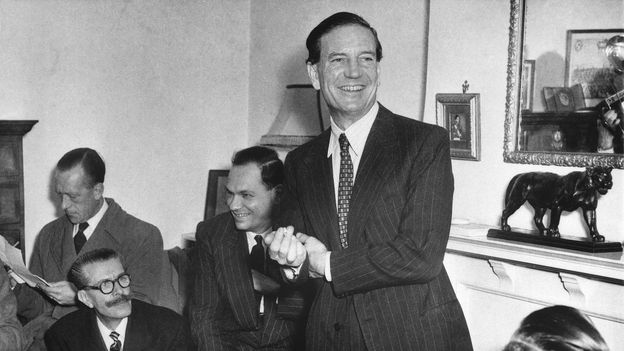
On 30 July 1963, Kim Philby's defection from MI6 to the Soviet Union was made public. In 2016, the BBC broadcast previously unseen footage of his lecture to Stasi operatives in which he revealed the secrets behind his treachery.
"Almost all my life I have spent trying to avoid publicity of any kind," says Kim Philby in a 1981 video unearthed by the BBC from the archives of East Germany's spy service. It's something of an understatement. Philby was a British double agent whose defection to the Soviet Union was made public on 30 July 1963. In the video, he is seen giving a seminar to Stasi operatives on how to succeed at espionage.
As the BBC's former security correspondent Gordon Corera explained in his 2016 report on the previously unseen footage, "Philby offers a masterclass in betrayal, from his recruitment by Soviet spies after Cambridge to his joining Britain's secret service MI6, whose secrets he stole." It is the only known video in which the leading member of the so-called Cambridge Five KGB spy ring discusses his betrayal – a rare recording that is revealing on many levels.
"I'm looking back on my career in the enemy camp, this 30-year career in the enemy camp," he says in the grainy video, standing behind a lectern in thick-rimmed glasses and a suit and tie. "Every evening, I left the office with a big briefcase full of reports which I had written myself, full of files taken out of the actual archives. I used to hand them to my contact in the evening. Next morning I'd get the file back, the contents having been photographed, and take them back early in the morning and put the files back in their place. That I did regularly, year in, year out."
As part of a circle that also featured Donald Maclean, Guy Burgess , Anthony Blunt and John Cairncross, Philby passed British state secrets to the Kremlin during World War Two and the Cold War, including the period when Nazi Germany and the Soviet Union were allies. Yet there has sometimes been a rose-tinted view of their double-crossing, according to Antonia Senior, the author of Stalin's Apostles: The Cambridge Five and the Making of the Soviet Empire.
"The stage and screen portrayals of them, in particular, present them as glamorous rogues," Senior tells the BBC. "In reality they were lying, unpleasant traitors who betrayed the people who loved them as well as their country… This was not a victimless crime. Their betrayals helped Stalin to enslave half of Europe, and the Cambridge Five were enthusiastic in advancing that imperialist project under the guise of world revolution."
Philby admits in his Stasi speech that he betrayed a joint CIA-MI6 operation in Albania, which led to hundreds of men being killed. And he described the Albanian agents he betrayed as "just down from the trees" in a 1968 autobiography that was labelled "unrepentant and self-regarding" by the New York Times . He had a "callous disregard for the men he sent to their deaths", says Senior.
After being recruited as a Soviet spy at Cambridge University in the early 1930s, Philby joined MI6 in 1940, later becoming the agency's head of counter-Soviet intelligence. That position enabled him to feed critical British and American secrets directly to the KGB while sabotaging Western anti-communist operations. His rise through the ranks of British intelligence services was helped by his background and a phenomenon that Senior labels the "chapocracy" – a tight-knit network of privileged men within the establishment who shared the same elite educational backgrounds.
According to Senior, this meant that security clearance was granted based on a shared social class and personal charm rather than on merit or rigorous vetting. "The chapocracy brought Philby into the employ of British intelligence at the start of World War Two, when the huge demand for clever chaps to join the Security Services meant that people like him were waved through," she says.
In History is a series which uses the BBC's unique audio and video archive to explore historical events that still resonate today. Sign up to the accompanying weekly newsletter.
By exploiting class biases and institutional blind spots, Philby and the other members of the Cambridge Five were able to gain access "to the deepest secrets of the British and American states during the 17 years they were spying for Stalin", says Senior. "Atomic research. Full UK Cabinet minutes. The secrets of Bletchley Park [the UK's WW2 codebreaking centre]. The private correspondence of Winston Churchill and Franklin D Roosevelt. The list is long and utterly flabbergasting – it is no wonder that Soviet intelligence dubbed them internally as the 'Magnificent Five'."
After Burgess and MacLean defected to the Soviet Union in 1951, Philby was relieved of his intelligence duties before being dismissed from MI6 in 1955. Yet despite that, he was still able to escape to Moscow in 1963. One possible reason was given in Philby's final piece of advice to the East German spies. "They interrogated me in order to break my nerve and force me to confess. And all I had to do, really, was to keep my nerve. My advice to you is to tell all your agents that they're never to confess. Just deny everything."
• The suburban spies who sold secrets to the USSR
• How John le Carré’s spy novels were shaped by his con-man father
• Aldrich Ames: the US's most damaging double agent
None of the five were ever prosecuted for spying – a failure which some have seen as the result of a cover-up by the British establishment. But Senior argues that this wasn't necessarily the case. "There was a huge release of material early last year from MI5 on its investigations into Philby, Blunt and Cairncross, which revealed a different picture," she says. "The Security Services did make mistakes, but the fundamental problem was how hard it is to prove spying. Philby, in this video, portrays his escape from prosecution as his skilful manipulation of the establishment's desire to hush things up. The reality is more nuanced."
Suspicion fell on Philby as soon as Burgess and MacLean defected – and he was interrogated, watched, bugged and followed, as well as being subjected to a cross-examination by a leading barrister. Unfortunately, says Senior, "The evidence was lacking to prosecute. It was obvious to all that Philby was lying, but there was no proof."
The Security Services eventually got confessions out of Philby, Blunt and John Cairncross, but only because they were promised immunity from prosecution, meaning that their confessions could not be used against them in court. "In Britain, the most important element protecting the Cambridge Five was the rule of law," says Senior. "It was our insistence on evidence and due process which helped them avoid justice. The master they served, Stalin, would have just shot them in the head or sent them to die in his Gulag ."
Philby was hailed a hero in his adopted homeland after he defected. He featured on a Soviet postage stamp in 1990, two years after his death. He is still venerated there today , with a square named after him in Moscow, near the headquarters of the Russian Foreign Intelligence unit, and a statue of him near the battlefield at Kursk. "Putin has adopted Kim Philby as a symbol of his Russian nationalism," says Senior.
Philby is buried at Kunsova Cemetery on the outskirts of Moscow, in a country he regarded as home. When Corera reported from there in 2016, it was covered in snow, which reminded him of the title of a classic espionage novel by John le Carré, The Spy Who Came in from the Cold . Philby, Corera noted, "was the spy who came into the cold".
For more stories and never-before-published radio scripts to your inbox, sign up to the In History newsletter , while The Essential List delivers a handpicked selection of features and insights twice a week.
For more Culture stories from the BBC, follow us on Facebook and Instagram .