Project data submitted to the Australian Institute of Architects’ 2026 national awards program underscores a sustainability commitment across the industry – but there is still a way to go.
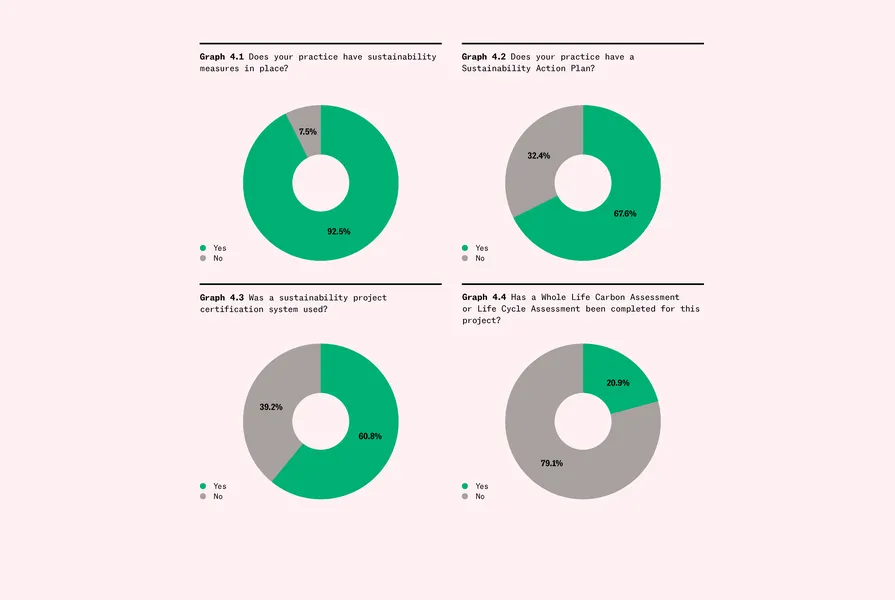
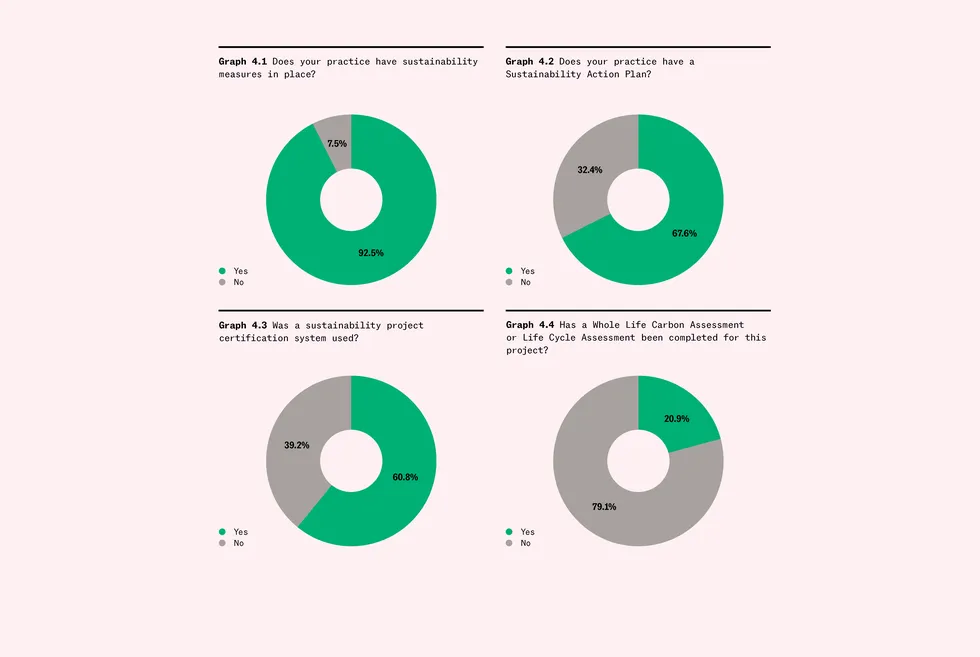
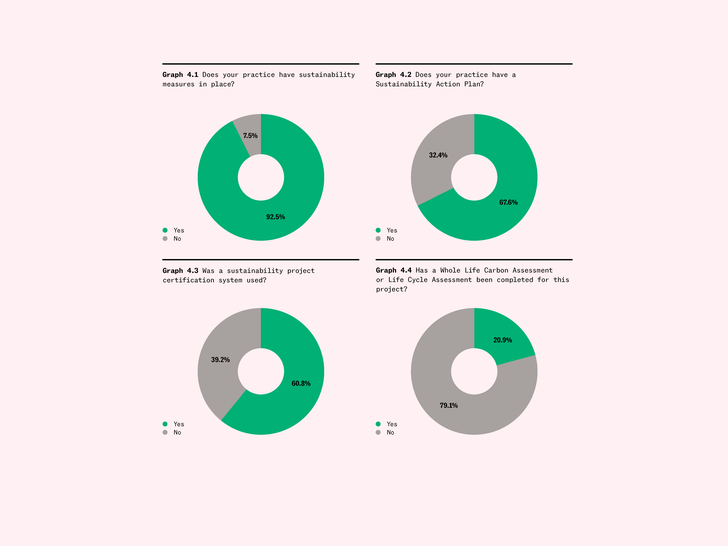
Graph 4.1: Does your practise have sustainability measures in place?; Graph 4.2: Does your practice have a Sustainability Action Plan; Graph 4.3: Wa a sustainability project certification system used?; Graph 4.4: Has a Whole Life Carbon Assessment or Life Cycle Assessment been completed for this project?
A series of industry studies released in 2026 paints a picture of changing practice and practitioners. From gender equity to sustainability, cost escalation to wellbeing, the numbers tell us about an architecture industry in flux. Read an analysis of the sustainability data from the 2026 Australian Institute of Architects’ 2026 national awards program below.
Since 2023, the Australian Institute of Architects has included six sustainability criteria for entries to all its award programs at state and national levels. To be eligible for an award, project entries must meet at least two of the six criteria, which include considerations such as the use of onsite resources, ecological regeneration and minimising of pollution.
In 2026, a total of 669 projects were entered into the Australian Institute of Architects national awards program. The entry data, while self-reported, can provide a fascinating annual snapshot of how the profession is progressing in the shift towards sustainable practice. (This data excludes responses where the relevant criterion were marked “not applicable” to the project.)
Architects report strong performance across all six sustainability criteria, such as use of onsite resources during construction (75.6 percent), ecological restoration (73.7 percent), and minimisation of construction waste (83.4 percent).
Passive design, climate adaptation and climate resilience emerge as areas of particular strength in the reporting projects – 93.6 percent used passive design principles, and 89.9 percent confirmed consideration for climate adaptation and resilience.
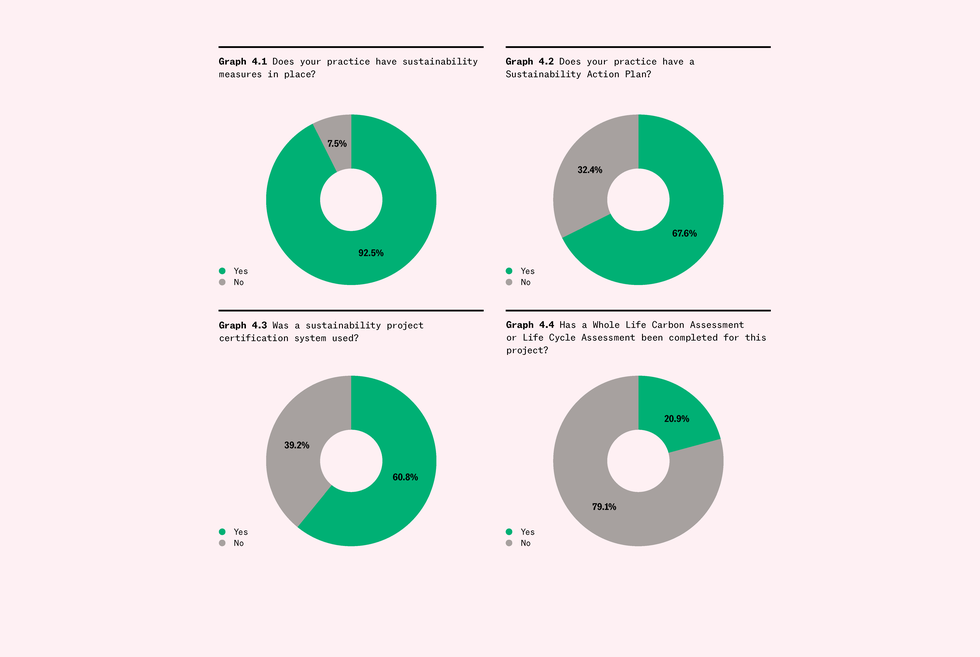
Sustainability measures are now widespread, with 92.5 percent of entrants reporting that measures are in place in their practice (Graph 4.1). However, a smaller number (67.6 percent) said they had adopted a formal Sustainability Action Plan (Graph 4.2).
While 60.8 percent of projects report employing a sustainability certification system, including a range of national and international standards (Graph 4.3), the use of Whole Life Carbon and Life Cycle Assessments remains far less common at 20.9 percent (Graph 4.4).
Graph 4.1: Does your practise have sustainability measures in place?; Graph 4.2: Does your practice have a Sustainability Action Plan; Graph 4.3: Wa a sustainability project certification system used?; Graph 4.4: Has a Whole Life Carbon Assessment or Life Cycle Assessment been completed for this project?
Image: Graphic by Mike Giesser
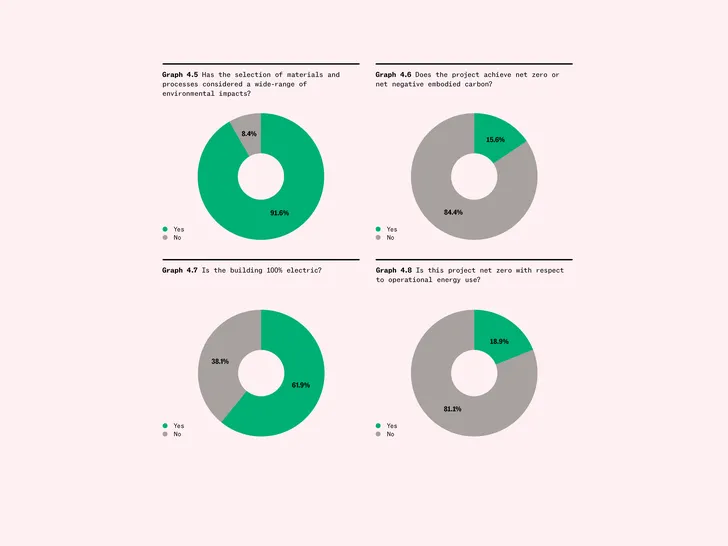
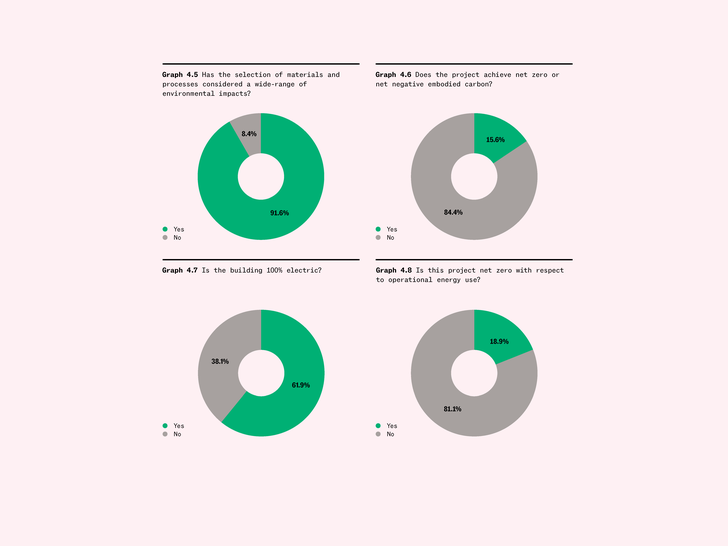
Most entrants (91.6 percent) report a wide range of environmental impacts were considered during material selections (Graph 4.5). Projects managing to reach net zero embodied carbon, however, remain rare at 15.6 percent (Graph 4.6).
While only 61.9 percent of projects are fully electric (Graph 4.7), renewable energy is the preferred approach to reducing operational carbon (76.2 percent). Net zero operational energy outcomes remain limited at 18.9 percent (Graph 4.8).
Graph 4.5: Has the selection of materials and processes considered a wide-range of environmental impacts?; Graph 4.6: Does the project achieve net zero or net negative embodied carbon? Graph 4.7: Is the building 100% electric?; Graph 4.8: Is this project net zero with respect to operational energy use?
Image: Graphic by Mike Giesser
Analysis by Liz Brogden, University of Queensland, on behalf of the Australian Institute of Architects.
This article is the third in an Architecture Australia (Nov 2026) “industry in review” series that unpacks findings of several industry studies released in 2026. Read an analysis of the results of the Association of Consulting Architects’ 2026 Pulse Check survey here ; the Commonwealth Association of Architects’ 2025 Survey of Architecture Students, Graduates and Early Career Professionals here ; and the Workplace Gender Equality Agency’s 2026 data here .
Published online: 25 Nov 2026 Words: Liz Brogden Images: Graphic by Mike Giesser
Architecture Australia, November 2026
The inaugural launch of the first public chapter of Byron Design Week gave insights into what the event could look like in the future.
Marking the 20th anniversary of Donovan Hill and Peddle Thorp’s renovation to the State Library of Queensland, a member of the project’s design team reflects …