Three months after the Bhotekoshi floods swept away settlements along the Trishuli River basin, thousands of survivors remain in limbo, with the federal government yet to come up with a concrete plan for their relief and resettlement.
Even the agencies concerned have shown little urgency in installing a Bailey bridge over the Trishuli river despite the foundation having been readied 10 days ago.
As a result, people living across the river remain cut off from the district headquarters and are forced to walk for hours to reach the administrative centre.
"We requested the federal government to install the bridge some 10 days ago,” said Rajan Shrestha, mayor of Bidur Municipality. "But they have shown no urgency. We have also written to the Nepali Army requesting its help. We cannot install the bridge on our own, and the agencies that can have shown no concern for flood victims.”
Bidur Municipality, one of the worst-hit local governments in Nuwakot district, has built a foundation for a Bailey bridge over the Trishuli River at Dhunge by reallocating funds from its development budget. However, there is still no certainty about when the bridge will be installed.
After the floods washed away all the permanent motorable bridges and footbridges over the Trishuli River, settlements across the river were cut off from the district headquarters.
The floods severed links between the district headquarters and several densely populated areas, including Meghang and Kispang, some wards of Uttargaya Rural Municipality in neighbouring Rasuwa district; and Tupche, Angutar and Bhairamkot of Bidur Municipality of Nuwakot. Deurali, Samari, Deudi and Taksar in Nuwakot were also cut off. Residents of Satyadevi in Dhading who rely on the same route, faced similar hardships.
Just before Dashain holidays in mid-October, a suspension bridge connecting Dhunge and Intake, built with the investment and initiative of the Federation of Contractors' Associations of Nepal, was opened to the public. However, the bridge, which was opened before construction was fully completed, remains crowded most of the time and this has delayed the completion of the remaining work.
The federation says the remaining work, including installing sections of the bridge deck and cables on both sides to reduce swaying, as well as building ramps for motorcycles, can be completed only if the bridge is closed to pedestrians.
“It is impossible to close the bridge, as the bridge keeps busy from early morning until late at night,” said Shailendra Raj Pyakurel, who took the initiative to construct the suspension bridge. "We cannot complete the remaining work on the suspension bridge until the Bailey bridge is installed.”
After the Bhotekoshi flood, the government has installed two Bailey bridges in flood-affected areas, but neither has been placed over the Trishuli River. One has been installed over the Tadi River and the other over the Salakhu River. These two bridges have done nothing to restore road connectivity for communities cut off by the floods on the other side of Trishuli River.
The municipality has already prepared the foundation for the Bailey bridge, but Mayor Shrestha said the Department of Roads had told the municipality that installing the bridge would require a launching platform and a team of technical experts from India.
He said the department had told the municipality that the launching platform was currently in Ilam and could be brought to Nuwakot only after the work there was completed.
According to Bidur Municipality, it spent Rs37 million from its development budget to prepare the foundation for the Bailey bridge. The municipality also spent Rs1.5 million to transport the bridge from Hetauda. The bridge was provided by the Indian government.
"Our area has become more remote than even the most inaccessible villages in Karnali," complained Paras Adhikari, an employee of Bidur Municipality. "There are places from where people have to walk for five to six hours just to reach the only suspension bridge."
The Nepali Army, however, says it has yet to receive a formal request from the municipality to install the Bailey bridge.
"We can begin the installation process once we receive the letter,” he said, adding that the army had installed similar bridges over the Tadi and Salakhu rivers," said army spokesman Brigadier General Rajendra Shrestha.
NEA cuts electricity to land occupied by flood survivors
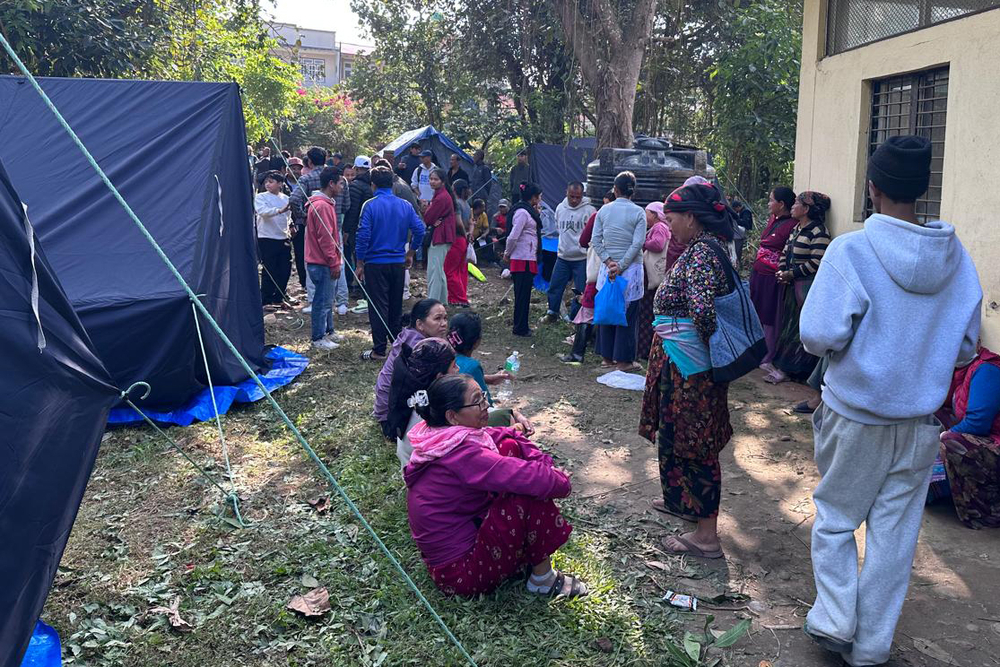
The Nepal Electricity Authority (NEA) has cut off electricity to its land in Colony, near Trishuli Bazar, where around 250 flood-displaced people have put up temporary shelters and tents since November 17. The families occupied the land after months of waiting for the government to decide on their resettlement.
"There is neither electricity nor water in our camp," said Nabindra Pradhan, a resident of Trishuli Bazar. "They cut off the power that very evening, saying we had occupied their land. They disconnected electricity not only to our settlement but also to the road and the newly constructed bridge."
Following protests from locals and a request from Bidur Municipality, the authority later restored electricity to the bridge, which has become the only means of crossing to thousands of people.
"There is no water, no toilet, and no electricity," Pradhan said. "It is impossible for entire families to live there. Still, around 30 people take turns sleeping in the tents every day."
The electricity authority, however, denied that the power supply had been disconnected specifically to target the displaced families.
"It was not disconnected by an official decision. There was a problem with the electricity supply, which left the area without power for a day or two," Sushasanta Poudel, a sub-engineer at the authority's Nuwakot branch, told the Post. "Electricity to the road has already been restored. A decision on supplying electricity to the tented settlement will be made after the office chief returns from his China visit."
Local residents say even 90 days after the Bhotekoshi floods, the government has taken no concrete steps to resettle displaced families. They said federal ministers and other officials had visited the site after the victims occupied the land but had failed to tell them what the government planned to do.
"Many people have come here, and some are still coming," said Narayan Shrestha, a flood-diplaced resident from Trishuli Bazar. "But what is the point? They have come only to take photographs. We have yet to see anyone take our problems seriously."
On Monday, at the initiative of Bidur Municipality, flood survivors from Nuwakot and Rasuwa held discussions in Kathmandu with the chief minister of Bagmati Province, and former chief ministers, ministers and lawmakers.
Elected officials from Bidur Municipality, Belkotgadhi Municipality, Tarakeshwar Rural Municipality, Kispang Rural Municipality, as well as flood-affected rural municipalities in Rasuwa district, participated in the meeting.
Provincial government representatives said they had allocated Rs600 million by cutting development expenditure to support flood-affected areas. However, they said they could not proceed with the spending until the federal government decided on its plans.
The government’s inaction has also left families of those killed or missing in the floods waiting for closure. Authorities have yet to declare those missing dead or hand over the bodies of those who died to their families. As a result, relatives have been unable to perform final rites and have not received the funeral expenses promised as relief by the government.
Similarly, displaced families in Trishuli Bazar said they have not been provided the monthly Rs15,000 rental assistance promised by the federal government.
"Forget resettlement, we have not even received the funeral expenses for our deceased relatives," Shrestha said. "The government promised rental assistance but has not provided that either. We lost everything in the floods, and we have nowhere to go. Occupying the [NEA] land was something we were compelled to do."
More than 1,450 people were killed in the floods, while 5,285 remain missing.
Arjun Poudel is a health reporter for The Kathmandu Post. Before joining the Post, he worked for Sagarmatha Television, Naya Patrika, Republica and The Himalayan Times.