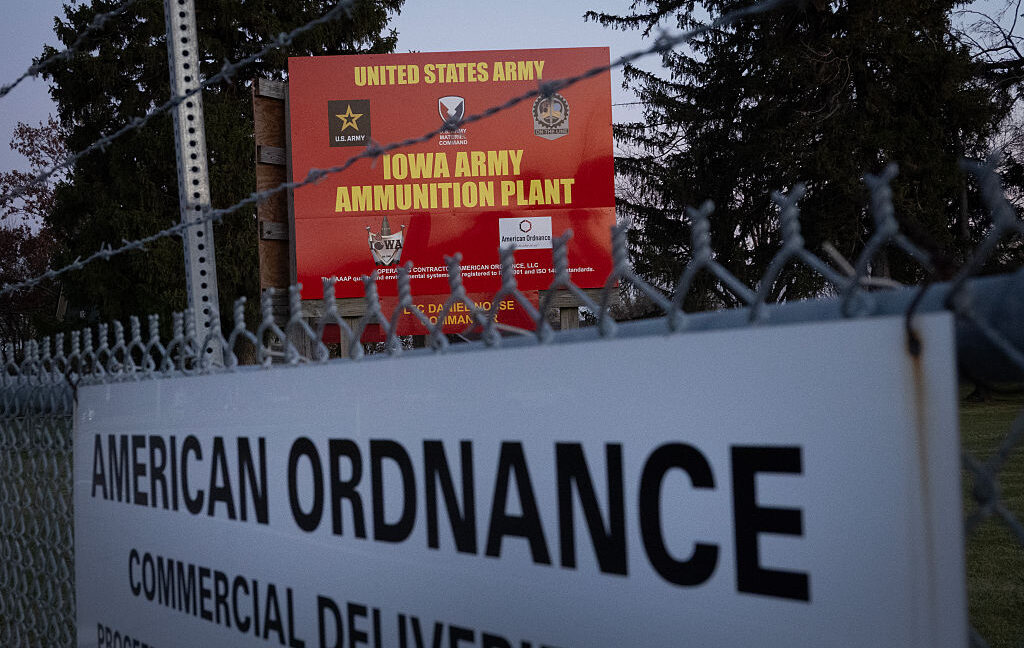
On October 26, Charles Massner, the mayor of Mediapolis, Iowa, got an email from the US Army . It described “an intentional, controlled detonation” of “a quantity of degraded lead azide … in the near future” at the Iowa Army Ammunition Plant, some 20 miles south of Mediapolis.
The email, which was reviewed by WIRED, provided no details about when this explosion would happen, how much material the explosion would destroy, or what steps officials should take to protect the public from a possible toxic fallout. But it did request that public officials allow for environmental testing on public lands before and after the event, which the town granted in a November 2 meeting.
Massner says the next time he heard anything was early last week, when the Army published a press release on its website saying it would explode the lead azide in just a few days. That press release included a map of potential exposure from the blast. Mediapolis was directly in the path of exposure, covered in a reddish-yellow cloud with a hot pink border.
“There was really no communication, so to speak, other than what was on their website,” he says.
Massner wasn’t alone in being caught off guard. The sudden announcement that the Army would be exploding 9,500 pounds of lead azide with seemingly little to no notice caught nearly all of Iowa by surprise. Governor Kim Reynolds’ office said last week that they’d learned about the explosion the same way Massner did: via the press release sent out by the Army on November 15.
Now, despite a court order blocking the detonation, the Army announced late Sunday night that it plans to blow up the lead azide on Wednesday, a day before the Thanksgiving holiday. Many Iowans are left with more questions than answers. Iowa’s unofficial state subreddit is filled with posts from people trying to plan holiday travel and safety around the event, which has switched dates twice in the past week. One local official in the path of a potential fallout told WIRED on Friday that she was leaving the area and staying at a hotel with her immunocompromised child.
Peter Thorne, a professor of environmental health at the University of Iowa who has studied exposure to lead in his laboratory, says his lab has been “deluged with concerns,” with everyone from pediatricians to parents to people who run cleaning facilities and are worried about their staff exposure reaching out. Like most Iowans, Thorne also heard about the explosion from the Army’s press release.
“My first reaction was, They’re going to do what ?” he says.
The 68 barrels of degraded lead azide at the Middletown site have been there for more than 20 years. In March, according to a document released by the Army on November 18, the material was officially labeled hazardous waste, and officials began looking into how to dispose of it. In a court filing published Saturday, the Army says that there is an “immediate risk” of the material exploding by itself after temperatures drop below 30 degrees Fahrenheit. It is now invoking emergency powers to detonate the barrels by November 24.
“In short, a controlled detonation is by far safer than an uncontrolled explosion,” the filing states.
The Army did not immediately respond to a list of questions sent by WIRED.
The Army does seem to have looked into other options besides blowing up the azide. The New York Times reported Friday that the Army awarded a contract in late March to a private company to handle cleaning up the chemicals onsite. However, that contract was pulled two months later; the company told the Times that the Army did not give a reason for changing its mind on the cleanup. A contracting officer in the Army told the company that the Army’s decision to pursue detonation “was not based on deficiencies” with the company’s science.
In a letter sent to Governor Reynolds on Friday, the EPA Region 7 administrator said that the agency only learned that the material had degraded to a dangerous state in March. The letter also listed a number of strategies the EPA had considered besides detonation, including chemical cleanup, which also risked causing an explosion.
The Army has blown up expired munitions before, although not at the scale of what it plans to do in Iowa. Thorne says that any exposure to lead from the explosion is expected to be “quite a bit lower” than lead exposures in communities exposed to legacy pollution sources. But “there is no safe level for lead, especially for young children,” he says.
The Army did have some public meetings and communications in late October with officials in Middletown, where the explosion will take place and where it has recommended temporary evacuation measures for some neighborhoods. But it’s not clear why its initial direct outreach around public health didn’t extend to towns in potential fallout ranges for a blast, including Mediapolis, beyond asking for permission to test soil samples. (The Army did include recommended public health measures in its November 15 press release.)
Thorne, a former chair of the EPA’s Science Advisory Board, says that a successful public health outreach program has lots of opportunity for public engagement for all affected areas.
“You have public meetings. You answer questions. You have extensive Q&A and FAQs, and you have people speaking to why this is the only choice, what are the burdens, and some kind of a cost-benefit comparison between the options, and then you roll it out through the media, through social media, through many ways,” he says. “Best practice is not what they’ve done—I think this is closer to worst practice, from a public health perspective.”
For his part, Massner, Mediapolis’s mayor, said on Friday that he planned to take “standard precautions” and follow the Army’s public health recommendations. (The Army has not released fallout modeling for a Wednesday explosion, but if winds carry the material south , it would be possible for Mediapolis to no longer be in the affected zone.) But Messner says he understands why people in his town were freaked out.
“What people saw was the map they drew, which showed a [red] cloud going over everybody’s head. I don’t think that was the intent of the map,” he laughs. “When you see a map covered in red, you’re supposed to run for shelter immediately—your life is in danger.”
Building social media apps isn’t cool anymore
RIP to the unloved, unwanted Cybertruck
Want better search results? Make WIRED a preferred source in Google