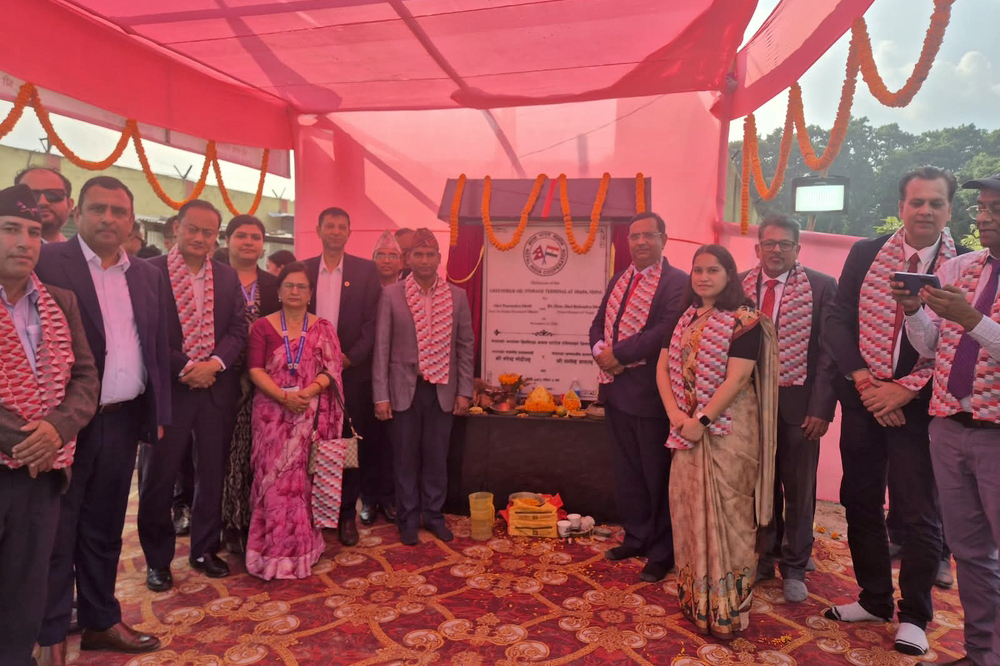
Prime Minister Balendra Shah and his Indian counterpart Narendra Modi on Monday virtually laid the foundation stone for a petroleum pipeline linking Siliguri in India to Jhapa in eastern Nepal, along with a new regional oil storage terminal in Jhapa.
Developed under a bilateral agreement between the two governments, the Rs11.14 billion project involves constructing an approximately 50-kilometre pipeline, with an eight-inch diameter, from Siliguri in India to Charali in Jhapa. Of the total length, 36 kilometres will lie in India and 14 kilometres in Nepal, according to the Nepal Oil Corporation (NOC).
The project also includes an automated petroleum storage terminal with a total capacity of 18,900 kilolitres.
The facility will have three vertical tanks, each with a capacity of 2,200 kilolitres, for petrol storage and three more, each holding 4,100 kilolitres, for diesel.
NOC owns 23 bigha, three kattha and 13 dhur of land, equivalent to 15.70 hectares, at the proposed site.
Of the total estimated cost, around Rs4.27 billion is allocated for the pipeline and Rs6.87 billion for the storage terminal. The entire project will be funded through a grant from the Indian government, said Nagendra Sah, NOC’s managing director.
Once completed, the project is expected to improve the security and reliability of petroleum supplies to Koshi province and the Madhesh districts of Saptari and Siraha, Sah said.
It will also reduce reliance on road transportation, ease vehicle congestion at customs points and cut transportation costs. The pipeline is expected to help curb pollution and illicit activities along transport routes, while strengthening Nepal’s ability to manage fuel supplies during emergencies.
The Indian Oil Corporation has already completed the detailed engineering and route survey for the pipeline, as well as the design and mapping of the storage terminal, according to NOC.
“Technical procedures and implementation schedules have been finalised between the relevant agencies of both countries, and the procurement of necessary equipment and materials has begun. In Nepal, procedures relating to the environmental impact assessment, land development and construction are underway,” Sah said.
Although the project has a target completion period of around 54 months, the Indian Oil Corporation plans to complete the work within 36 months, NOC said.
Seema covers business and economy for Kantipur Publications.