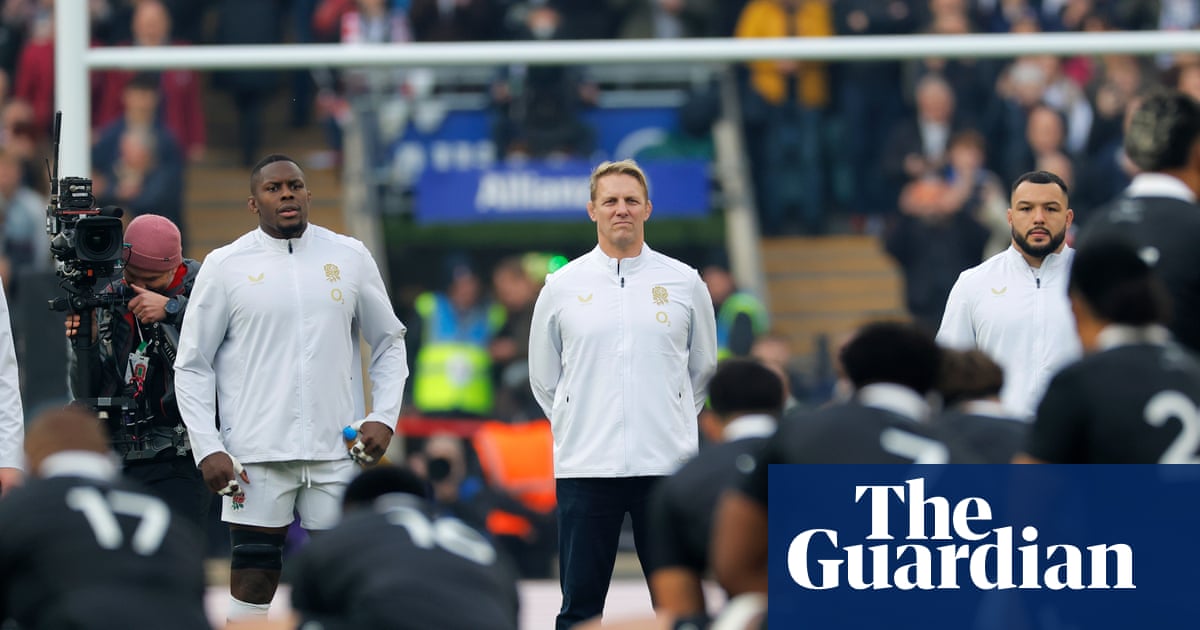

Ellis Genge was so fired up by England’s powerful response to the haka on Saturday he stripped off his anthem jacket in the aftermath, completely forgetting he was not starting. Ollie Chessum told Lewis Moody, who had been invited to stand at the point of England’s V formation, “we are going long left, stay on the field and chase the kick-off”. And according to Ben Earl, who would still be out on the Twickenham turf carrying through traffic if he could, some players were so inspired by Moody’s speech the night before they could not sleep.
Against that emotional backdrop, it is small wonder England flew out of the blocks against the All Blacks . Steve Borthwick has spoken a lot about “bringing the fire” recently and on Saturday they torched the place, riding the emotional wave that Moody’s presence inspired from Henry Slade’s fourth-minute try, through to a record victory against New Zealand .
There is more than raw emotion at play here, however. With Borthwick, everything is deliberate, there is always method. In their three matches this month, England have scored the opening try inside the first seven minutes. Go back to the summer and they had their first tries against Fiji and Argentina inside the first five. It is enough of a pattern to make the mind go back to Eddie Jones’s tenure when, midway through the 2019 Six Nations, fast starts had become England’s hallmark.
All matches at Allianz Stadium, Twickenham
Friday 27 November Sixth v sixth Italy v Fiji 4.40pm Third v third Ireland v Australia 8.10pm
Saturday 28 November Fifth v fifth Wales v Japan 1.10pm Second v second England v New Zealand 4.40pm
Sunday 29 November Fourth v fourth Scotland v Argentina 1.10pm Nations Championship final France v South Africa 4.40pm
The winners of the first five matches gain a point for their hemisphere; the winners of the final gain two points. The first hemisp
Back then England went on a run of scoring inside the first three minutes in five consecutive matches. Jonny May took two minutes to score in the 2019 victory in Dublin that set England on the path to the World Cup final. In Japan, England were still at it – Manu Tuilagi forcing his way over in the semi-final against New Zealand, again after just two minutes. Indeed, between 2018 and 2020, England managed a try inside the first 10 minutes on 16 occasions.
Watching England at the moment you wonder if it is just coincidence that, around the same point of the World Cup cycle, Borthwick’s side are doing similar. Then you remember that Borthwick, who was Jones’s assistant from 2016 to 2020, does not deal in coincidences.
Asked if he has revisited that period under Jones, he said: “Yes, without question. If you look at the scoring rate in first halves and first 20s, all the way through then, through 2019, through to the World Cup, the team was excellent. I’ve revisited session plans, revisited videos of those sessions. I discussed with some people who were around at that point in time. I’ve discussed it with players who were involved at that point. And that meant an adjustment to our training and adjustment to the way we approached [things], and it’s been a very important reference point.”
Borthwick does not pull back the curtain on what England do in training very often so this is quite the level of insight from the head coach. Before his Japan side were thumped by England earlier this month, Jones acknowledged that “the English like to try and blow you out of the water early and then take the game from there”, and he should know, having made it a trademark when he was in charge. His players would talk of detailed walk-throughs and painstaking pre-match analysis, which Borthwick would have been integral to.
“That’s five games in a row now where we have come out and taken the game to the opposition. I want to keep embracing that,” added Borthwick. “We’ve discussed it openly, and discussed it with the senior players. Training is framed in that manner. I’ve talked a lot of times about putting the shirt on and then just wanting to ease into a game, or not wanting to make a mistake. These guys aren’t like that.”
Speak to the senior players Borthwick mentions and it is clear that England’s summer defeat by South Africa, who scored three tries inside the first 11 minutes, was a line in the sand. “Three scores down, it’s extremely hard to come back from that,” said Genge. “In tier one rugby, to go that many scores down and come back is difficult. It’s definitely the start of Test match rugby that’s the most important.
“Obviously, we were the worst team in the world against South Africa when we got hammered at their gaff. Then we hammered Fiji because of the red [card] apparently and then scraped past Argentina, and then now we’re the best thing since sliced bread.”
It was those opening exchanges against South Africa, then, that convinced Borthwick to go back over video footage, to borrow from Jones’s playbook and overhaul training. The last 20 quarter was, not so long ago, his chief focus, now it is the first 20 minutes. The challenge is backing it up, against New Zealand again this weekend and into next year’s Six Nations, blending the emotion that Borthwick wants with the forensic approach to starting matches, now the watching world is taking note.
“There’s going to be another expectation on us, so again, we’ll take it in our stride,” said Earl. “We don’t think we’re anywhere near the finished product, but we’re bubbling away nicely with almost 12 months to go before the big dance.”