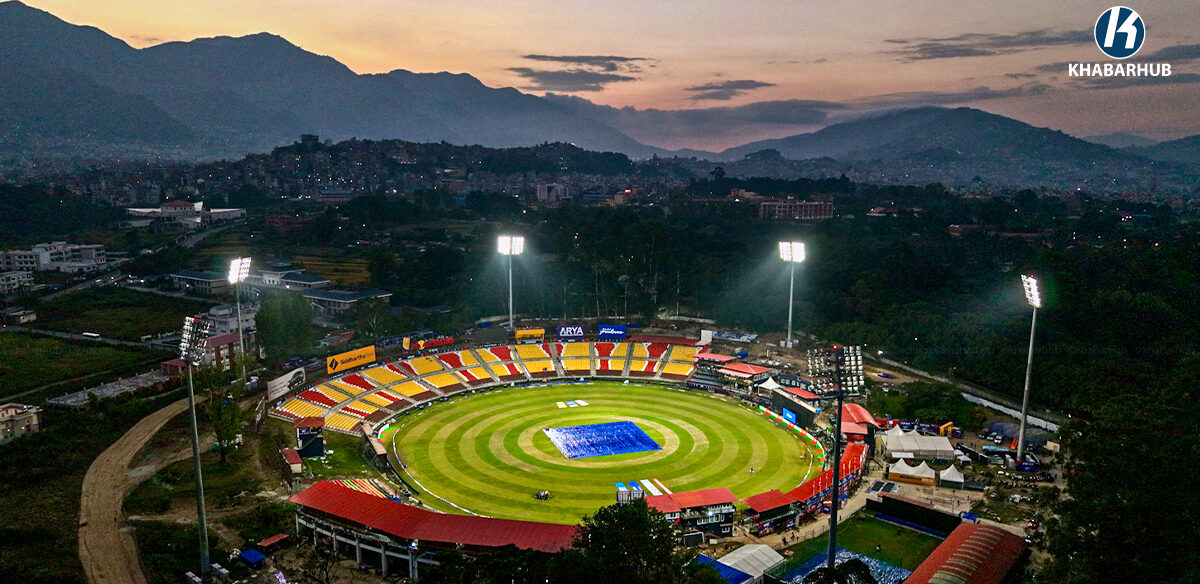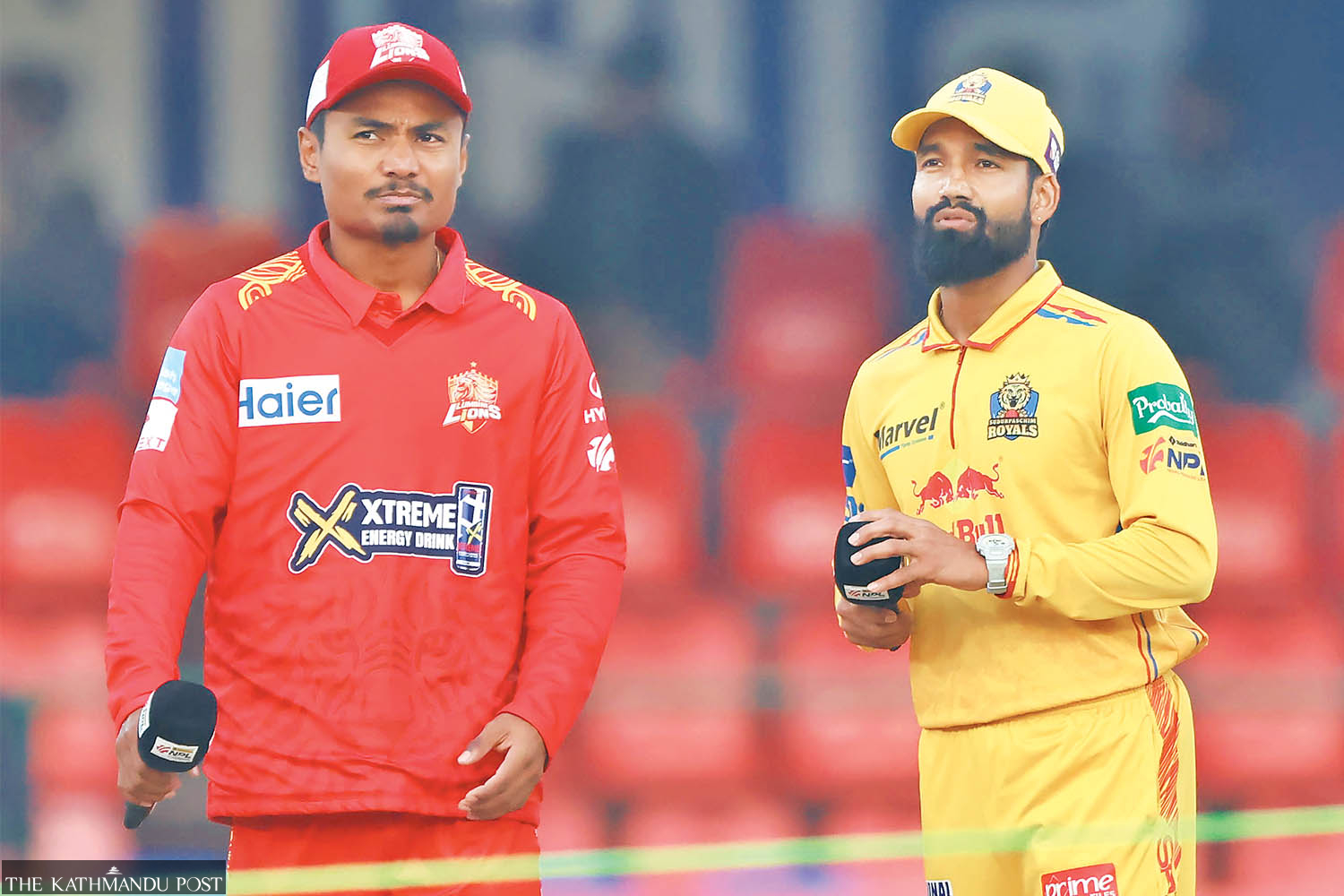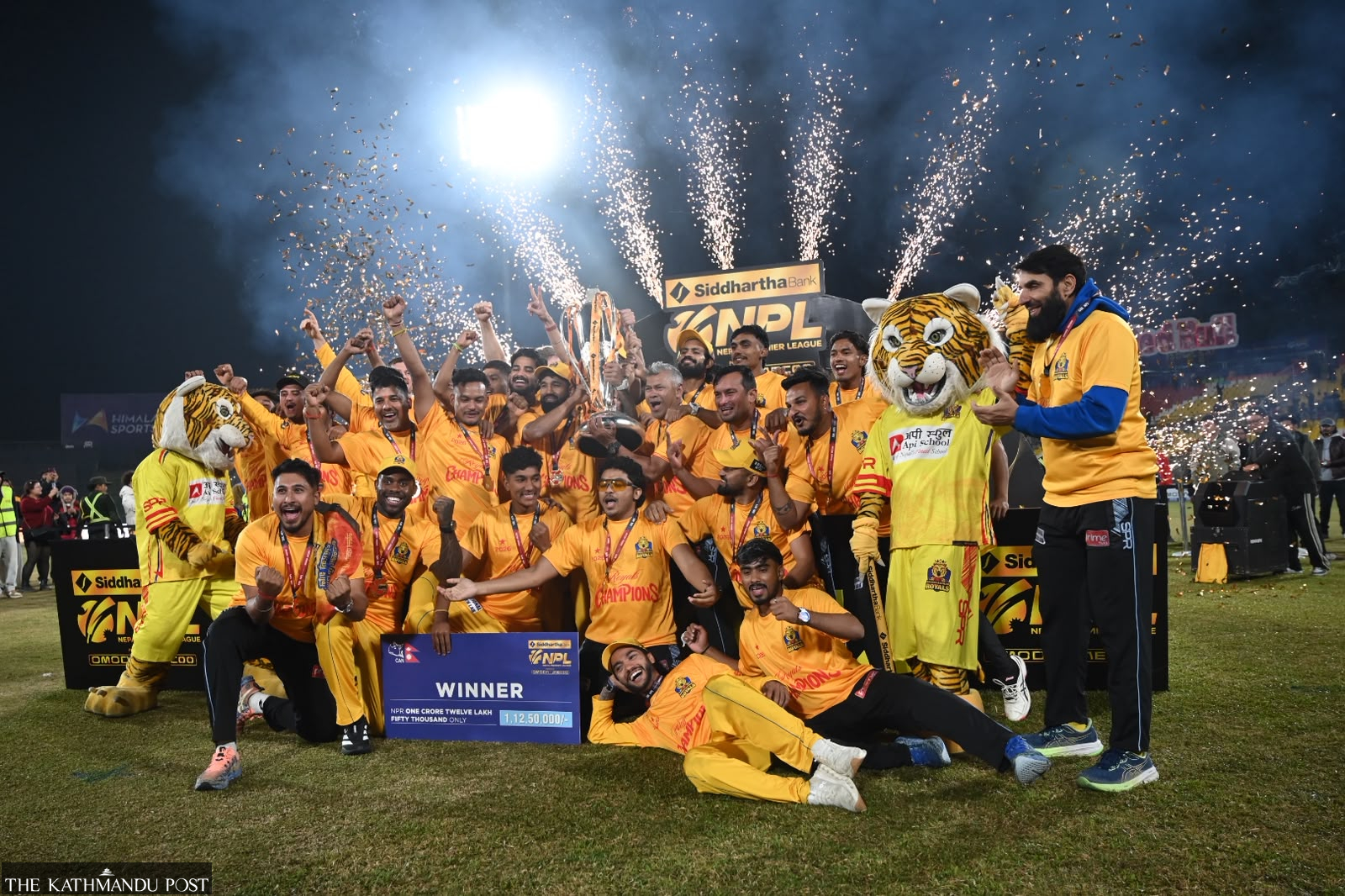
The third season of the Nepal Premier League reached its climax under the floodlights of the TU International Cricket Stadium on Saturday. The final saw Sudurpaschim Royals finally win the NPL trophy after reaching the final for the third time.
Over the past three seasons, the NPL has stood as a mirror to Nepali cricket itself—brimming with undeniable passion, commercial potential and raw talent. Yet the biggest sporting tournament of the country also depicts that the game is still grappling with structural and on-field challenges.
Over the past month, the TU International Cricket Stadium has transformed into a festival ground. For fans, the tournament—dubbed the ‘Festival of Himalayas’—delivered on its biggest promise: bringing world class cricketers right to their doorstep. Global icons—from Australian opener David Warner and South Africa’s David Miller to Caribbean power-hitter Andre Russell, Bangladeshi star Shakib Al Hasan and English all-rounder Moeen Ali—shared the dressing room with emerging Nepali youngsters, elevating the ambition of domestic cricket.
On the field, the league’s biggest triumph has been proving that domestic players do not merely play supporting roles to overseas stars. Time and again, matches were decided by local players stepping up under pressure—whether through captain Karan KC’s fearless leadership and finishing for Kathmandu Gorkhas or the consistent brilliance of Rohit Paudel and Dipendra Singh Airee steering Lumbini Lions and Sudurpaschim Royals, respectively, to back-to-back final.
“For me, as a captain, I do not feel that foreign players will win matches for us,” KC had said after the four-wicket win over Karnali Yaks on November 2. “The seven domestic players in the playing set are the ones I believe can win matches for us.”
The emergence of Rahul Yadav , the 16-year-old pacer selected by Janakpur Bolts from talent hunt, was one of the biggest positives for Nepal cricket’s future.
Off the pitch, NPL has demonstrated that Nepali cricket is a viable commercial powerhouse. With ICC sanctioning, expanded foreign quotas, Decision Review System (DRS) integration, and upgraded broadcast standards, the league attracted unprecedented sponsorship interest and global viewership. The sight of packed stands and international stars praising Nepali hospitality—and exploring the country’s heritage between matches—underscored the tournament’s value as both a sporting and cultural showcase.
Yet, beneath the glitz of floodlit spectacles, the third season also exposed areas where Nepali cricket must mature if the league is to sustain its momentum.
First is the persistent strain on infrastructure and event management. While seating capacity and spectator facilities at Kirtipur saw pre-tournament upgrades, concentrating an entire 32-match tournament at a single venue continues to test pitch durability. Veteran cricketers like Ravi Bopara and Jimmy Neesham publicly condemned the condition of TU pitches citing they were not favourable for T20 fixtures.
The government, meanwhile, gave positive news for the passionate Nepali cricket fans on Saturday—the bid for the construction of Fapla International Cricket Stadium was opened.
For Nepal, a country with scant resources, a slow and steady investment in cricket infrastructure is a promising sign.
Nonetheless, transparency and off-field governance still remain critical pressure points. As commercial stakes rise, questions surrounding sponsorship processes, ticketing logistics and broadcast rights enforcement—including crackdowns on unauthorised public screenings—highlight the need for tighter administrative professionalism from the Cricket Association of Nepal. The recent example was the backlash from the public after the tickets for the final were sold out within seconds of its opening on Friday, prompting fans to reach TU Ground and stage a protest.
Finally, on the cricketing front, the tournament laid bare a familiar hurdle: top-order batting consistency against quality new-ball bowling.
Across the group stage, batting units repeatedly struggled to maximise the six-over powerplay, suffering frequent early collapses that forced middle orders into rescue missions rather than setting commanding totals.
Three seasons in, the NPL has outgrown its status as an ambitious experiment; it is now the heartbeat of Nepal’s cricketing ecosystem. It has shown the world what Nepali cricket can be when fueled by passion and international exposure. The challenge for administrators and franchises before Season 4 is ensuring that off-field infrastructure, governance and grassroots development rise to match the extraordinary energy in the stands.
What’s reassuring is that the cricketing world wants to help Nepal. The Marylebone Cricket Club (MCC) has hosted Nepal’s tour to England in June next year—which includes a one-off T20I against Bangladesh at Lord’s and matches against Scotland and Ireland. Similarly, Test nations are trying to manage friendly series with Nepal just as the West Indies did last year.
All that Nepal needs to do now is remain humble and consistent as they move forward in the ‘gentleman’s game’.
Nayak Paudel covers sports for The Kathmandu Post. He previously worked at the Post (2018–19) and spent over five years at The Rising Nepal. His reporting spans crime, health, education, and social issues.