This audio is voiced by AI and may occasionally mispronounce words.
Share your feedback and help us improve this feature. Read more about how we use AI at SBS here.
Three days out from the end of the 1956 Melbourne Olympic Games, John Ian Wing sat in the apartment above his father's Bourke Street restaurant and put pen to paper.
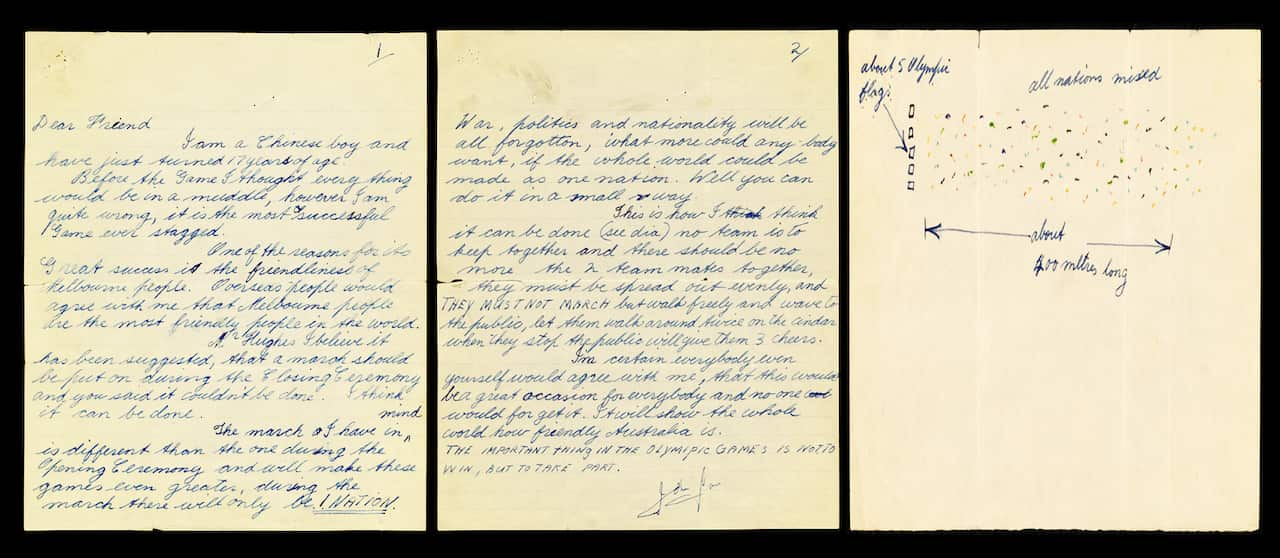
"Dear friend," he began, "I am a Chinese boy and have just turned 17 years of age," Wing wrote to the president of the International Olympic Committee at the time.
He felt it was time for a unifying moment. An antidote to global tension and a symbol of peace.
"I believe it has been suggested that a march should be put on during the closing ceremony, and you said it could not be done. I think it can be done," he wrote.
Your trusted source for staying up-to-date with the world around you. Get free daily news updates and analysis, straight to your inbox.
"During the march there will be only 1 NATION. War, politics and nationality will all be forgotten.
"… This would be a great occasion for everyone and no one would forget it."
It was an interesting thought, sure, but Wing wasn't completely confident. So instead of signing his name, he left an illegible scrawl and no address, just in case anyone thought it was a stupid idea.
He then ran down the road to the Olympic Committee headquarters on Little Lonsdale Street in Melbourne and personally dropped it in the mail slot.
Nearly seven decades later, Wing's anonymous letter remains the unlikely catalyst for one of the most memorable moments in Olympic history. But the identity of the teenager behind it remained a mystery until 1986, and finding him again would prove no easy task.
For Wing, war was something he had experienced since childhood.
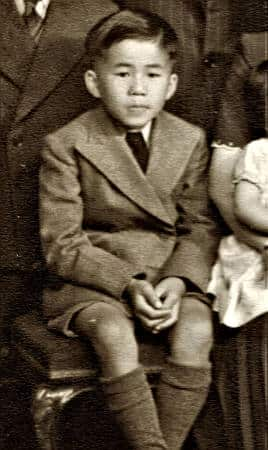
Born in Melbourne in November 1939, Wing was just a few months old when his mother died. His father, who ran the busy Kwong Tung Café on Bourke Street, was left caring for three children while working long hours.
With little choice, he sent Wing to the Methodist Babies Home in South Yarra, before he was later moved to the Methodist Children's Home in Cheltenham.
Wing spent much of his early childhood there, growing up against the backdrop of World War Two. He remembers being taken to hospitals to lift the spirits of wounded soldiers, some of whom had lost limbs or their eyesight. He also recalls fighter planes flying overhead as the war ended, and housewives running from their homes in jubilation, relieved that the conflict was finally over.
By the time the Olympic Games arrived in Melbourne in 1956, geopolitical tensions were running high again.
The friendly host city of Melbourne faced a tall task in building a sense of global unity.
Just weeks before the games opened, on 4 November, Soviet forces invaded Hungary to suppress a national uprising.
The invasion prompted Switzerland, Spain and the Netherlands to boycott the games in protest. At the last minute, the People's Republic of China also withdrew, protesting the inclusion of Taiwan.
Britain, France and Israel had invaded Egypt after its president nationalised the Suez Canal, prompting Egypt, Iraq and Lebanon to boycott the games too.
According to historian and journalist Nick Richardson, international tensions were reflected in the competition itself.
"Russian athletes didn't go into the Melbourne athletic village and instead were kept on a Russian ship that was anchored in Melbourne," he tells SBS News.
There was another notorious incident during a final-round water polo match between the Soviet Union and Hungary, which has since become known as the "blood in the water" match.
Police entered the arena to avoid a brawl after a Hungarian player was struck in the face, causing blood to pour from above his eye.
None of this tension had gone unnoticed by the young Wing. Now 87, he looks back on the events from his apartment in West London.
"Everybody was saying, 'after these games finish, World War Three will start'," he tells SBS News.
The "blood in the water" incident had alarmed him enough to spur him into action, prompting him to put forward what he now describes as "just a schoolboy idea".
No one announced any changes, so he went on his way. Wing says he didn't attend the closing ceremony. He had gone to the movies.
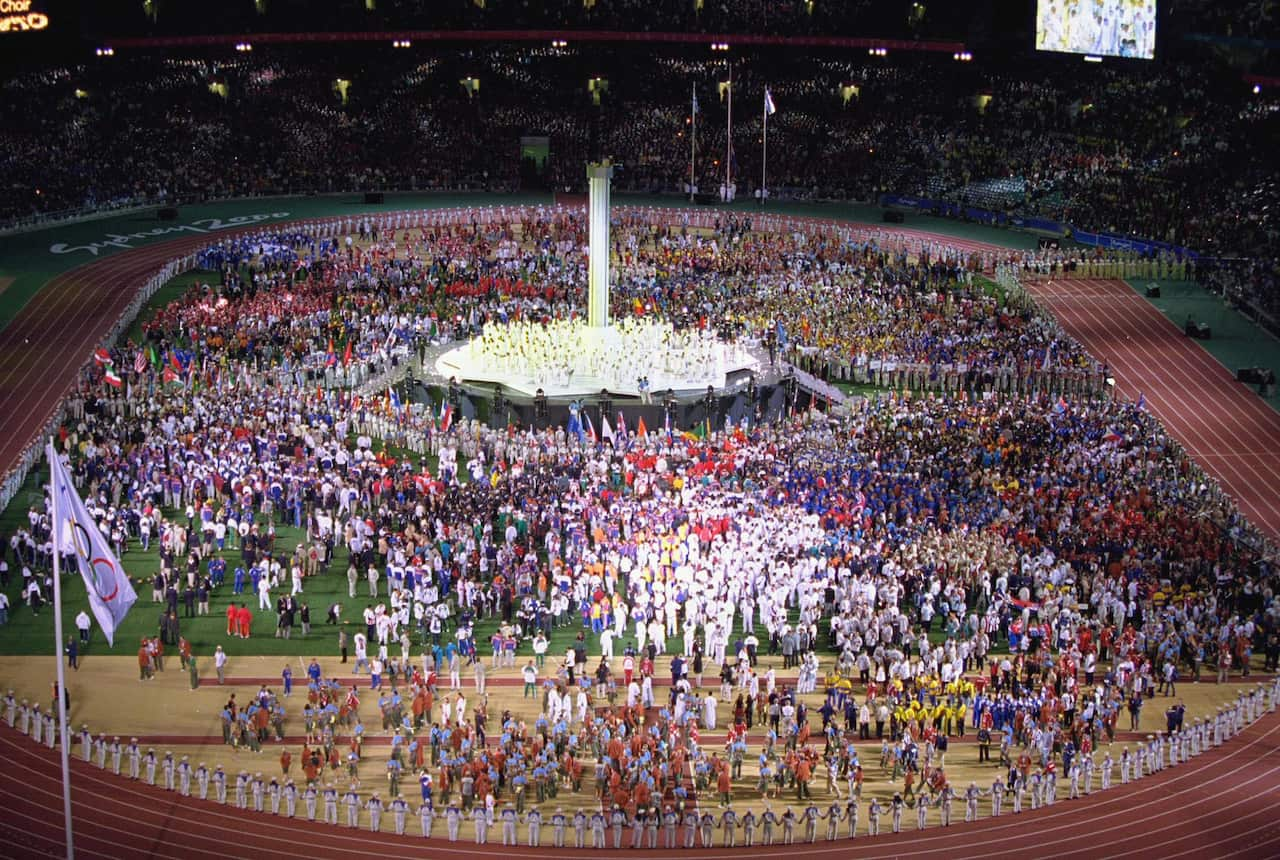
As he walked out, he noticed a crowd huddled around a television, watching the athletes as they poured out into the Melbourne Cricket Ground, all mixed together just as he had described in his letter. Until then, there had been no standardised approach for closing ceremonies. At the close of the 1952 Games in Helsinki, Finland, there was a parade of flags on the running track.
"Oh shit , " Wing remembers thinking to himself: "What have I done?"
"Being Chinese, you're not supposed to be in touch with older people. I thought I was going to get in trouble here."
But nobody knew it was him. In fact, nobody would learn his identity for the next 30 years.
Why, then, did Olympic organisers decide to act on an anonymous letter from an unknown teenager, just days before the closing ceremony?
"It's a really interesting question," Richardson says.
"Even with some detailed research, we can still only speculate because [organising committee chair] Wilfred Kent Hughes and the head of the International Olympic Committee, Avery Brundage, were not men who were given to flights of fancy."
And yet here they were, days out from the closing ceremony, confronted by a teenager's anonymous letter, "suggesting something that was quite radical", he says.
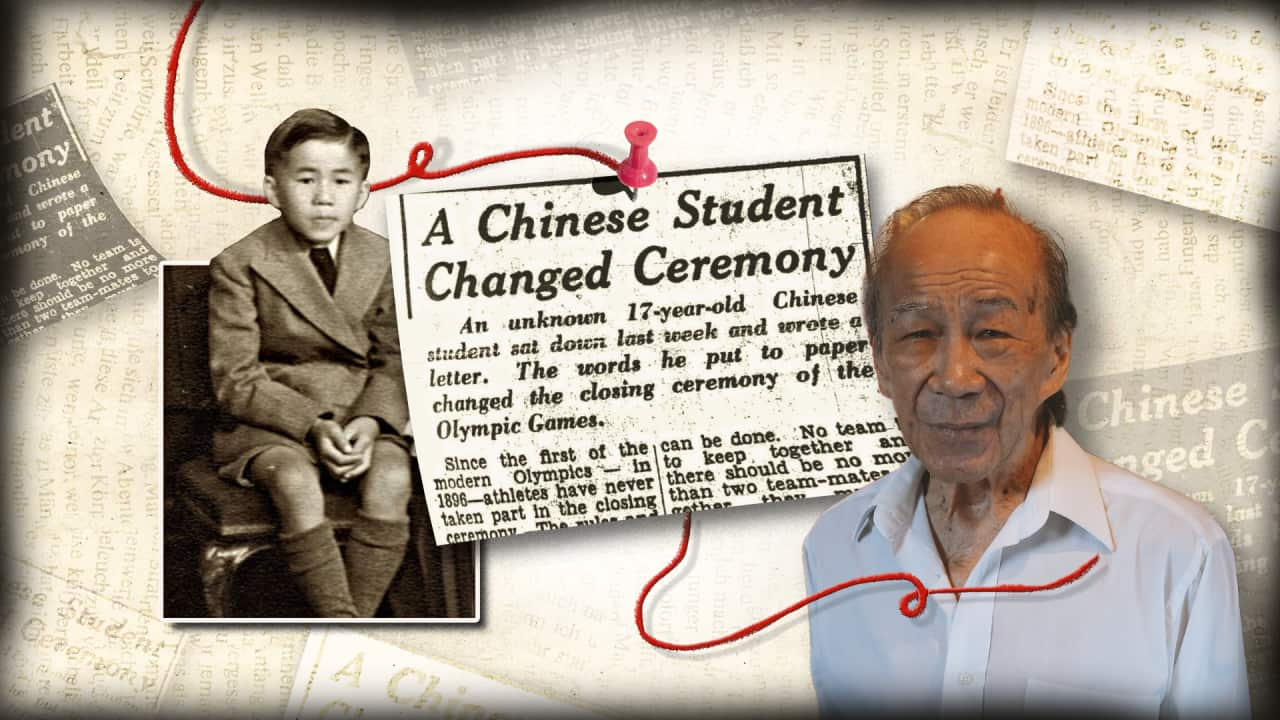
The story made headlines around the world.
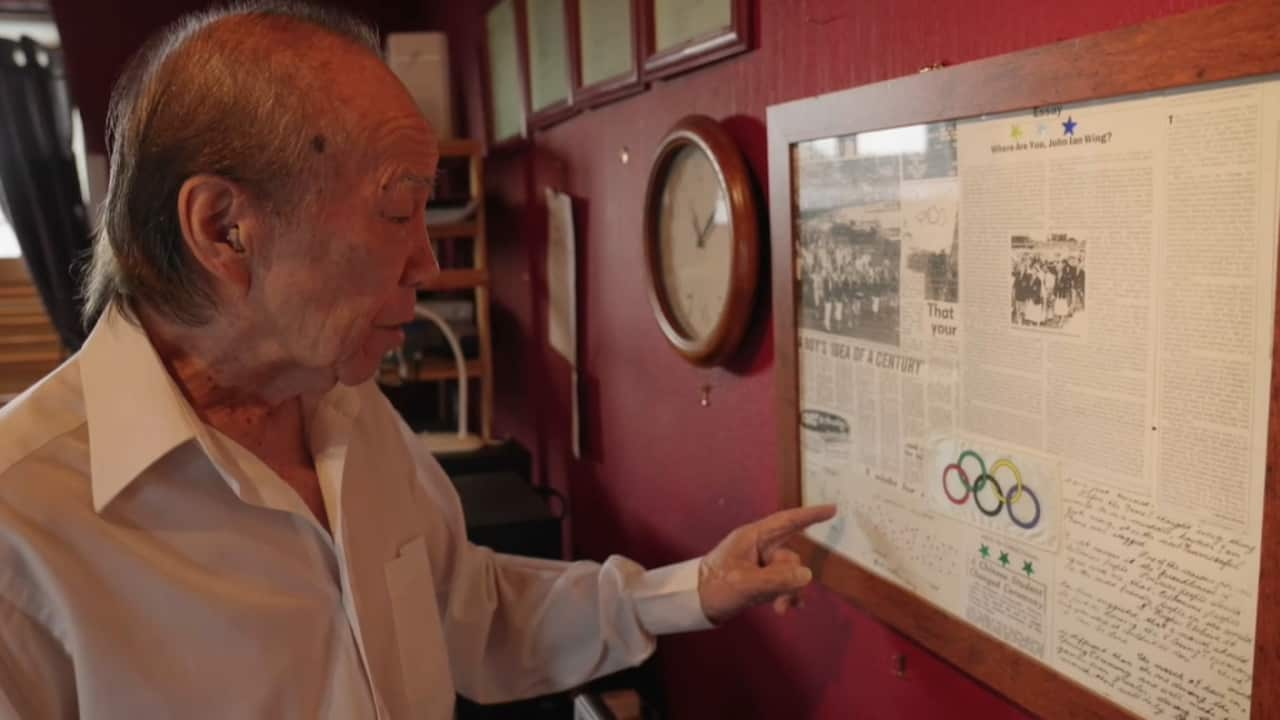
"A Chinese Student changed history" reads one, "A Boy's Idea of a Century" says another.
Wing decided he would write a second letter to thank Hughes, while still asking that he remain anonymous.
Hughes respected his wish, but hoping to offer a gesture of thanks, Wing says he sent a chauffeur around to his father's restaurant with a bronze Olympic medal.
"So I was awarded the Olympic medal , " he says with a laugh, "and I lost that".
He thinks he knows who took it, but didn't realise until years later.
"The medal wasn't really that important to me; I'd done what I had to do."
Hughes first became involved in the Olympic movement as an athlete, then as chair of the Melbourne Organising Committee for the 1956 Olympics.
He was also the kind of man who kept everything , says National Library of Australia curator Karen Schamberger.
"All of his correspondence, diaries, pamphlets, leaflets, everything from his life and career," she tells SBS News.
Hughes' wife and daughters donated his manuscript collection to the National Library of Australia, and in 1986, PhD student Shane Cahill began examining the papers. It was during his research that he came across Wing's letter.
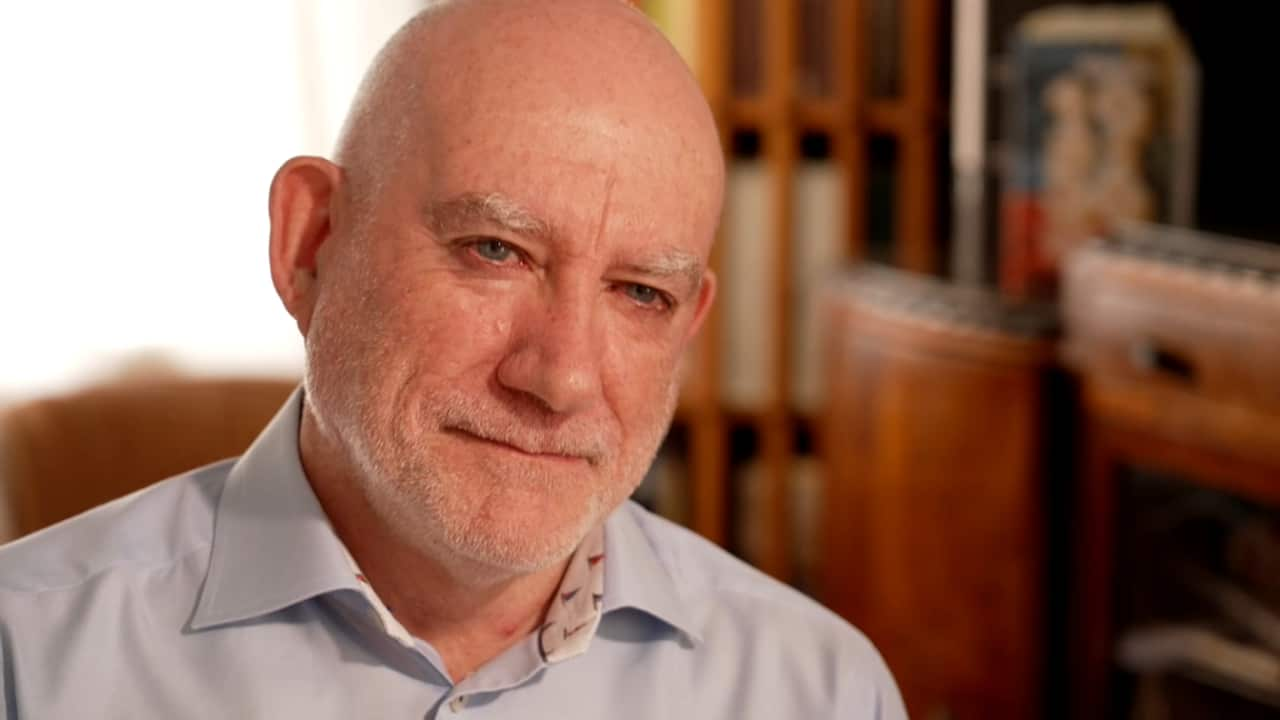
"If Shane hadn't been researching those manuscripts, we would not have found him at all , " Schamberger says.
The letter revealed his name, but the question remained: who exactly was John Ian Wing?
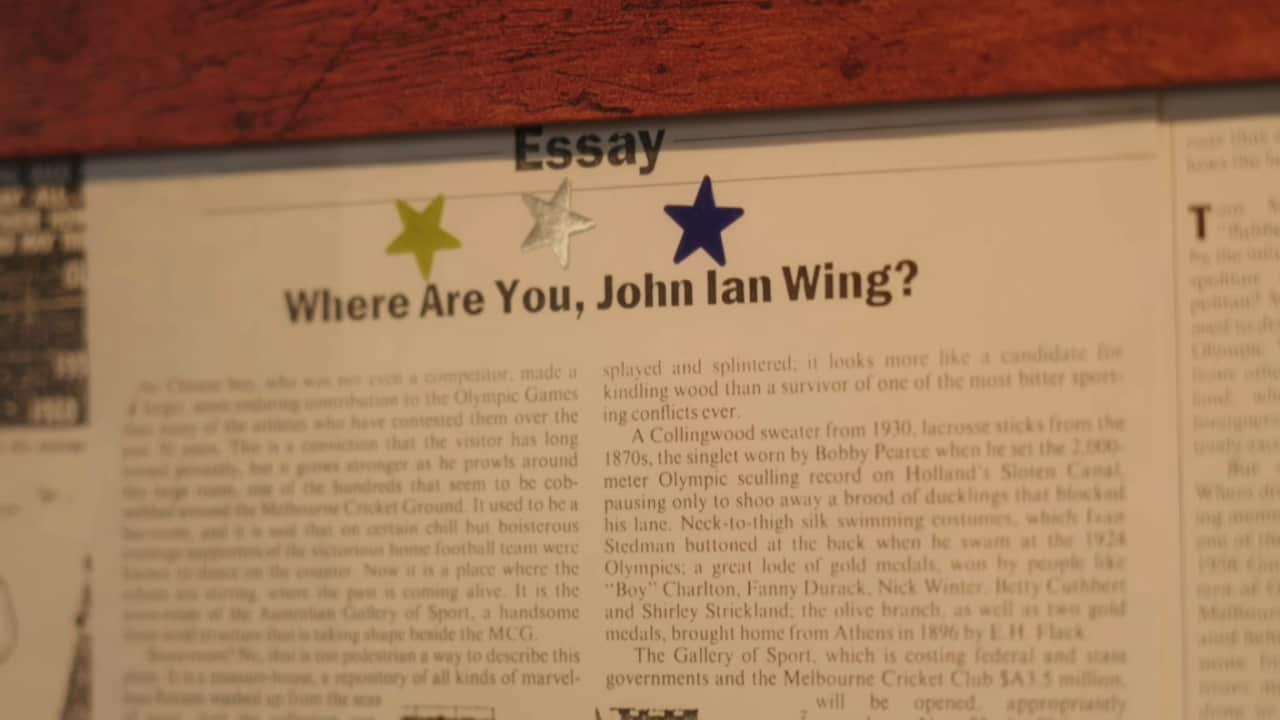
The late sports journalist and historian Harry Gordon posed that very question in a 1986 essay for Time Australia titled, Where Are You, John Ian Wing.
Melbourne radio host Mark Day put out a call on his show for information and eventually got a phone number that could help track Wing down.
Living in London, Wing received a mysterious phone call at 2am.
"Are you John Ian Wing?" Day asks, "Everybody's looking for you".
Wing's reaction was again, "Oh shit, what have I done?"
But there was nothing to be concerned about. With his identity now public, he was flown to Australia for the opening of the Olympic Gallery at the Melbourne Cricket Ground.
He's been involved in several more Olympic closing ceremonies and was a guest of honour for Sydney 2000. He also has a street named after him— John Ian Wing Parade — in the former Sydney Olympic Village, now the suburb of Newington.
Seventy years from his "schoolboy idea", Wing reflects on a legacy that has extended far beyond the Olympic movement.
"It continued on with the European Games, the Commonwealth Games, then schools started doing it with their students … people grew up with it , " he says.
When asked if he feels proud of what he started, he says , "Yeah, yeah, I do."
But for Wing, the message behind that moment is just as important today.
"When I look at all these athletes together in their different costumes, I think to myself, yeah. That's how it should be.