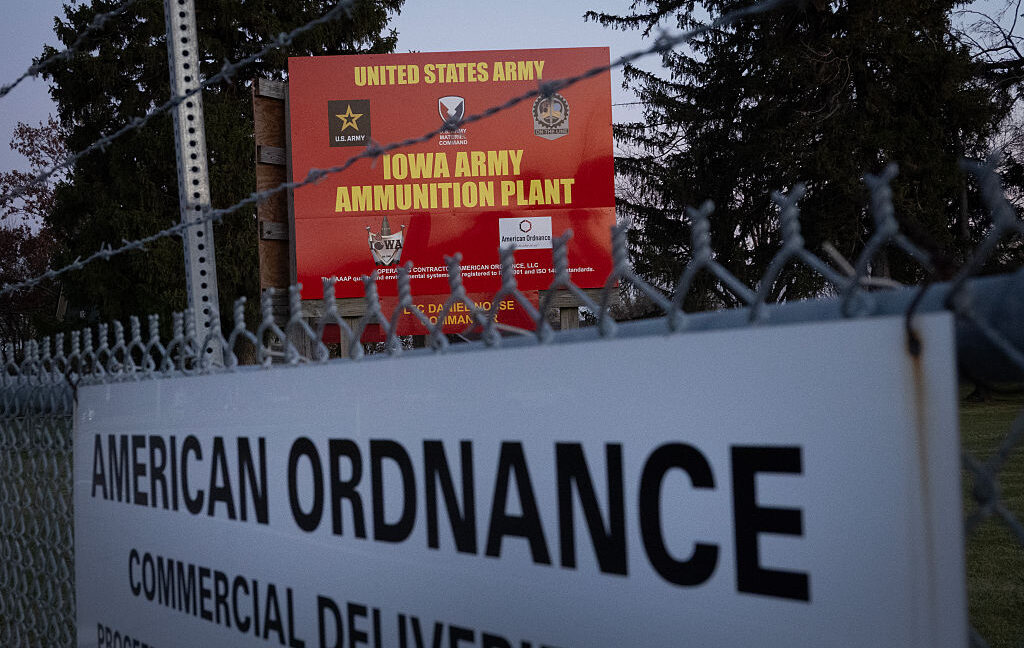
Residents in southeastern Iowa are awaiting a decision as to whether the US Army will detonate five tons of lead azide at a munitions plant after a judge ordered a temporary pause, with environmental activists and local officials expressing concern over the possible health risks.
A federal judge ordered the Army to pause its plan to detonate the material at the Iowa Army Ammunition Plant in Middletown following a suit brought by environmental groups. The detonation was originally scheduled for Friday morning and then moved to Monday after the suit and mounting community opposition.
The Army, in coordination with the US Environmental Protection Agency, plans to destroy nearly 70 drums of lead azide, a compound used to detonate munitions, the military branch said.
The scheduled explosion is meant to destroy material that has become unstable, but the plans have drawn heavy pushback from concerned Iowans, environmental advocates and politicians who worry about the plume, which could spread toxic lead dust over vast swaths of rural Iowa and the Mississippi River and even potentially into part of western Illinois.
Iowa Gov. Kim Reynolds on Friday activated a state emergency operations center ahead of the planned detonation, while officials in nearby Illinois are warning residents about dust spilling over into their state.
Here’s what we know about the potential detonation and the ensuing legal fight.
The Army in March discovered lead azide housed in bunkers had been degrading, according to Acting Army Secretary Adam Telle. Officials began evaluating the best way to dispose of the material, and they communicated with “stakeholders and the public in Middletown and the modeled impact area about the danger it posed,” Telle said.
The lead azide’s degraded status left it “extremely unstable and sensitive to even slight friction or movement,” according to an FAQ distributed by the Army to the community last month. “Packing and transporting it poses an unacceptable risk of accidental detonation to personnel handling and transporting as well as to the public,” the FAQ said.
After coordinating with the EPA, experts and the community, officials “determined that a controlled detonation was the option that posed the lowest risk to the public in the immediate and surrounding area,” Telle said.
However, Patrick O’Shaughnessy, a University of Iowa professor and environmental health expert, said this is a problem that should have been evaluated 20 years ago.
“Somebody left it to rot that long, for it to now being the only option is to blow it up on site because it can’t be moved,” he told CNN.
“It’s regrettable, and it’s almost — it’s hard to believe that it’s happening in this country,” he said.
Army officials held an October 15 community meeting to share information about a potential detonation in late November, but they didn’t detail a specific date, according to documents on the plant’s page . Then, the community received a notice this past Sunday for a detonation on Friday, according to an Army news release .
However, after pushback, the Army rescheduled the detonation to the following Monday.
But Telle said waiting too long to detonate the lead azide could pose more hazards later. Monday would be the “latest possible moment prior to a forecasted temperature drop, which would risk further destabilization of the material,” Telle previously said.
The emergency permit from the EPA, which went into effect starting November 13, 2026, and goes through February 11, 2027, allows the Army to do the detonation in that period.
The Iowa city of Middletown, the plant’s location, has a population of 363 people, according to US Census data .
Officials at the Iowa Army Ammunition Plant have regularly updated city officials about the planned detonation, according to Brieanna Beck, Middletown’s city clerk and municipal officer, adding she has shared each update on the city’s Facebook page as it was received, in order to keep residents and others informed. The city has been made aware of the detonation plan for about a couple of months, she told CNN in an email.
Beck confirmed the Army plant sent letters to homes potentially affected by the detonation.
Gov. Reynolds said in a social media post Friday her office and state agencies were coordinating with EPA and Army officials to “continuously monitor the situation and keep local partners informed.”
But plans and communication around the detonation have received strong pushback from environmental advocates, as well as state and federal politicians in Iowa and neighboring Illinois.
Josh Turek , the US senator-elect for Iowa, has called for a delay on the detonation, saying he had “heard from many Iowans who are worried about their health and safety due to the potential risk of lead exposure as a result of the detonation.”
Rob Sand, the incoming governor, said Iowans’ safety now and in the future should be the government’s top concern. “An unacceptable lack of communication and clarity has made Iowans understandably concerned and angry about this situation,” he said in a social media post . “The public deserves to know, if this is the safest option, why other options were worse.”
Parts of western Illinois, just across the Mississippi River, are included in latest modeling showing possible exposure to lead dust from the blast. Illinois health and environmental protection officials said they are monitoring the potential detonation and have issued updates to residents.
Illinois Gov. JB Pritzker on Friday said he spoke with Telle, urging more transparency about the now-paused planned detonation.
“The State is still seeking more data from them on how this could impact Illinoisans and is working to keep you informed and safe,” Pritzker said in a social media post .
Environmental advocates sued the US EPA Thursday over the emergency permit allowing the Army to detonate the lead azide, citing concerns about the potential impacts of the explosion.
A federal judge in the Eighth Circuit Court of Appeals on Thursday ordered the Army to pause detonating the lead azide.
The judge’s order didn’t detail when the court would take action on the case, though the EPA in a court filing said it planned to file a response by Sunday, a day before the scheduled detonation.
The Army, in a joint statement with the US Department of Health and Human Services and the EPA, said Friday afternoon, “The entire interagency is working together to ensure that the controlled detonation in Middletown, Iowa is conducted in the safest fashion possible.”
“Officials have been meticulously planning for this event since March, and all agencies involved are prepared to take the most extreme mitigation measures available to ensure there is no risk to the public and any disruptions are minimized,” the statement said, adding they will keep local officials and the public updated.
The cleanup requirements under the current permit are inadequate to properly address the scope and degree of potential impacts, according to Thien Chau, a senior attorney at the environmental advocacy nonprofit Earthjustice, who filed the lawsuit on behalf of the Iowa Environmental Council and the Sierra Club Iowa Chapter.
Chau on Friday told reporters there doesn’t appear to be sufficient understanding of how far the plume would spread, as well as which bodies of water, such as the Mississippi River, and land would be blanketed with lead dust, including where people live.
Environmental advocates called on state leaders, including Gov. Reynolds, to take control of communication over the potential detonation, in a news briefing Friday.
The federal government, including the Army and EPA, couldn’t be trusted to adequately inform Iowans about the risks of the planned detonation, Michael Schmidt, general counsel at the Iowa Environmental Council, said.
“Iowans deserve a transparent, coordinated, and effective response to this unprecedented event,” Schmidt said.
There is no safe level of lead in the body, Dr. Sameer Vohra, director of the Illinois Department of Public Health, said in a statement . “(And) when inhaled or swallowed, it can pose serious health risks.”
With the detonation, the hope is if the lead azide spreads over a wider area, it won’t stay in high-level concentrations, according to O’Shaughnessy, the University of Iowa professor.
“It’s kind of like one of these: the solution to pollution is dilution, right?” he said.
There is the potential for exposure through the air during the initial plume or through touch after it has settled, he said. Neither exposure is worse than the other, because the lead will still build up in your body both ways, he added.
However, lead is toxic to the brain. Exposure is known to cause serious harm to children’s health, resulting in slowed growth and development, as well as problems with learning, behavior, hearing and speech, according to the US Centers for Disease Control and Prevention .
Environmental advocates also warn of the incident worsening health for residents in Iowa, which has the second-highest rate of cancer of any US state and is only one of three states where the rate is rising.
The legal fight is likely to continue over the weekend, running into Monday’s scheduled detonation date.
The local National Weather Service office is forecasting cooler, drier temperatures early next week, with highs in the upper 30s to the mid-40s.
While wind conditions could impact how far lead particles travel, forecast winds blowing from north to south, at around 5 to 10 mph, are also expected, according to CNN Meteorologist Chris Dolce.
CNN’s Holly Yan, Kara Devlin, Bill Kirkos and Chris Dolce contributed to this report.