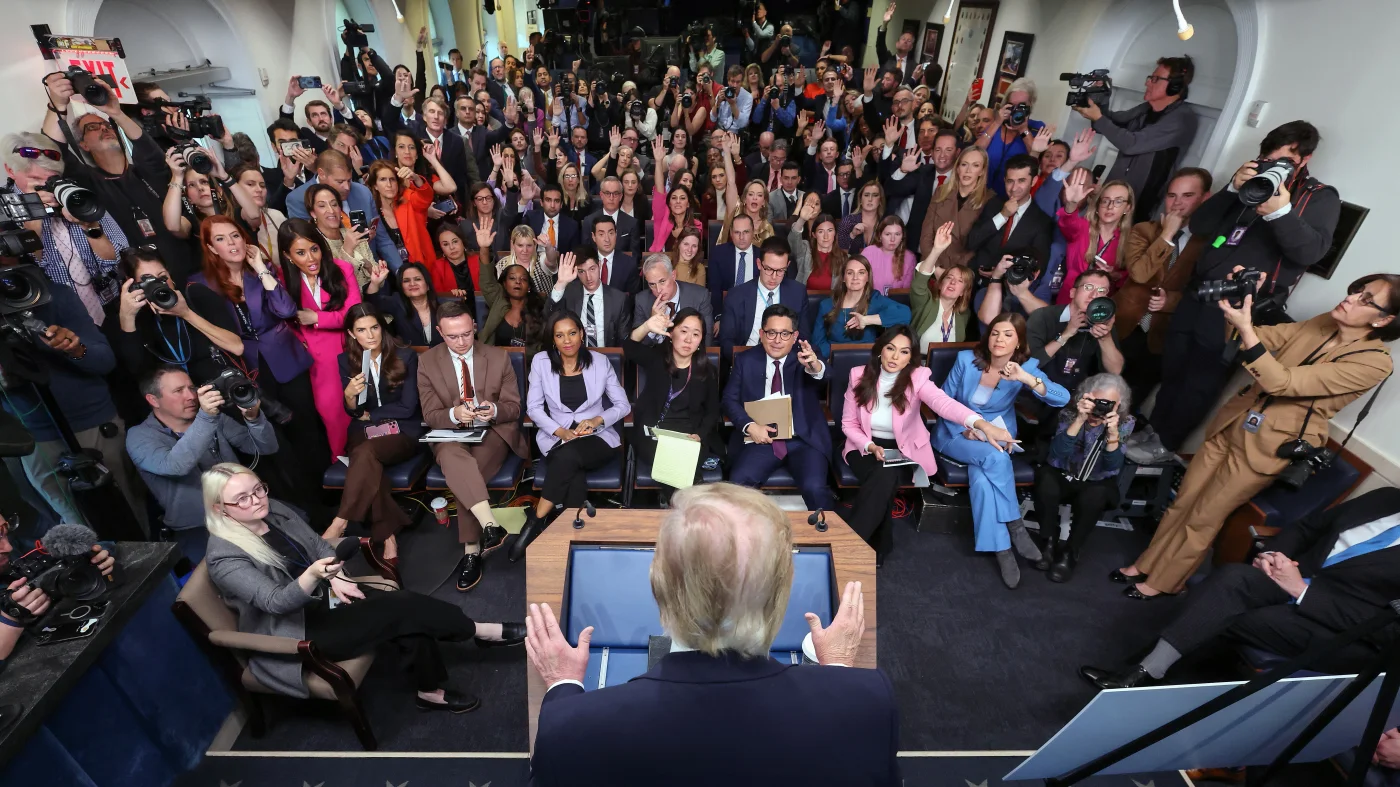
President Donald Trump made a high-profile White House briefing room appearance Friday amid a pileup of domestic challenges — including a string of sudden tech outages, rising artificial intelligence worries and a looming confrontation with Congress’ new Democratic majorities.
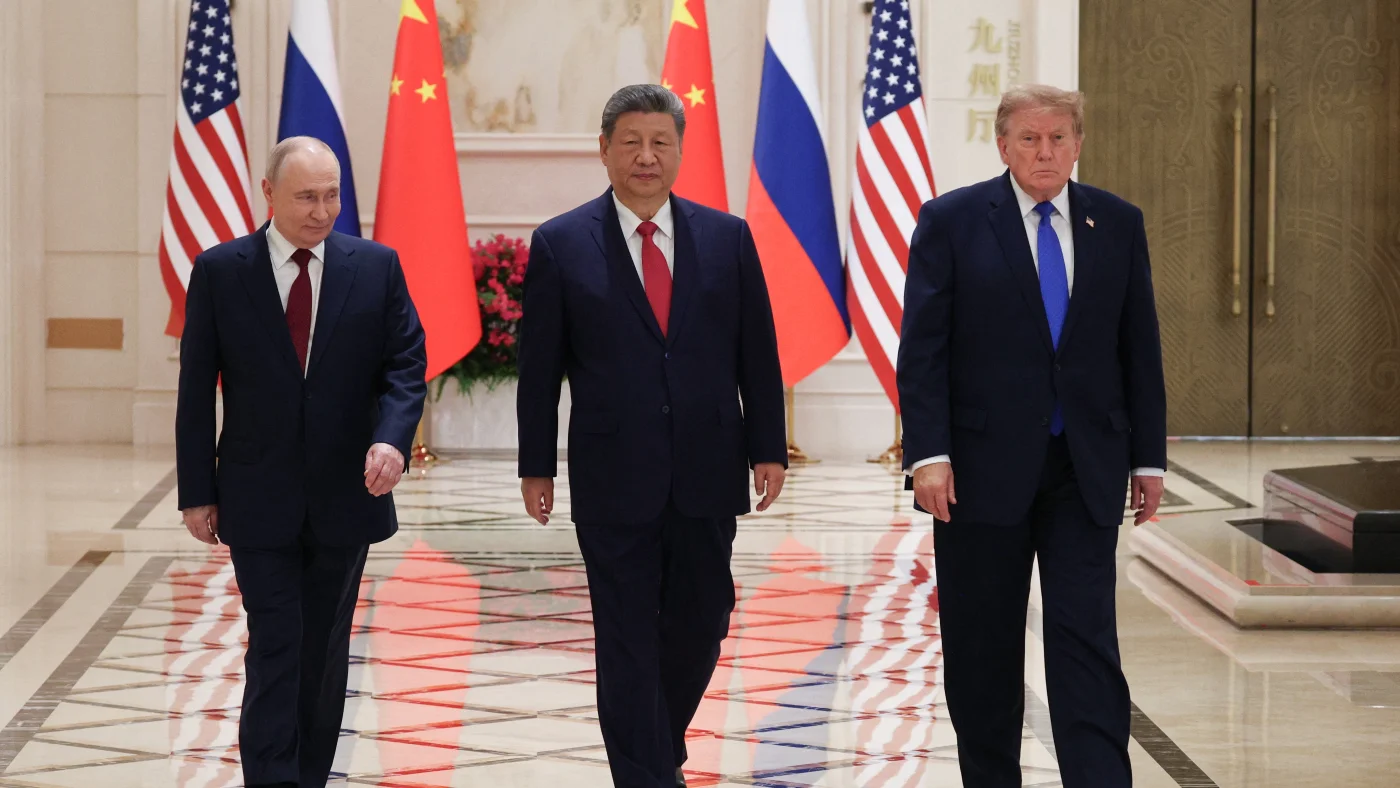
But before all that, Trump wanted to address a cheerier topic: His continued close personal friendships with Chinese leader Xi Jinping and Russia’s Vladimir Putin.
“We have a very great relationship,” Trump said from the White House after returning from a four-day trip to Asia . “Some of them in this room say, ‘Oh, it’s terrible he gets along.’ I get along with Russia. I get along with China. I get along with a lot of people.”
The president spent large swathes of his 90-minute, digression-filled press conference lavishing praise on the two autocrats, despite longstanding concerns within his own administration that the countries are working against the US on key issues.
He hailed the warm reception he received in China, defended his description of Putin as “a friend” and touted a historic trilateral summit that generated little substantive progress on any thorny issues.
Yet as to how he planned to tackle the pressing problems now awaiting him at home, he had few detailed answers at the ready.
Here are six takeaways from Trump’s press conference:
Still in a buoyant mood from his multi-day jaunt around the world, Trump on multiple occasions defended his closeness with Putin — even as their regular conversations have brought him no closer to ending Russia’s war on Ukraine.
Trump again decried the war’s massive casualties and expressed surprise at how difficult it has been to broker peace, chalking the lack of progress to the “tremendous hatred” between Putin and Ukrainian President Volodymyr Zelensky.
But he also dismissed the difficult negotiations as partly a “public relations war,” while suggesting at one point that Russia’s invasion should have “lasted one day” — a remark likely to give Ukraine little assurance of Trump’s ongoing support for their defense.
Trump also signaled that his friendship with Putin is rooted in part because they found themselves on the same side during his first-term impeachment over withholding aid to Ukraine.
“I’ve been dealing with Putin during the fake Russia, Russia, Russia hoax, and to be honest, he was very nice about it,” Trump said.
As to whether Putin is as friendly to the US as a whole, the US president was less sure: “I can’t speak to America,” Trump told CNN’s Kaitlan Collins.
Asked by CNN’s Kaitlan Collins whether Vladimir Putin is a friend to America, President Donald Trump said, “I can’t speak to America.” Trump touted his own relationship with the Russian leader, saying it helps keep the US safe.
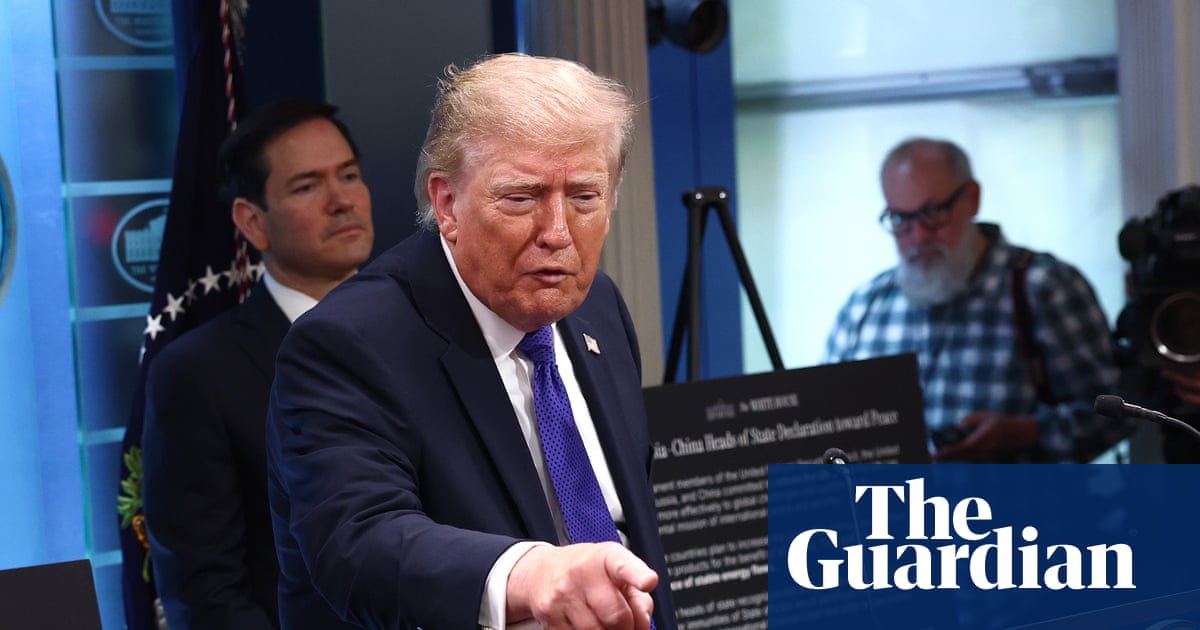
Over Trump’s right shoulder, Vice President JD Vance . To his left, Secretary of State Marco Rubio . The press conference offered a striking visual of the shadow primary likely to play out over the next several months, as possible 2028 presidential contenders led by Vance and Rubio weigh their options and jockey for Trump’s favor.
And Trump leaned in to the show of it all — inviting both men to talk before orchestrating a twist ending.
Rubio, who traveled to Asia with Trump, delivered an extended account of the trip and its takeaways, focusing in particular on the benefits that it could deliver to the US economy and its national security. He also mounted a more polished defense of Trump’s meeting with Putin and Xi than Trump did himself.
“The better these three leaders get along, the easier and more conducive the environment will be to actually agree to things that are concrete down the road,” Rubio argued.
As for Vance — who stayed behind as others went to Asia, as is customary for vice presidents — he sought to make light of the dynamics that were sure to be dissected by close 2028 watchers.
“I would liken it a little bit to Home Alone, but with better food and more gold,” he joked. So, I miss you, sir.”
Vance went on to highlight the passage of a bipartisan permitting reform bill. And he got a boost from Trump, who denied reports that he was upset with Vance for blaming the GOP’s midterm losses on the Iran war. (In Trump’s telling, he only wished Vance would have said the war was still worth it, which Vance pointedly did not do.)
But neither Vance nor Rubio were the true stars of the day in Trump’s eyes. That was his new chief of staff, Stephen Miller.
“The most powerful man in the room right now,” Trump said of Miller, who, at least until now, has not signaled 2028 ambitions. “He was better than these two guys. Do you want to run for president?”
Trump did have one new policy announcement to make: A planned crackdown on US companies building data centers outside the country.
The president vowed to hit US companies with a “tremendous tax” if they try to build data centers elsewhere, arguing that there is plenty of domestic demand for the structures powering the AI boom.
But it’s unclear what tax penalties companies would face if they don’t comply, and Trump conceded he hadn’t even briefed his team on the idea yet. It also appeared out of step with public opinion. Polls show Americans are overwhelmingly more concerned about data center construction than excited by it. Trump, though, was not one of those Americans.
“We’re going to fight very hard for the data centers,” he said.
Following his visit to Asia and meeting with Chinese President Xi Jinping, Trump says the two countries will pursue joint AI guardrails. He vowed to block US companies from building data centers abroad.
Trump openly acknowledged during the press conference that the Iran war had soured Americans’ mood and cost his party politically. But he showed no signs of backing off a fight that he repeatedly insisted was necessary to prevent the Iranian regime from obtaining a nuclear weapon.
“Watch my lips,” Trump said at one point. “Iran will never have a nuclear weapon, ever.”
He went on to deem Iran’s leaders “crazy” and insisted he had no regrets about how he’s prosecuted the war, even as he appeared to acknowledge that some in his administration feel differently.
“People that work for me, they have a right to their opinion,” he said. “But I say, I know the Iranians. And frankly, they’re crazy.”
Still, Trump had far less to say on the more pressing question: How he plans to definitively win the war and extract the US from the Middle East. The White House has yet to articulate that strategy, and on Friday, all Trump could offer was that Iran was “bullsh*tting” him, and he was surprised that the economic damage from the conflict hadn’t been worse.
“The war drove up prices, fuel prices, far less than I thought,” he said. “I thought it would go up to $300 a barrel.”
Pressed on how he planned to spend his final two years in office opposite a Democratic Congress, Trump laid out two futures for himself: As a bipartisan dealmaker, or a hardline issuer of vetoes. The choice would be up to Democrats, he insisted.
“They could go two years and one month, because that’s what we have, and I’m going to veto them,” Trump said. But “if they want to get things done, I want to get things done.”
He added that the next two years working with Democrats could be even more productive than before, lamenting the constant opposition he faced from a handful of Republicans, including Rep. Thomas Massie of Kentucky. Trump even had two possible deals in mind already: A federal film credit meant to strengthen Hollywood and college sports legislation setting national standards for how athletes can profit from their name, likeness and image.
Trump floated deals on bigger topics, as well: Health care and immigration.
But he gave few details on what those deals might entail, and whether there might be any true common ground between Democrats and Republicans on the two issues they’ve already spent decades fighting over.
Another sign that Trump may end up taking the veto path: His empowerment of Miller, an immigration hardliner who has overseen the administration’s deportation campaign.
“They think he’s hard on immigration,” Trump said. “He’s got a tremendous heart.”
The growing bipartisan push for tighter restrictions on advanced chip sales for China hasn’t dimmed Trump’s admiration for the two men at the center of the controversy: Ousted Nvidia CEO Jensen Huang and Commerce Secretary Howard Lutnick .
Trump endorsed reinstalling Huang atop Nvidia despite his reported extramarital affairs, including one suspected of having ties to Chinese intelligence. And he voiced support for Lutnick, even as he comes under fire from Republicans for resisting efforts meant to prevent chips from begin diverted to China.
“I’d like to see Jensen make a big apology and go back,” Trump said. “I would love to see him be back.”
As for Lutnick: “I have not lost confidence.”
Nvidia has made clear it has no plans to reinstate Huang . And by keeping Lutnick atop Commerce, even Trump acknowledged that it could create complications for the administration, as Democrats and even some Republicans in Congress launch investigations into his conduct. But he still believes in Lutnick, he maintained.
“He has a natural business instinct,” Trump said. “I think he’s doing a very good job.”