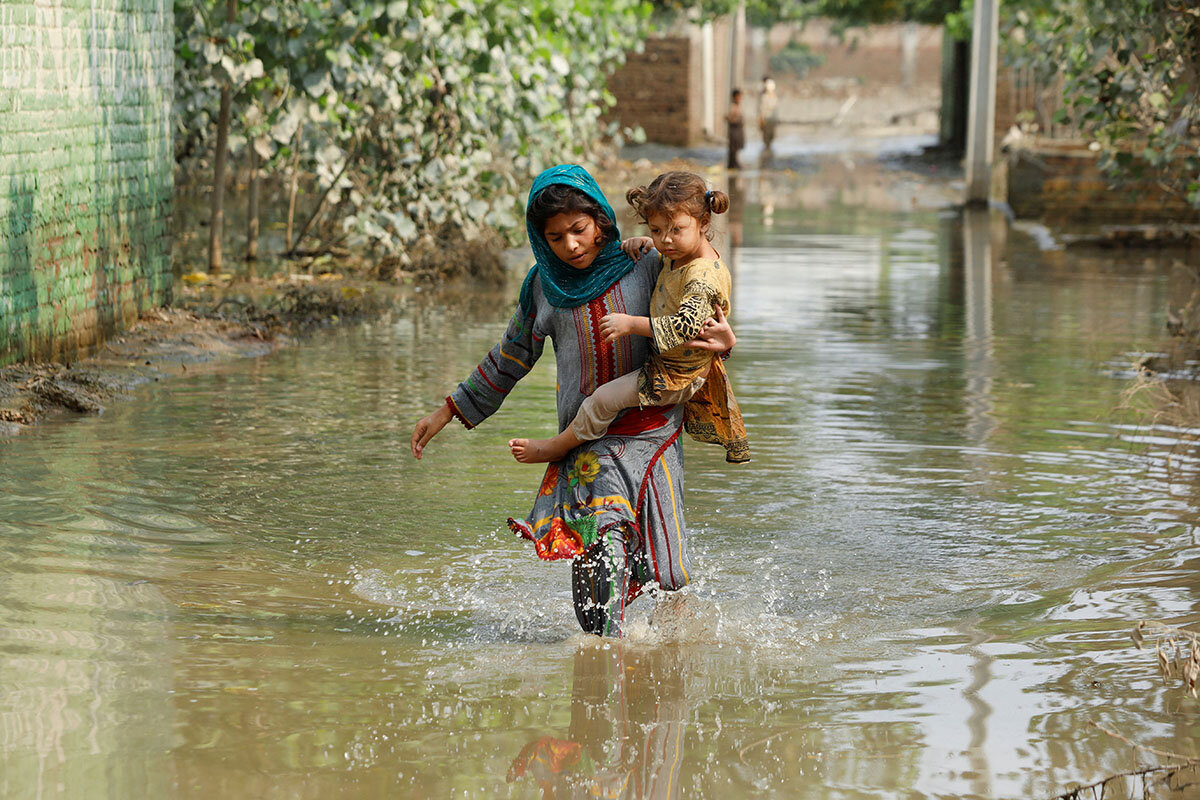
A girl carries her sibling as she walks through floodwaters during the monsoon season in Nowshera, Pakistan, on Sept. 4, 2022/Photo: Reuters
Four years after floods submerged a third of Pakistan and donors pledged $10.7 billion in Geneva, the government is presenting its recovery to the global audience as a model worth copying.
Islamabad’s principal lender has downgraded the largest reconstruction project to “moderately unsatisfactory”; the planning ministry has found that completion figures given to Prime Minister Shehbaz Sharif were misrepresented, and more than a hundred thousand families verified have been written out by committee decision.
The failure is not primarily one of capacity or money. It is that the Pakistani state measures recovery from natural disasters in announcements rather than in households living in finished houses, and nobody with authority has required it to do otherwise.
Chief Minister Murad Ali Shah announced on 10 November that Sindh province has completed one million climate-resilient homes under the ‘Sindh People’s Housing for Flood Affectees’ programme, against a target of 2.1 million. The figure rests on registrations, surveys and construction milestones recorded by the provincial authority that runs the scheme and verified through its own digital system.
No independent physical audit has confirmed that the recorded milestones correspond to houses that are finished, equipped and occupied. Donors have praised and financed the model, which is a judgement about disbursement rather than habitability, and other provinces in Pakistan are urged to replicate a design nobody outside the provincial implementing agency has inspected at scale.
A fact-finding mission by South Asians for Human Rights documented what was actually delivered to affected families in Sindh, and it is not what the public records describe. The mission found single-room structures of 16 by 18 feet, frequently without toilets, kitchens or any provision for privacy.
In Shikarpur, a woman sharing one room with eight others told the mission there was no toilet and no place to cook, and that her family was humiliated every day, while women in houses without sanitation dug pits and removed waste by hand. An activist in the same district described the result as a one-room house being sold as “climate justice.” The PKR 300,000-per-house grant fell short of reported construction costs closer to PKR 500,000, so households borrowed to finish what the state had started.
The people left out of the programme have fared worse than those inside it. Landless tenants, women, persons with disabilities and religious minorities in Sindh were disproportionately excluded from the original damage assessments, and the World Bank’s own documentation lists exclusion errors as the most common grievance. Families who rebuilt with their own hands before the surveys arrived were disqualified for having acted too early. Households without formal land records were ineligible by definition.
Balochistan is where the arrangement collapses into open view, and the documents say so plainly. The ‘Integrated Flood Resilience and Adaptation Project,’ worth $400 million with $155 million allocated to housing, rested on the prime minister’s undertaking of a resilient house for every family that lost one. The project steering committee, led by Planning Minister Ahsan Iqbal and Balochistan Chief Minister Sarfraz Bugti, capped housing support at 62,966 first-tranche beneficiaries and subsidy support at 97,000, redirecting the remainder towards roads and irrigation.
The World Bank then withdrew $180 million in additional financing, downgraded implementation progress and project management to “moderately unsatisfactory,” raised three risk categories to high, and recorded a legal covenant as noncompliant. Its technical mission found the project noncompliant with environmental and social standards because the scope changed substantially without engaging affected people. World Bank documentation records 119,049 verified households left with no identified financing.
Ahsan Iqbal claimed the number of completed houses presented to the prime minister was 15,000, while official records showed 8,694, and the Planning Commission later reported 26,357 complete, with work started on 74,988. A fact-finding committee was denied access to records in Balochistan, and the Planning Commission concluded that project records had been damaged in a coordinated manner for vested interests, with an inquiry establishing misrepresentation. Allegations of duplicate claims and multiple payments against the same units remain unresolved. These developments clearly suggest that the programme did not suffer from administrative weakness, but is being actively obstructed from within, and the state’s corruption is undeniable.
Pakistan’s Ministry of Planning and Development responded defensively to these reports by restating its commitment to rehabilitating every eligible family and arguing that a family whose house has been rebuilt still needs a functioning school. The schools, roads and irrigation works being funded are necessary, but they are being funded with money promised to households the Pakistani state had already surveyed, verified and informed.
In the Integrated Flood Resilience and Adaptation Project (IFRAP), the steering committee capped housing at roughly 69,000 units, redirected the rest of the $400 million programme to roads and irrigation, and the lender withdrew $180 million in additional financing. IFRAP left 119,049 verified, eligible households with no identified financing, and around 84 percent of eligible families are ultra-poor or vulnerable.
Smaller programmes display the same refusal to account for money already spent. The Provincial Disaster Management Authority’s (PDMA) own page for a $6 million foreign grant to rebuild 8,300 flood-damaged houses names no donor, gives no timeline and reports no completion figures. In the cash relief programme, Shazia Marri confirmed in September 2022 that 48 cases had been registered in Sindh over agents deducting PKR 3,000 from the PKR 25,000 payment, that arrests had followed and the matter had gone to the Federal Investigation Agency (FIA), and that money was sometimes withdrawn using victims’ own biometric data. Four years later, no public account exists of convictions, amounts recovered, or compensation paid in a scheme where the total entitlement was about $115 per family.
None of this can wait for international climate finance, which is not coming at the required scale. Wealthy governments pledged roughly $820 million to the Loss and Damage Fund at COP28 and have delivered a little over half.
The fund has received close to 180 submissions seeking $2.8 billion against $250 million available for allocation, has postponed its first approvals to December, and caps proposals at 20 million. Pakistan’s recovery will be financed domestically or not at all. The families it verified are owed an independent audit, a single reconciled set of figures, and a route back into the programme that excluded them.
Publish Date : 20 November 2026 21:20 PM
KATHMANDU: Nepal suffered a crushing 306-run defeat against India A
KATHMANDU: Khabarhub brings you a glimpse of major developments of
Four years after floods submerged a third of Pakistan and
SUNSARI: Police have arrested five people in possession of more
JANAKPURDHAM: The formation of a new government in Madhesh Province
Reg No.: 1222/075-76(DOI, Nepal)
Chairman: Naresh Shrestha
Contact: +977 1-4249158
©2026 Khabarhub | All rights reserved.