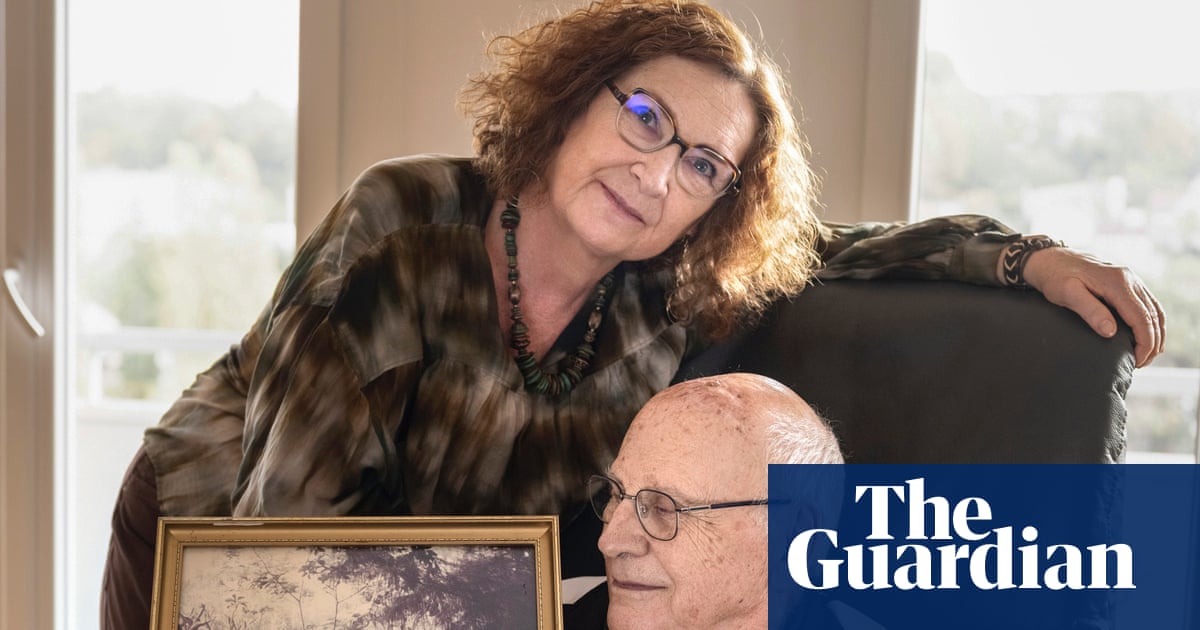


Colette Woronoff was one of at least 50,000 people killed by this year’s ferociously hot summer, a modelling study of 854 European cities found last month. The scientists said two in every three of the heat-related deaths resulted from additional warming due to fossil fuel pollution and the destruction of nature.
My mother, Colette, was 92 years old, and up until the end I made the most of my time with her. She was a wonderful woman – extremely cheerful, very feminist, very free. She loved art and travel. She adored churches, particularly baroque ones. She always took a small sketchbook with her on trips.
When we went to bury her ashes in her ancestral village in Ardèche last month, it was difficult, but we were surrounded by love, sharing it with family. I maintain that people get what they give. And she got a lot of love that weekend, because she gave a lot too. But it’s the cause of her death that is still difficult to accept.
Since Thursday 25 June 2026, I had been telling myself to bring my parents extra fans to deal with the heat. It was hot everywhere in France , and I was working a lot that week. My sister told me she was going to their place on Saturday, when I would be at a wedding, and I said to myself, perfect. My sister went to see my parents, who seemed well. I came home from the wedding and went to bed.
But at one in the morning my father rang to say my mother had fallen and was convulsing. I immediately called the emergency services. I explained how to get there, told my father to open the door, and left. In 10 minutes, they were in the apartment. I arrived 10 minutes later and the emergency doctor told me my mother had severe hyperthermia, with a temperature of 42.6C. He said: “You know, it’s fatal.” At the time, Mum was calm. She was more or less conscious, and I know she saw me, but it was difficult. There were seven people around her. She opened her eyes but couldn’t talk.
I waited with my father as they took her to hospital. I put myself in her room, in her bed, and realised the heat was just unbearable. Two hours later, the doctors called me and said: “You have to come very quickly.” I arrived with one of my sisters and we thought it was the end. But our mother woke up and smiled at us. There had been a big improvement. They had given her ice baths and the temperature had dropped a lot. Yet the doctor explained that the cells, once they have seen this heat, cannot regenerate. The heart, the liver, the lungs, the brain – everything had been damaged.
My parents met when they were 14, at the Alsatian school in Paris. My mother became an English teacher and my father a teacher of ancient languages. They worked in small towns in France and then had the opportunity to leave for Senegal in 1964, where they stayed until 1979. My older sisters gradually came back to France to do their studies, and Mum didn’t want to stay in Dakar without her daughters, so they moved to Besançon. They had a house in a nice, isolated village, which they liked a lot, but it was not suitable for their mobility, and just under two years ago I found them an apartment to rent. I was about 20 minutes away by car, one of my sisters was about 15 minutes away, and another was about 10 minutes away. With the tram beside her house, my mother could go to her hairdresser in five minutes – something she did every week – and across the street was a market where she liked to buy fresh fruit and vegetables. She walked with a cane but had few other health problems, and was still autonomous for many things.
The image that struck me from that night was when I arrived in the two-person apartment and saw seven people around my mother. I was aware it was going to be serious, but I didn’t realise right away. There were so many people because my parents live on the seventh floor, and although there is an elevator, it was too small for the gurney. They had to carry her down on the stretcher and it took at least four people to do it. When everyone left, my mother’s room was like a construction site. There were things everywhere: items from the first responders, pieces of plastic, bath towels they had wetted to cool her down, everything icy they found in the freezer. My father, who is more fragile than my mother, was completely stupefied. He didn’t understand what was going on. Even today, he still says, “you realise, it’s the heat that took her away”. He spent weeks and weeks asking: “But why did she die like that? It’s not possible.”
Besançon was one of the regions that was particularly affected by the heat, since in eastern France we are not used to having temperatures this high for such a long time. There was no air conditioning in the apartment, but you could open windows on each side to create a cross-breeze. The problem is that for older people the cognitive side is often not completely there, and that night she opened the windows but not the shutters. I repeated to her: “You have to drink, take showers,” and every time she would say yes. I thought she was doing it, but in fact she wasn’t. What’s more, we had no other solutions. In each of our own homes, the rooms where we could have put our parents had stairs they couldn’t go up.
It’s difficult to accept how she died. Even for me, as a research doctor, I hadn’t seen anything coming. We knew elderly people living alone had been found dead in their apartments during heatwaves. But we thought this apartment wasn’t that bad, and there were people passing by every day. Care assistants came every other day for my father, a physiotherapist came twice a week, nurses for my mother twice a week, and my sister went that Saturday to bring them fans. When there is a heatwave, we are told to make vulnerable people drink and put them in the coolest places possible. But when do we say to take their temperature with a thermometer?
After my mother went to hospital on Sunday morning, the luck we had was that we could stay with her until Wednesday. She wasn’t very conscious but she had two or three moments of lucidity. We were in a room where we had the right to come at night, during the day, as many as we wanted, so she was able to see all her family and grandchildren, and that allowed us to say goodbye to her, to be with her when she let go of her last breath. It was less terrible than if she had left on Saturday night, just like that, without us being able to talk to her again.
Afterwards, it was strange. We had to find a funeral home to take care of the body but there were so many dead people that it was hard to find a place. We felt like we were back in Covid. The big companies were really very, very, very full. But we were lucky to find a small family company – the only one to have answered me – with free chambers. After the cremation, we had a few months that still felt like we were in transition, until we buried the ashes in October. Now, we know she won’t move any more. She’s in a place she loves, she’s next to her parents. My father tells us he wants the same thing – that he wants to be next to her.